



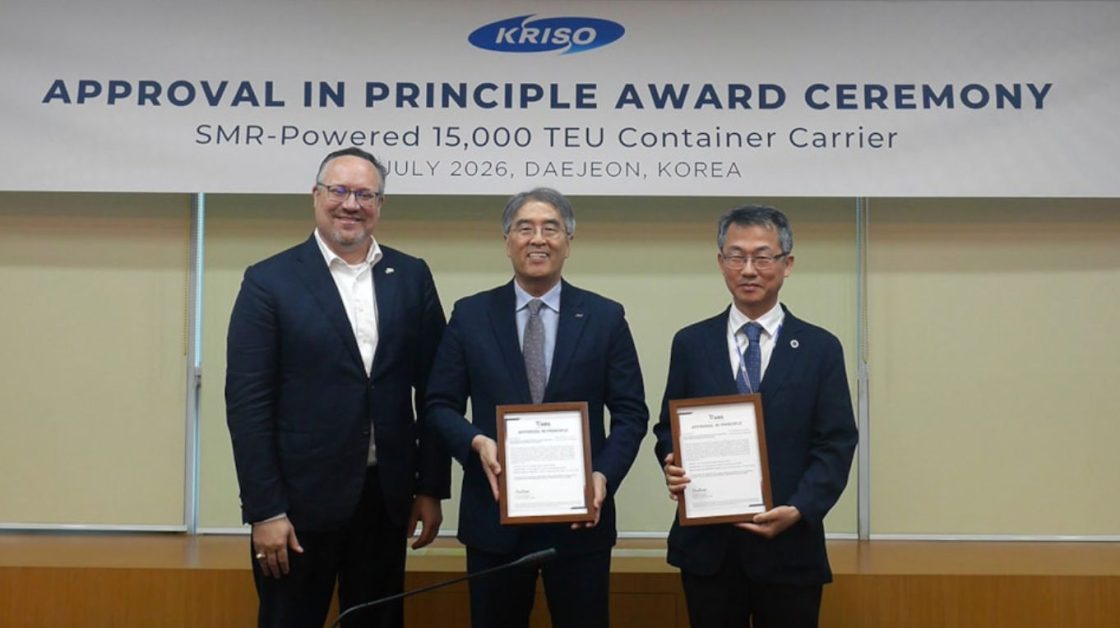

Classification society ABS has granted Approval in Principle for the concept design of a 15,000 TEU nuclear-powered containership, developed jointly with the Korea Research Institute of Ships and Ocean Engineering and the Korea Atomic Energy Research Institute, marking a significant step toward nuclear-powered commercial shipping.
What technology powers this nuclear containership design?
The vessel is designed around a small modular reactor using marine molten salt reactor technology. KRISO developed the containership concept, while KAERI designed the marine molten salt reactor system. ABS carried out the classification review, assessing the overall concept against class and safety requirements.
What does the AIP mean for nuclear-powered shipping development?
The approval represents another milestone in the ongoing joint project between ABS, KRISO and KAERI to evaluate the technical feasibility of nuclear-powered commercial vessels. The collaboration forms part of a broader effort to address the technical, regulatory and safety challenges associated with deploying nuclear propulsion in merchant shipping, building on a 2025 memorandum of understanding between ABS and KRISO covering nuclear-powered ships and floating nuclear power platforms.
What did ABS say about the significance of nuclear propulsion?
Patrick Ryan, Senior Vice President and Chief Technology Officer at ABS, said nuclear technology has the potential to reshape commercial shipping by changing vessel design, operating range and energy economics. He added that ABS remains focused on developing the technical and safety framework required to support future nuclear-powered ships entering commercial service.
How are KRISO and KAERI viewing the project’s next steps?
KRISO President Keyyong Hong said small modular reactor powered vessels could become a key technology for the future competitiveness of the shipping industry, adding that KRISO will continue research and international cooperation to improve the marine application of nuclear-powered vessels and support the development of global standards.
KAERI Senior Vice President Jinyoung Cho said the institute will continue refining the interface between the reactor system and the vessel, while advancing testing and demonstration activities necessary to support the commercialisation of small modular reactor powered ships.
What does this mean for the future of container shipping?
The AIP signals growing industry interest in alternative propulsion technologies as shipping companies explore long-term solutions for decarbonisation, extended operating range and energy efficiency. Nuclear propulsion, while still in early development stages, is being positioned by classification societies and research institutes as a potential pathway for large containerships operating on long-haul global trade routes.
 Join our WhatsApp channel for more updates:
 Subscribe to our YouTube channel for more updates: