



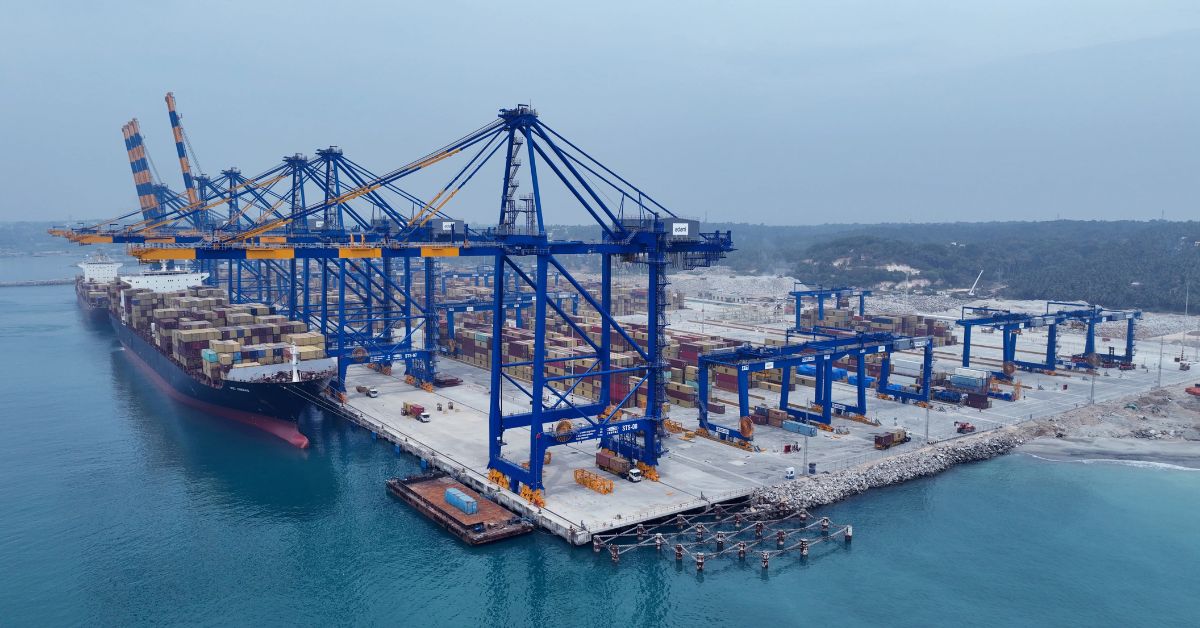

Adani Ports and Special Economic Zone (APSEZ) has fast-tracked the Phase II expansion of Vizhinjam International Seaport following surging transshipment volumes during the West Asia crisis, which pushed the facility to full capacity . The port’s strategic location just 10 nautical miles from the international East-West shipping corridor, has made it a key beneficiary as disruptions in Gulf ports prompted carriers to seek alternative hubs.
APSEZ CEO Ashwani Gupta confirmed during the Q4 FY26 earnings call that the port was operating at 100% capacity, with vessels waiting offshore during the peak crisis period . The company has decided to advance the expansion timeline to capitalize on transshipment overflow and prepare for future EXIM cargo from the hinterland.
Capacity Expansion Details
The Phase II expansion will increase Vizhinjam’s annual handling capacity from 1.6 million TEUs to 5.7 million TEUs . Key infrastructure additions include extending the container berth to create a continuous 2-km quay—which will be India’s longest container berth—and expanding the breakwater to 3.88 km . The terminal will be equipped to simultaneously handle five mother vessels of up to 28,000 TEU capacity, supported by additional ship-to-shore and yard cranes.
APSEZ plans to invest approximately ₹16,000 crore in the Phase II development, with operational efficiencies already enabling throughput 20-30% above designed capacity.
LNG Bunkering Initiative
In parallel, APSEZ has signed an MoU with Bharat Petroleum Corporation Limited to establish India’s first ship-to-ship LNG bunkering facility at Vizhinjam . Gupta noted that LNG bunkering infrastructure remains limited along the East-West trade corridor, positioning Vizhinjam to encourage the deployment of LNG-powered vessels on the route.
The port currently has road connectivity for cargo evacuation, with rail connectivity under evaluation to support long-term EXIM cargo growth, according to APSEZ CFO D Muthukumaran.
 Join our WhatsApp channel for more updates:
 Subscribe to our YouTube channel for more updates: