



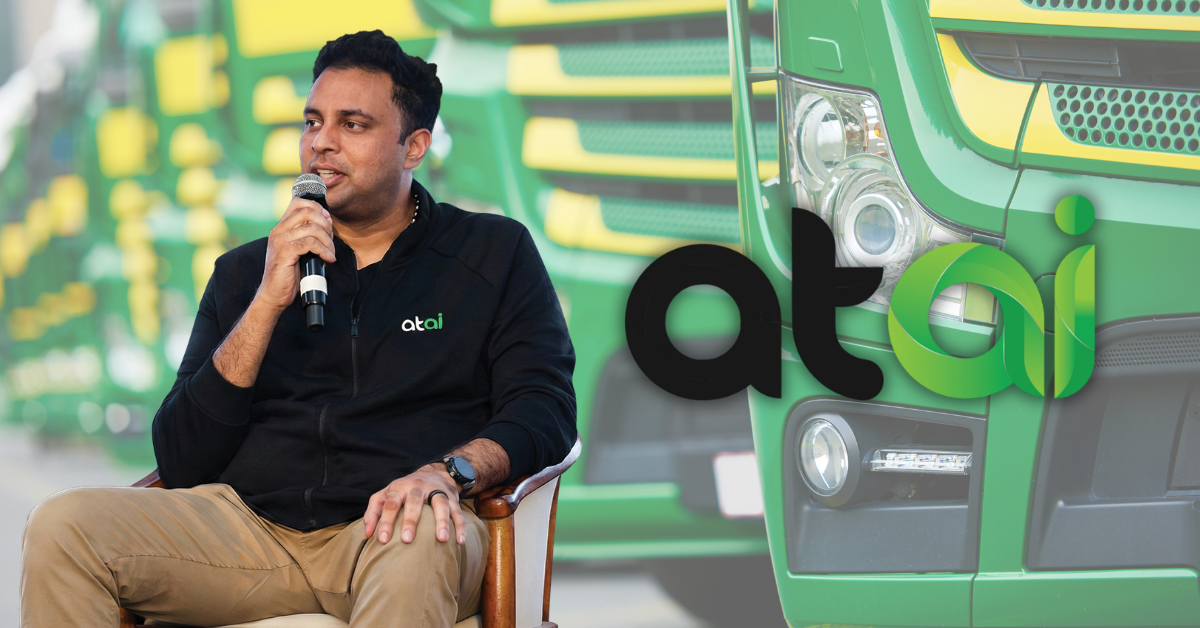

This article highlights how Gangadhar Gude transformed ATAI from a solution addressing truck congestion at an Indian port to a platform tackling bottlenecks across 200 sites worldwide. ATAI isn’t merely a gate automation provider; it is a one stop solution for complex multidimensional port-related problems.
At the intersection of artificial intelligence, computer vision, and operational technology stands ATAI — a company that has evolved from solving truck congestion at an Indian port to deploying AI-driven automation across nearly 200 sites worldwide. Its founder, Gangadhar Gude, did not begin with a global blueprint but with a single critical bottleneck.
The Origin: Krishnapatnam Port, 2019
The story began in late 2019 at Krishnapatnam Port. Chronic truck queues at the gates were slowing cargo movement, damage claims were on the rise, and there was increasing uncertainty about where exactly inefficiencies were occurring and where container damages were taking place.
“There were significant traffic bottlenecks at the truck gates. There was limited visibility as to whether damages were occurring on the vessel, inside the yard, or at the gate. At the same time, there was a clear need to process trucks faster. This became the foundation of what we set out to build and the problem we wanted to solve.”
— Gangadhar Gude, Founder, ATAI
Within months, ATAI had built AI and computer vision models that could automatically read container numbers, detect structural damages, capture truck turnaround times, and create an auditable digital trail of movements. Cameras became intelligent sensors. The gate became a data capture point. The yard became measurable.
Scaling Domestically: The CONCOR Pilot
What began as a single-site deployment soon expanded into a pilot project with Container Corporation of India. For CONCOR, which operates a vast network of inland container depots and rail-linked terminals across India, the challenge was scale and standardisation. Manual inspections, inconsistent data entry, and documentation gaps created variability in operations.
ATAI’s pilot focused on automating container identification and damage assessment at entry and exit points. The objective was not only speed but uniformity. By capturing ground-truth data through computer vision, CONCOR gained greater transparency across terminal operations. The pilot demonstrated that AI-driven inspection could significantly reduce manual intervention, improve accuracy, and strengthen claim management processes.
Going International: European Ports
Encouraged by domestic traction, ATAI began exploring international markets. European ports presented a different set of expectations. Regulatory frameworks were stringent, data protection requirements were more rigorous, and integration with legacy terminal operating systems was complex. Yet the operational challenges were familiar: congestion, damage disputes, and visibility gaps were universal.
Execution at select European port facilities required ATAI to refine its technology to handle varied lighting conditions, differing container standards, and high-automation environments. The systems were integrated with existing yard management and terminal operating platforms, enabling seamless data flow rather than parallel dashboards.
The European deployments validated ATAI’s ability to operate in mature, compliance-driven markets. They also reinforced Gangadhar’s conviction that operational technology must adapt to local conditions without losing its core intelligence.
“We always begin with what is actually happening on the ground. Technology should not be built in isolation. It must reflect real-world conditions.”
— Gangadhar Gude
Beyond Gate Automation: A Digital Nervous System
After gaining international exposure, ATAI further strengthened its proposition in the Indian market. The domestic logistics ecosystem was undergoing structural change: Dedicated Freight Corridors were progressing, multimodal logistics parks were being conceptualised, and ports were investing in mechanisation and digital platforms. Yet fragmentation across nodes continued to persist.
ATAI evolved beyond a gate automation provider to become a digital nervous system for logistics infrastructure. Its solutions expanded to cover automated gate complexes, yard visibility platforms, container damage analytics, rail terminal monitoring, and warehouse automation interfaces.
Operational and Financial Impact
The impact of these deployments has been multidimensional. Truck turnaround times have been reduced through automated identification and pre-clearance mechanisms. Damage disputes have declined due to timestamped visual evidence. The reliance on manual paperwork has been minimised, resulting in improved auditability and compliance. Operational planning has become more predictive, with historical movement data enabling trend analysis.
For operators, the financial implications are significant. Reduced congestion lowers fuel consumption and emissions. Faster processing increases asset utilisation. Accurate damage detection mitigates insurance costs and claim disputes. In high-volume terminals, even marginal improvements in processing time translate into substantial productivity gains.
Challenges and Barriers
The journey has not been without difficulty. Resistance to change remains a recurring hurdle. Terminal operators often rely on established manual processes deeply embedded in workforce routines. Integrating AI systems with diverse terminal operating software requires technical customisation, and upfront capital expenditure can be a concern, particularly for smaller facilities.
Data ownership and cybersecurity present critical considerations, especially in cross-border deployments. ATAI has had to invest significantly in compliance frameworks and secure architecture to meet global standards.
The Market Opportunity
Despite these barriers, the market opportunity remains substantial. Global container traffic continues to grow, even as supply chains diversify. Ports are under pressure to enhance productivity without proportional land expansion. Inland logistics nodes are expected to absorb rising domestic cargo volumes. Across these environments, visibility is no longer optional.
The addressable market extends beyond container terminals. Rail freight operators, warehouse clusters, free trade zones, and manufacturing logistics parks face similar visibility gaps. As digitalisation initiatives gather momentum worldwide, the demand for embedded AI solutions is poised to accelerate.
Infrastructure That Thinks
From the truck queues at Krishnapatnam to pilots with CONCOR and deployments at European ports, ATAI’s trajectory reflects a larger shift in the maritime ecosystem. Infrastructure alone is not sufficient. Intelligence layered onto infrastructure creates differentiation.
Gangadhar’s approach remains grounded in operational reality: start with a problem, capture real-world data, build technology that integrates seamlessly, and scale without losing relevance. In an era when logistics efficiency influences national competitiveness, the ability to see and respond in real time is what defines success.
By building what it describes as a digital nervous system for global logistics, ATAI is not merely automating gates or inspecting containers. It is redefining how infrastructure thinks.Maritime
 Join our WhatsApp channel for more updates:
 Subscribe to our YouTube channel for more updates: