



ClassNK has released a revised edition of its Guidelines for Ships Using Alternative Fuels, with Edition 3.1 updating safety requirements for vessels using hydrogen, methanol and ethanol as fuel, alongside a separate announcement of its participation in a joint project to verify GHG emission reductions from AI-based voyage optimization technology.
What is the purpose of the alternative fuel guideline revision?
The changes are aimed at helping shipyards, designers and shipowners develop alternative-fuelled vessels in line with the latest international standards, reflecting the classification society’s continued effort to keep pace with evolving propulsion technology in the sector.
What new requirements have been introduced for hydrogen-fueled ships?
ClassNK carried out a full revision of Part D of the guidelines, which covers hydrogen-fueled ships, incorporating the IMO’s Interim Guidelines for the Safety of Ships Using Hydrogen as Fuel, designated MSC. 1/Circ.1701. The classification society also added estimated hydrogen leak frequencies to the guidelines, calculated using a Bayesian method and included in Appendix 2 of Part D, which ClassNK said can support the safety assessments required for administration approval of alternative-fueled ships. The society participated in developing the IMO hydrogen guidelines as part of the Japanese delegation to the IMO’s Sub-Committee on Carriage of Cargoes and Containers.
What has changed for methanol and ethanol fuelled vessels?
ClassNK also revised Part A of the guidelines, introducing structural strength requirements for methanol and ethanol fuel tanks, developed based on the classification society’s experience reviewing the design of such vessels. ClassNK noted that specific structural strength requirements for these tanks are not included in the IMO’s existing guidelines for ships using methanol and ethanol as fuel, MSC.1/Circ.1621, meaning its own additions fill a gap in current international standards while making fuel tank design assessments more efficient.
What does the new AI voyage optimization project involve?
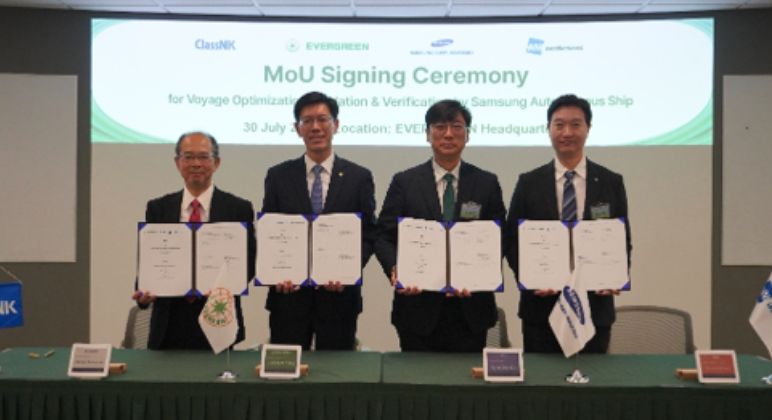
Separately, ClassNK has joined a project with Evergreen Marine Corporation, Samsung Heavy Industries and Weathernews Inc. to objectively verify reductions in fuel consumption and greenhouse gas emissions achieved through AI-based autonomous navigation in actual vessel operations. The four parties signed a Memorandum of Understanding at Evergreen’s headquarters, establishing a cooperative framework to verify the GHG reduction effects of AI-based voyage optimization technology.
How will the project be structured across the four partners?
Using an actual commercial vessel operated by Evergreen, the project will apply the Samsung Autonomous Ship system developed by Samsung Heavy Industries, combined with meteorological and oceanographic data from Weathernews. Evergreen will provide the demonstration vessel, operational and fuel consumption data, and crew cooperation. Samsung Heavy Industries will operate the speed optimization algorithm, manage real-time vessel control and install and maintain the SAS equipment. Weathernews will develop baseline voyage routes and supply high-resolution and historical weather and ocean forecasting data. ClassNK will conduct technical review of the verification methodology and issue a Statement of Fact, contributing to the objectivity and credibility of the project’s findings.
Why is establishing a verification methodology important for this technology?
The effectiveness of voyage optimization technologies can vary depending on weather and sea conditions, vessel condition and operational requirements for each voyage, making an objective, standardised verification methodology essential for evaluating fuel-saving effects in real operating conditions rather than controlled testing environments.
What does this mean for the maritime industry’s decarbonisation efforts?
ClassNK said it will continue actively supporting innovative initiatives aimed at decarbonising the maritime industry, contributing to the practical implementation of advanced technologies and the realisation of sustainable maritime transportation, spanning both updated safety standards for alternative fuels and independent verification of AI-driven efficiency technologies.
 Join our WhatsApp channel for more updates:
 Subscribe to our YouTube channel for more updates: