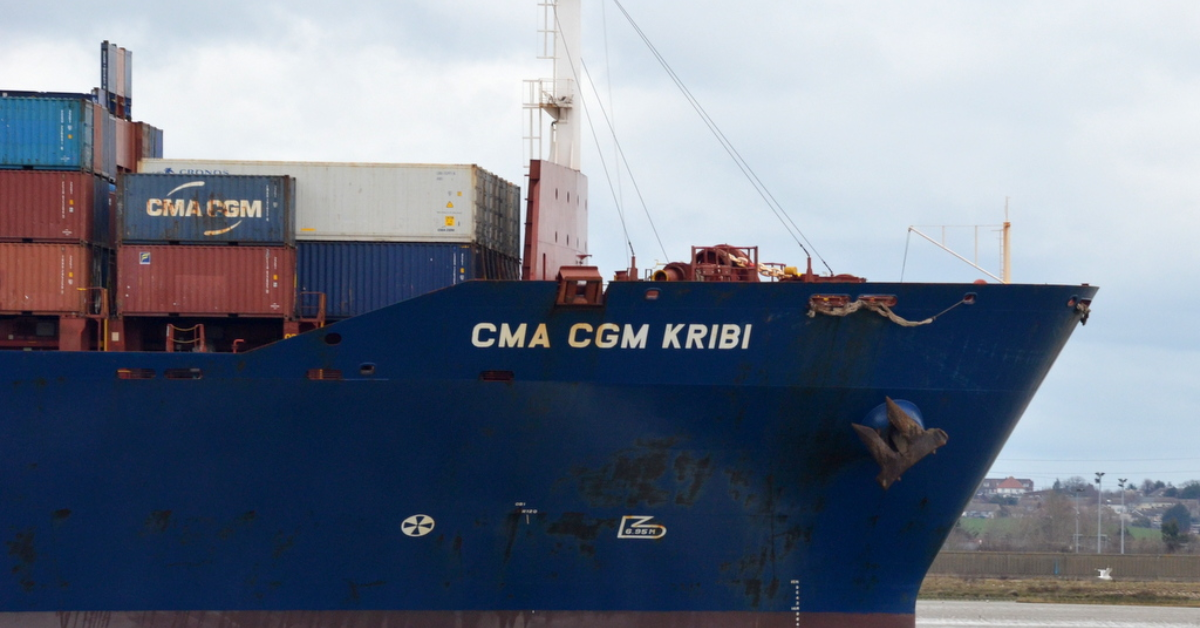

The CMA CGM Kribi — a container vessel operated by French shipping giant CMA CGM and sailing under the Maltese flag — has successfully transited the Strait of Hormuz, marking the first known passage by a vessel linked to a Western European shipping major since Iran imposed severe transit restrictions following the US-Israel military campaign that began on February 28.
According to ship-tracking data, the Kribi departed waters off Dubai and navigated close to Iran’s coastline, passing between Qeshm Island and Larak Island — the narrow northern channel that Iran has designated for controlled transit — before emerging safely into the Gulf of Oman. By Friday morning, the vessel was reported near Muscat. The transit is commercially and diplomatically significant: CMA CGM is a French state-backed shipping company, and France is a participant in the UK-led multilateral Hormuz talks. A French-linked vessel transiting under what appears to be Iranian escort or clearance protocols raises questions about what arrangements, if any, were made to facilitate the passage.
UNCTAD: 95% Traffic Collapse, Global Economic Shock Underway
The Kribi’s transit — however significant as a data point — must be placed against the backdrop of a near-total shutdown that UNCTAD’s latest rapid assessment has now quantified with stark precision. Vessel traffic through the Strait of Hormuz has collapsed by approximately 95 per cent, falling from around 130 ships per day in February to just six ships per day in March, the UN trade agency reported. The scale of this collapse exceeds even the worst-case scenarios that shipping industry analysts had modelled at the onset of the crisis and represents, in UNCTAD’s words, a global economic shock that is disrupting energy flows, driving up costs, and placing mounting pressure on developing countries that depend on Gulf energy imports.
UNCTAD noted that the disruption is hitting maritime transport, air cargo, and port operations simultaneously, as energy shortages ripple through logistics systems. Countries with limited foreign exchange reserves and high fuel import dependency — including many in South Asia, Sub-Saharan Africa, and the Pacific — are facing acute supply chain stress that is qualitatively different from the pressures experienced by larger economies like India, which has the diplomatic relationships and financial depth to manage partial supply diversification.
LPG Tanker Pine Gas Escapes Hormuz After Three-Week Ordeal; Rerouted to Vizag
The human dimension of the Hormuz transit continues to emerge in individual vessel accounts. The Indian-flagged LPG tanker Pine Gas, carrying 45,000 metric tonnes of LPG, successfully exited the Strait of Hormuz after being stranded for nearly three weeks following its loading at Ruwais Port on February 27 — one day before hostilities began. Chief Officer Sohan Lal described the crew’s ordeal of witnessing daily missile and drone activity overhead while awaiting clearance, with visual evidence of multiple projectiles crossing the night sky above the anchored vessel during the standoff. The Pine Gas has subsequently been rerouted to Visakhapatnam — rather than its original destination — to expedite delivery and ease supply pressures in eastern India, demonstrating the operational flexibility that port operators and refiners are deploying to manage the crisis’s real-time distribution challenges.
 Join our WhatsApp channel for more updates:
 Subscribe to our YouTube channel for more updates: