




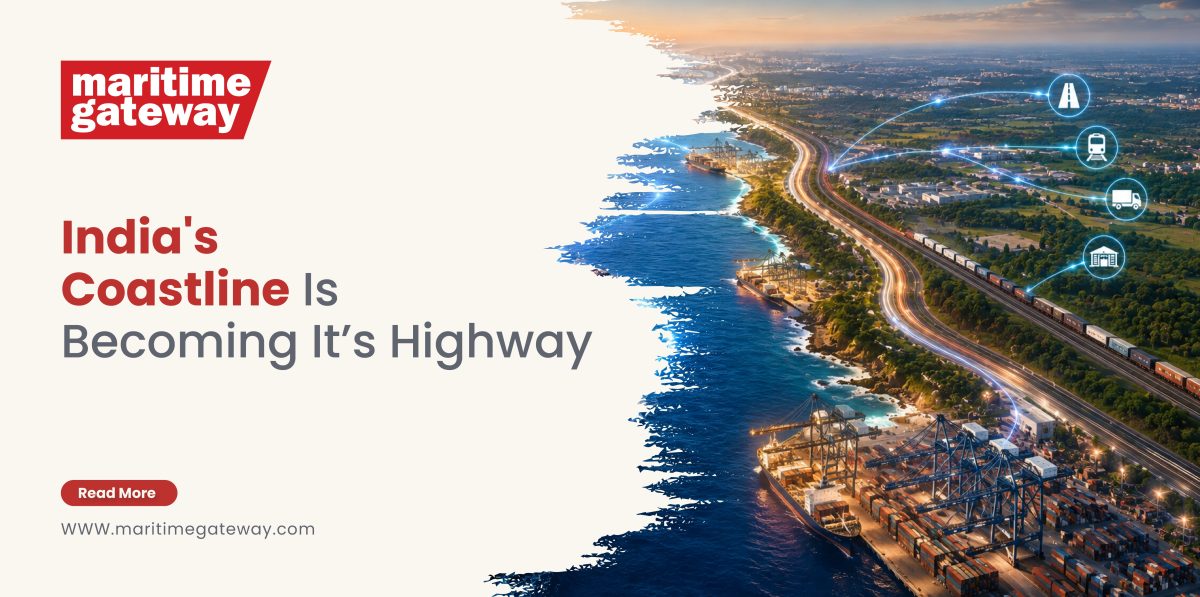

Coastal shipping in India is finally getting the policy push and infrastructure attention it has needed for decades. With a coastline stretching 11,098 km across nine states and four union territories, India has long under-used one of its cheapest and greenest transport modes, but that is changing fast. Coastal cargo handled at major ports has grown from 119.5 million tonnes in FY15 to 213.5 million tonnes in FY26, and the government has now backed this momentum with a dedicated legal framework, the Coastal Shipping Act, 2025. This blog breaks down what coastal shipping means for India’s logistics ecosystem, the real benefits it brings to trade and the environment, and the structural challenges still holding it back from reaching its full potential.

Join the conversation and be part of the ideas shaping the future. Don’t miss your chance to connect, engage, and make your voice heard.
Register Now—https://smartlogisticssummit.in/
What Is Coastal Shipping?
Coastal shipping refers to the transportation of cargo and passengers by sea between two ports located within the same country. In India’s case, it means moving goods along the western and eastern coastlines rather than through inland road or rail networks. It sits alongside inland waterways as part of India’s water-transport basket, and both have been central to the government’s Sagarmala program, launched in 2015 to reduce logistics costs through port-led development.
Historically, road and rail have dominated India’s freight movement, with coastal shipping contributing only a small share of the overall modal mix. But a mix of policy reform, fiscal incentives, and infrastructure investment is now nudging that balance slowly but visibly toward the coast.
The Policy Turning Point: Coastal Shipping Act, 2025
For nearly seven decades, coastal trade in India was governed under Part XIV of the Merchant Shipping Act, 1958, a colonial-era framework built primarily around vessel licensing rather than growth. That changed in 2025.
The Coastal Shipping Bill, 2025, was passed by the Lok Sabha on April 3, 2025; cleared by the Rajya Sabha through a voice vote; and received presidential assent on August 9, 2025, carving out a standalone and modernized framework for coastal shipping consolidated into six chapters and 42 clauses. It repeals Part XIV of the old Merchant Shipping Act and, notably, expands the scope of coastal trade beyond just carriage of goods and passengers to include services such as exploration, research, and other commercial activity (with fishing excluded). It also brings a wider range of vessels, including boats, sailing vessels, and mobile offshore drilling units, under its ambit, regardless of whether they are self-propelled.
Union Minister for Ports, Shipping and Waterways Sarbananda Sonowal described the shift plainly: the earlier law “focused solely on vessel licensing,” while the new act “provides a holistic framework aligned with global cabotage practices. ” The government has paired this with an explicit target: taking coastal cargo share to 230 million metric tons by 2030, up from 162 million tons in 2023-24—a jump that would represent roughly 119% growth over the preceding decade, continuing into a further leap this decade.
The Coastal Shipping Act didn’t arrive alone. It was part of a broader legislative overhaul of India’s maritime laws during 2025, alongside the Merchant Shipping Act, 2025 (replacing the 1958 law, assented on August 18, 2025) and the Carriage of Goods by Sea Act, 2025 (replacing a century-old 1925 law, assented on August 8, 2025). Together, these three laws mark what the ministry has called a complete modernization of India’s maritime legal architecture.
Key Benefits of Coastal Shipping in India
1. Significantly Lower Logistics Costs
Moving bulk cargo by sea is inherently cheaper per tonne-kilometer than road transport and often cheaper than rail for long-haul routes along the coast. This matters enormously for India, where logistics costs as a share of GDP have historically run higher than in comparable economies. The Sagarmala Programme was built around this exact premise using India’s 11,000+ km coastline to reduce logistics costs for both EXIM and domestic trade.
To make coastal vessels more commercially attractive, the government has also introduced direct financial incentives: a 40% discount offered by major ports on vessel and cargo-related charges to coastal cargo vessels, a priority berthing policy to reduce turnaround time, and a cut in GST on bunker fuel used by Indian-flagged vessels from 18% to 5%. These measures directly lower the operating cost of running coastal services, which has historically been one of the biggest deterrents for shipping lines.
2. Decongesting Road and Rail Networks
India’s national highways and rail freight corridors are under constant strain, particularly on routes connecting industrial clusters to ports. Shifting bulk commodities coal, cement, steel, fertilizers, POL products, and containers onto coastal vessels takes pressure off already-congested road and rail infrastructure. The government’s own framing of coastal shipping’s purpose is direct: it is a mode that can “ease traffic congestion on road and rail and arrest loss of human lives caused due to accidents.” Given India’s road accident fatality numbers, this isn’t a minor side benefit it’s a public safety argument, not just a logistics one.
3. Environmental and Fuel Efficiency Gains
Ships move considerably more cargo per unit of fuel than trucks. That’s why government agencies frame coastal shipping and inland waterways as fundamentally more sustainable freight options: cargo movement through coastal shipping and inland waterways is sustainable and environment-friendly, which is why the Sagarmala Programme has pushed projects that shift cargo from land-based transportation onto these water-based modes. As India works toward its broader emissions and green logistics goals under Maritime India Vision 2030, coastal shipping is one of the more straightforward levers available; the infrastructure exists (or can be built cheaply relative to new highways), and the fuel-efficiency gains are immediate.
There’s also a forward-looking green angle: India and the Netherlands are working on establishing a green and digital corridor between Indian ports and the Port of Rotterdam to boost clean energy trade, focused on exporting green hydrogen and derivatives while enhancing port digitalization and green shipping.
4. Growth in Indian Tonnage and Domestic Fleet Capacity
One of the stated goals of the Coastal Shipping Act is to build a coastal fleet that is Indian-owned and Indian-operated, both for commercial reasons and national security. Sonowal has been explicit that the overarching goal is to “develop a coastal fleet owned and operated by Indian entities.” This is already showing results at the broader fleet level. India’s fleet of Indian-flagged vessels grew from 1,204 ships in 2015 to 1,592 ships in 2025. A stronger coastal fleet also has knock-on employment benefits, since India is one of the largest global suppliers of seafarers, and the new coastal framework is designed to mandate a minimum number of Indian seafarers aboard foreign vessels operating in Indian coastal waters.
5. Regional and Coastal Community Development
Nearly a fifth of India’s population lives along its coast. According to the Ministry of Ports, Shipping and Waterways, approximately 18% of India’s population lives in the 72 coastal districts that make up 12% of India’s mainland. Coastal shipping growth, layered with Sagarmala’s coastal community development goals—fisheries, maritime tourism, and skill development—has the potential to generate livelihoods far beyond the shipping industry itself, from port-side logistics jobs to tourism-linked services like cruise and lighthouse tourism.
6. Better Integration with Inland Waterways
The Coastal Shipping Act’s provisions allow coastal vessels to operate on inland waterways, an integration that didn’t exist cleanly under the older law. This matters because inland waterway cargo has itself grown sharply from 18.1 million tonnes in FY14 to 218.2 million tonnes in FY26, and a unified coastal-plus-inland framework means cargo can move more seamlessly between the two water-based modes without duplicated compliance requirements.
7. Strong Fiscal Backing Through Sagarmala 2.0
The government has now doubled down on the port-led development model with Sagarmala 2.0. As of March 2026, 845 projects worth Rs 6.06 lakh crore have been taken up under the program, with 315 projects worth Rs 1.57 lakh crore already completed, 210 under implementation, and 320 in the planning stage. Separately, industry data pegs Sagarmala 2.0 as being supported with Rs 85,482 crore in government funding, aimed at catalysing Rs 3.6 lakh crore in overall investment. This scale of committed capital spanning port modernization, coastal berths, bunkering facilities, and hinterland connectivity gives coastal shipping a far stronger infrastructure foundation than it has ever had.
Challenges Facing Coastal Shipping in India
Despite the policy momentum, coastal shipping in India continues to face structural bottlenecks that have persisted for years and won’t disappear overnight just because a new law has been passed.
1. Lack of Return Cargo
One of the most cited operational problems is the absence of consistent return cargo on coastal routes. A vessel that carries a full load in one direction but returns empty effectively doubles its per-tonne cost, making coastal shipping commercially unattractive compared to trucking, which can usually pick up return loads more flexibly. The Ministry’s own assessment lists this directly as a primary constraint: “non-availability of return cargo” is named as one of the core challenges in coastal shipping.
2. Inadequate Dedicated Infrastructure
Most major ports in India were designed and built around deep-draft EXIM (export-import) traffic, not smaller, more frequent coastal vessel movements. Dedicated coastal berths, storage yards, and handling equipment sized for coastal parcel sizes remain limited. The government acknowledges a “lack of dedicated coastal shipping infrastructure” as a key gap, which is why Sagarmala has earmarked specific coastal-berth projects though at a comparatively modest scale of 25 projects worth Rs 2,883 crore focused specifically on coastal cargo-handling infrastructure, of which only 7 projects worth Rs 537 crore have been completed so far.
3. First- and Last-Mile Connectivity Dependence
Coastal shipping doesn’t operate in isolation; cargo still needs to move from factories or warehouses to the port and from the destination port to its final inland location. This first- and last-mile leg is almost always handled by road or rail, and any inefficiency there erodes the cost advantage that coastal shipping offers on the main sea leg. The ministry flags this explicitly: coastal shipping’s “dependency of first- and last-mile connectivity on other modes” remains an unresolved structural issue.
4. Insufficient Parcel Sizes
Coastal shipping is most cost-effective at large, consistent parcel sizes that justify a vessel call. Many Indian shippers, particularly smaller manufacturers and traders, don’t generate cargo volumes large enough to make coastal shipping viable on a standalone basis. The government lists “insufficient parcel size for transporting through a vessel” as one of the primary bottlenecks limiting broader adoption.
5. Historical Regulatory Complexity Under Cabotage Law
Even with liberalization, India’s cabotage regime under the Merchant Shipping Act, 1958, required foreign-flagged vessels to obtain a license from the Director General of Shipping to engage in India’s coastal trade, with eligibility largely tied to charters by Indian citizens, companies, or cooperative societies. While relaxations existed, for instance, allowing foreign-flagged vessels to transport agricultural, fisheries, horticultural, fertilizer, and animal produce commodities provided these made up at least 50% of the cargo, the underlying framework was widely seen by industry as overly rigid for a sector needing scale quickly. This is precisely the gap the new Coastal Shipping Act, 2025, is meant to close, though its practical, on-ground impact is still unfolding since the act only received presidential assent in August 2025.
6. Slow Pace of Project Completion
Even where funding and planning exist, execution has historically lagged. Of the 224 broader coastal-and-inland-waterway shift projects under Sagarmala worth Rs 14,295 crore, only 57 projects worth Rs 3,272 crore have been completed, with 58 projects worth Rs 4,596 crore still under implementation and 109 projects worth Rs 6,428 crore still in various stages of planning. This completion rate, roughly a quarter of committed projects finished, illustrates why policy ambition and ground reality in Indian coastal infrastructure often move at very different speeds.
7. Skewed Modal Share Compared to Global Peers
Despite the growth, India’s water-based freight modal share remains low by international standards. As of 2025, inland waterways account for approximately 2% of India’s freight modal share, compared to over 30% in developed economies. While this statistic is specific to inland waterways rather than coastal shipping alone, it reflects the broader structural challenge: India’s freight ecosystem is still deeply road-and-rail dominated, and shifting entrenched shipper behavior toward water-based modes takes far longer than passing legislation.
The Road Ahead
The numbers suggest genuine momentum. India’s major ports handled a record 915.17 million tonnes of cargo in FY 2025-26, a 7.06% year-on-year increase that surpassed the government’s own annual target of 904 million tonnes, and within that, coastal cargo accounted for 22.63% of total cargo handled at major ports during April-December of FY26. The legislative foundation is now in place with the Coastal Shipping Act, 2025, and the funding pipeline through Sagarmala 2.0 is substantial.
But the gap between policy ambition and on-the-ground execution visible in project completion rates, dedicated coastal infrastructure, and persistent operational issues like return-cargo availability means coastal shipping’s real test over the next few years won’t be legislative. It will be logistical: whether ports, shippers, and the new fleet-building push can actually convert India’s 11,098 km coastline into the reliable, cost-effective freight backbone the government has set out to build by 2030.

 Join our WhatsApp channel for more updates:
 Subscribe to our YouTube channel for more updates: