




Tamil Nadu’s Kamarajar Port makes history as the world’s largest and cleanest car carrier berths on Indian shores for the first time.
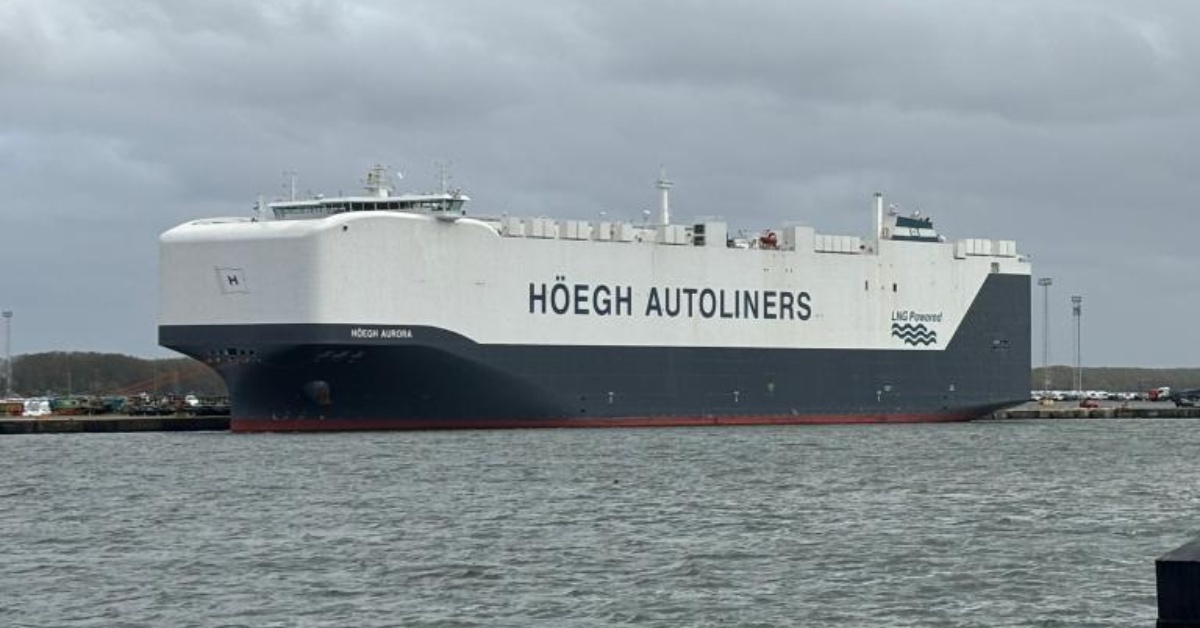
In a milestone that signals India’s growing stature as a hub for next-generation maritime logistics, Kamarajar Port Limited welcomed MV Höegh Aurora — the world’s largest and most environmentally advanced Pure Car and Truck Carrier (PCTC) — at its General Cargo Berth-1 on May 24, 2026.
Operated by Norwegian shipping giant Höegh Autoliners, the Aurora-class lead vessel is a technological marvel that redefines what a roll-on/roll-off (RORO) carrier can be. At 9,100 CEU (Car Equivalent Units) capacity — the highest ever for a PCTC vessel — and stretching 199.9 metres in length across 14 cargo decks, the Aurora-class represents the future of green automobile shipping. A 6.5-metre ramp enables it to handle oversized, high and heavy cargo with ease.
What makes MV Höegh Aurora remarkable, beyond its sheer scale, is its environmental ambition. The vessel runs on LNG (liquefied natural gas) dual-fuel propulsion systems and is designed for future conversion to ammonia and methanol — two fuels widely regarded as the pathway to zero-emission deep-sea shipping. The vessel’s decks are entirely EV-ready, making it capable of carrying electric vehicles without special adaptations. Five liftable decks further enhance cargo flexibility, while 1,500 square metres of rooftop solar panels and shore power capability allow the ship to draw power from the port grid, slashing emissions during berthing.
For Kamarajar Port — administered by the Tamil Nadu government and one of India’s 13 major ports — the Aurora’s port call carries more than symbolic weight. Port officials said the successful berthing underscores the facility’s capacity to accommodate the world’s largest RORO vessels, a critical differentiator in attracting global shipping business. The port is positioning itself as a leading LNG bunkering hub on India’s east coast, and a visit from a vessel of this class — which will require LNG bunkering services on future calls — is a tangible vote of confidence in that direction.
The automobile logistics ecosystem in India has been expanding rapidly, driven by surging domestic vehicle production and growing vehicle exports. India exported over 660,000 vehicles in FY2025, and that number is expected to grow as manufacturers like Tata Motors, Maruti Suzuki, and foreign OEMs scale up capacity. Having facilities capable of handling ultra-large PCTCs is essential for India to compete with established RORO hubs in the region such as Singapore and Port Klang.
The arrival of MV Höegh Aurora at Kamarajar also aligns with India’s Maritime Amrit Kaal Vision 2047, which targets making India a top-five maritime nation globally. Green shipping infrastructure — including LNG bunkering, shore power connections, and ports capable of hosting next-generation vessels — is central to that roadmap.
Industry observers noted that ports across India’s east coast will need to invest in upgraded ramp infrastructure and deeper drafts if they wish to compete for RORO traffic from the next generation of Aurora-class and similar vessels. Kamarajar Port’s successful hosting demonstrates both readiness and ambition.
 Join our WhatsApp channel for more updates:
 Subscribe to our YouTube channel for more updates: