




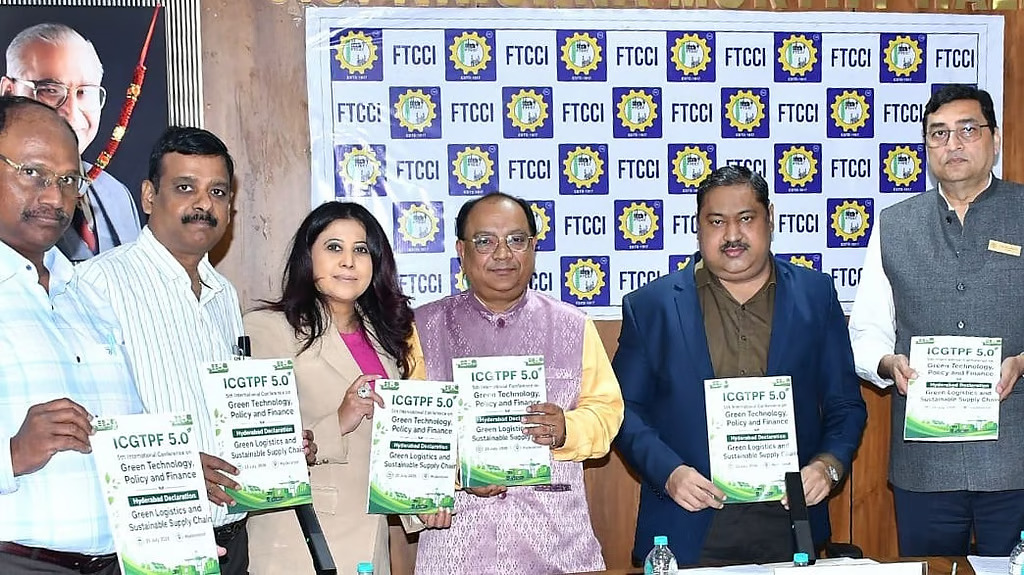

Experts, policymakers and industry leaders have unveiled the Hyderabad Declaration, a policy framework urging the Centre to establish a National Green Logistics and Sustainable Supply Chain Mission aimed at accelerating decarbonisation across India’s logistics sector.
What is the Hyderabad Declaration and where was it launched?
The declaration was unveiled at the International Conference on Green Technology, Policy and Finance in Hyderabad, with plans to submit it to NITI Aayog and other government bodies as a policy roadmap. ICGTPF and Chandradeep Solar Research Institute founder Sandip Chattopadhyay described it as a Cabinet-ready document designed to integrate green hydrogen, digital logistics, renewable energy and sustainable port infrastructure under a single national mission. The event was attended by Hyderabad Additional Collector Kadhiravan Palani, FTCCI president K K Maheshwari and vice-president Srinivas Garimella, among others, followed by a roundtable discussion on the sector’s path forward.
What economic impact does the declaration project?
According to the declaration, improving logistics efficiency could bring down India’s logistics costs from the current 14 percent of GDP to global benchmarks of 8 to 9 percent, potentially generating annual economic gains of USD 320 to 390 billion through operational efficiencies, fuel savings and stronger export competitiveness. It also aims to reduce fossil fuel dependence, strengthen energy security and position India as a global hub for green hydrogen and ammonia trade.
What are the key recommendations in the declaration?
The framework calls for launching a National Green Logistics and Hydrogen Corridors Mission, developing the Kandla-Delhi-Mumbai Industrial Corridor as a national hydrogen corridor pilot, converting major ports into zero-emission green ports, setting up a Green Logistics and Ports Fund through public-private partnerships, and deploying AI-enabled digital logistics platforms with carbon-tracking capabilities.
How is the declaration positioned for policy adoption?
Billed as India’s first integrated policy framework of its kind, the declaration is accompanied by a draft Cabinet note, a Prime Minister’s Office-level decision brief and state-specific implementation roadmaps for major industrial states, enabling adoption at both central and state government levels.
Why does this matter for India’s global trade positioning? Experts at the event noted that the declaration arrives as global trade increasingly shifts toward low-carbon supply chains, with strategic initiatives such as the India-Middle East-Europe Economic Corridor requiring green infrastructure to remain competitive on the world stage.
 Join our WhatsApp channel for more updates:
 Subscribe to our YouTube channel for more updates: