




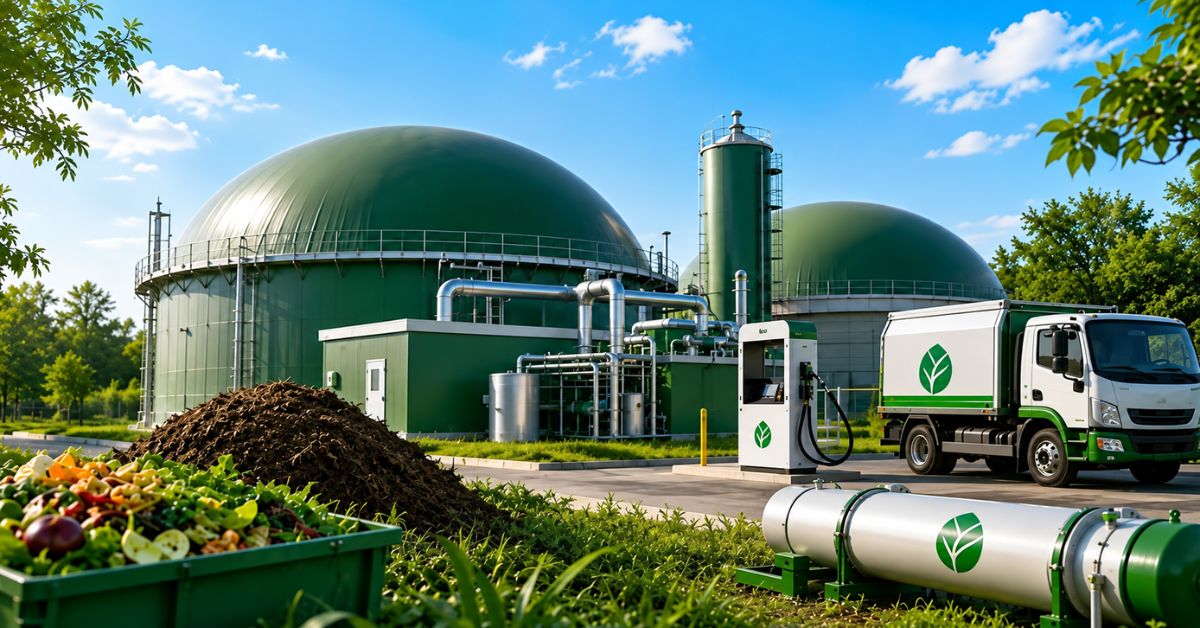

The Union Cabinet, chaired by Prime Minister Narendra Modi, has approved GOBARdhan, the National Circular Bioenergy Scheme, with a total outlay of Rs 23,731 crore, in a move officials say marks a defining moment in India’s clean energy journey. ˇBriefing media in New Delhi, Information and Broadcasting Minister Ashwini Vaishnaw said the scheme will create 1.5 lakh jobs and will transform the country’s agricultural residue, cattle dung, press mud, municipal organic waste and other biomass resources into clean fuel, organic manure, rural income and national economic value.
The scheme will be implemented from FY 2026-27 to FY 2035-36 and aims to establish Compressed Biogas (CBG) as a major pillar of India’s future energy mix, with domestic CBG production expected to increase nearly 10-fold, alongside large-scale private investment mobilisation and the creation of a vibrant circular bioeconomy across the country.
Import substitution and energy security
The scheme is being positioned as a key lever for reducing India’s dependence on imported LNG. Administered by the Ministry of Petroleum and Natural Gas, GOBARdhan brings the entire CBG value chain under one integrated platform through six components covering offtake, pricing, capital support, infrastructure, credit and ecosystem development. Through assured demand, remunerative and stable pricing, capital assistance, pipeline infrastructure, credit support and technology development, the scheme is designed to provide a strong and predictable framework to take India’s CBG sector to national scale.
The government has defined six “growth engines” under GOBARdhan, including assured CBG offtake, a stable CBG pricing framework, capital assistance, pipeline infrastructure development, credit guarantee support, and a CBG ecosystem challenge fund. Under the offtake assurance framework, procurement by City Gas Distribution entities will support achievement of the notified CBG obligation trajectory of 3% in 2026-27, 4% in 2027-28 and 5% from 2028-29 onwards in the CNG (transport) and PNG (domestic) segments. The scheme also introduces a stable administered CBG price of Rs 2,110 per metric million British thermal unit (MMBtu).
Building on existing momentum
GOBARdhan builds on the foundation laid by earlier initiatives, including the Sustainable Alternative Towards Affordable Transportation (SATAT) initiative and the Market Development Assistance Scheme for organic manure, under which more than 200 CBG plants have already been commissioned. The government expects GOBARdhan to strengthen energy security, mobilise private investment, boost rural livelihoods, support scientific waste management and expand the organic manure economy.
Other Cabinet approvals
The Cabinet Committee on Economic Affairs separately approved construction of a four-lane highway from Baihata Chariali near Guwahati to Tezpur along NH-15 in Assam, with a total project length of 135.87 km worth over ₹8,970 crore, to be developed on a Built-Operate-Transfer (BOT) toll mode basis. The project includes an Emergency Landing Facility at the Tezpur Bypass, finalised in coordination with the Indian Air Force, along with five major bypasses spanning 58.7 km to ease congestion through densely populated stretches including Baihata Chariali, Sipajhar, Kharupetia, Dekiajuli and Tezpur.
 Join our WhatsApp channel for more updates:
 Subscribe to our YouTube channel for more updates: