



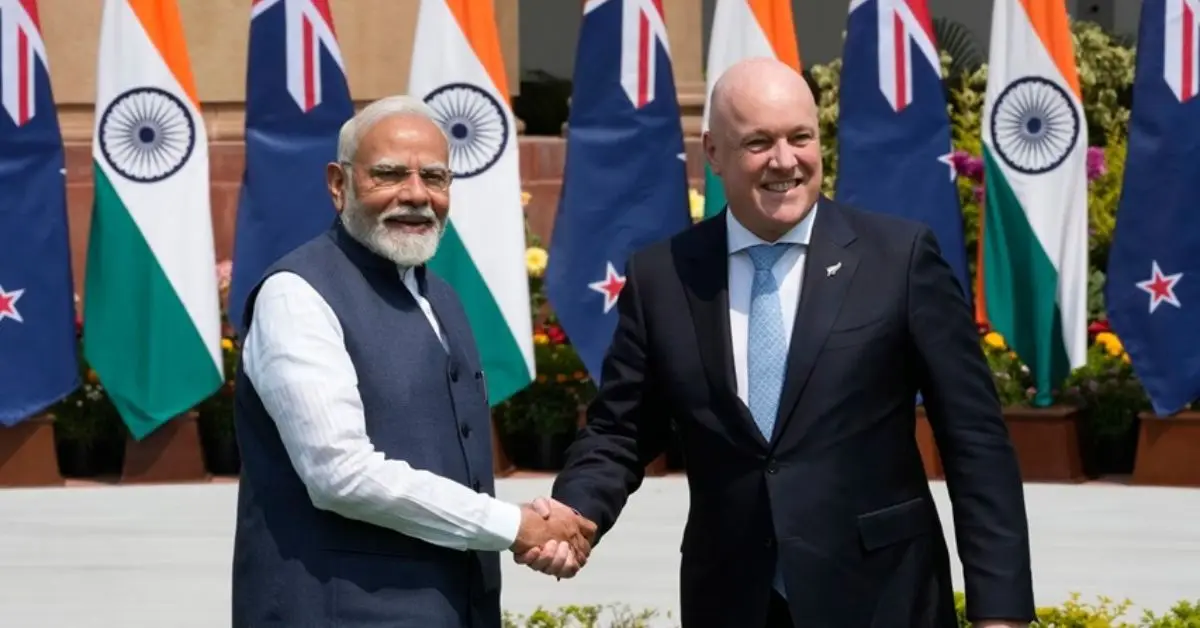

India and New Zealand have formally concluded negotiations on a long-awaited Free Trade Agreement (FTA), marking a significant step toward strengthening bilateral trade, investment and services cooperation between the two countries.
The talks, which began in May this year, were wrapped up. New Zealand Prime Minister Christopher Luxon confirmed the conclusion of the agreement following a conversation with Indian Prime Minister Narendra Modi, calling it a milestone in the growing partnership between the two nations.
According to Luxon, the FTA will eliminate or significantly reduce tariffs on about 95 per cent of New Zealand’s exports to India. He said the deal is expected to lift New Zealand’s annual exports to India from the current $1.1 billion to around $1.3 billion over the next 20 years, giving Kiwi businesses improved access to one of the world’s fastest-growing major economies and its 1.4 billion consumers.
In FY25, total bilateral trade between India and New Zealand stood at approximately $1.3 billion. India exported goods worth $711.1 million to New Zealand, while imports from New Zealand were valued at $587.1 million.
The agreement addresses a notable tariff imbalance between the two countries. New Zealand’s average import tariff is relatively low at 2.3 per cent, with over 58 per cent of tariff lines already duty-free. India’s average import tariff, by contrast, stands at 17.8 per cent, making tariff liberalisation a key gain for New Zealand exporters.
India’s exports to New Zealand are diversified but heavily weighted toward fuels, textiles and pharmaceuticals. Aviation turbine fuel emerged as the single largest export item at $110.8 million, followed by clothing, fabrics and home textiles worth $95.8 million. Pharmaceutical exports reached $57.5 million, while machinery, including turbojets, accounted for $51.8 million. Petroleum products such as diesel and petrol together contributed more than $70 million. Other notable exports included automobiles and auto components, paper and paperboard, electronics, iron and steel, seafood such as shrimps, basmati rice and gold jewellery.
New Zealand’s exports to India are dominated by raw materials, agricultural produce and industrial inputs. Wood and wood products, along with wood pulp, highlight strong linkages in construction, packaging and paper industries. Exports of steel and aluminium scrap underscore India’s reliance on recycled metal inputs. In the energy and heavy industry segment, New Zealand supplies coking coal and high-value aviation equipment such as turbojets. Agricultural and animal-based exports remain significant, led by wool, dairy ingredients like milk albumin, and fresh fruit including apples and kiwifruit.
Beyond goods, services trade forms a crucial pillar of the bilateral relationship. In FY24, India’s services exports to New Zealand were valued at $214.1 million, driven by IT and software services, telecommunications support, healthcare and financial services. New Zealand’s services exports to India were substantially higher at $456.5 million, led by education—largely supported by Indian students—followed by tourism, fintech offerings and specialised aviation training.
With the conclusion of the FTA negotiations, both countries expect deeper economic integration, stronger supply-chain linkages and expanded opportunities for businesses and service providers on both sides.
 Join our WhatsApp channel for more updates:
 Subscribe to our YouTube channel for more updates: