



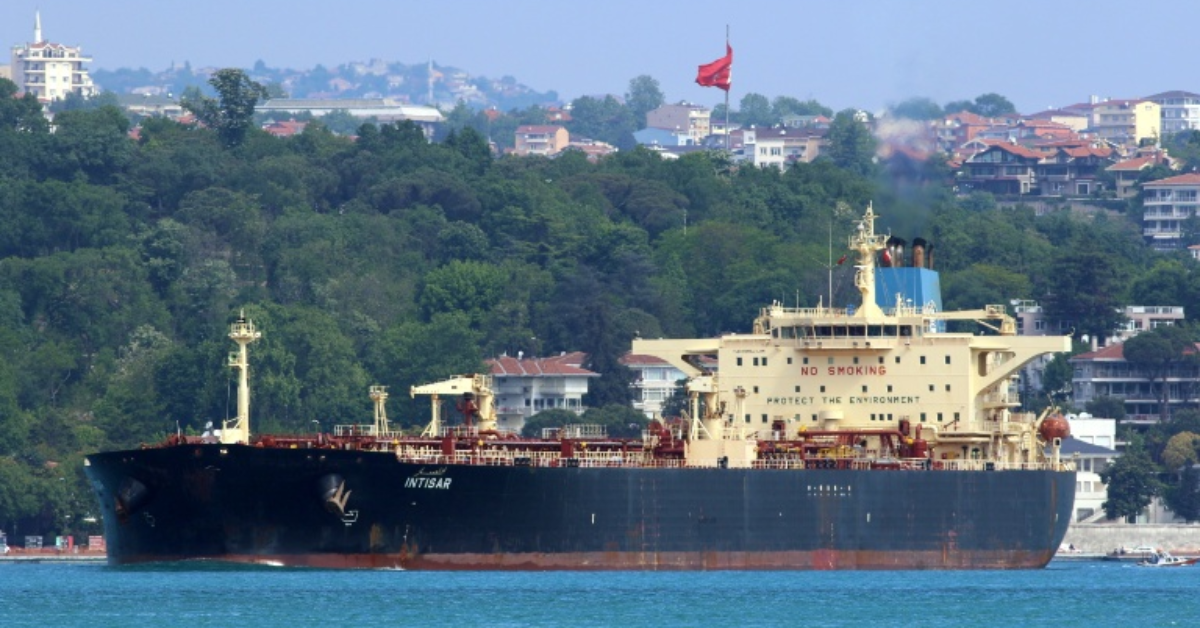

Tanker Nears Vadinar; Russia Imports Surge 90% Amid Hormuz Disruption
India is poised to receive its first shipment of Iranian crude oil since May 2019 — a seven-year gap that reflects the depth of the US sanctions regime that has kept Indian refiners away from Iranian supply — as a tanker carrying approximately 600,000 barrels of crude loaded from Iran’s Kharg Island is expected to dock at Vadinar in Gujarat on April 4.
According to live vessel tracking data, the tanker Ping Shun — sailing under the Eswatini flag and previously identified on Kpler’s monitoring system as carrying a sanctioned cargo originating from Kharg Island — is en route to Vadinar. The vessel had earlier signalled Vadinar as its destination before briefly appearing to divert toward Dongying in China in a mid-voyage course change that tracking analysts attributed to tightening payment terms and counterparty risk assessment. The ultimate arrival at Vadinar, if confirmed, would mark a significant recalibration of India’s crude procurement strategy — driven not by a formal policy change on Iran sanctions but by the practical reality of the Hormuz crisis creating supply gaps that only non-Western sanctioned crude can fill at competitive prices.
The Sanctions Calculus Has Shifted
India halted Iranian crude purchases in May 2019 after the Trump administration’s maximum pressure campaign eliminated the sanctions waivers that had previously allowed Indian refiners — notably Indian Oil Corporation, HPCL, and BPCL — to buy Iranian crude under defined volume caps. The decision cost Iran one of its largest pre-sanctions customers and cost Indian refiners access to heavily discounted crude that had substantially improved their refinery margins. The revival of Iranian crude flows to India under current conditions — with the US simultaneously engaged in military conflict against Iran — creates a complex geopolitical situation for New Delhi, which has carefully balanced its relationship with Washington throughout the Hormuz crisis.
Russia Crude Imports Jump 90%
The Iranian crude development coincides with reporting that India’s imports of Russian crude oil have surged by approximately 90 per cent in recent months as Indian refiners have sought stable and competitively priced alternatives to disrupted Gulf supply. Russian crude — available at persistent discounts to Brent crude pricing and delivered via Cape of Good Hope routing — has become the primary swing supplier for Indian refineries adjusting to reduced Gulf crude flows.
The 90 per cent surge in Russian crude imports creates a notable tension with India’s February 2026 bilateral trade deal with the United States, under which India committed to stop buying Russian oil as a condition for the reduction of US reciprocal tariffs from 50 per cent to 18 per cent. The Hormuz crisis has effectively forced Indian refiners back toward Russian supply — not as a strategic preference, but as an operational necessity when the primary Gulf supply routes are disrupted. How Washington interprets India’s Russian crude purchases in the context of the Hormuz emergency will be a significant diplomatic test of the India-US trade framework in the weeks ahead.
 Join our WhatsApp channel for more updates:
 Subscribe to our YouTube channel for more updates: