



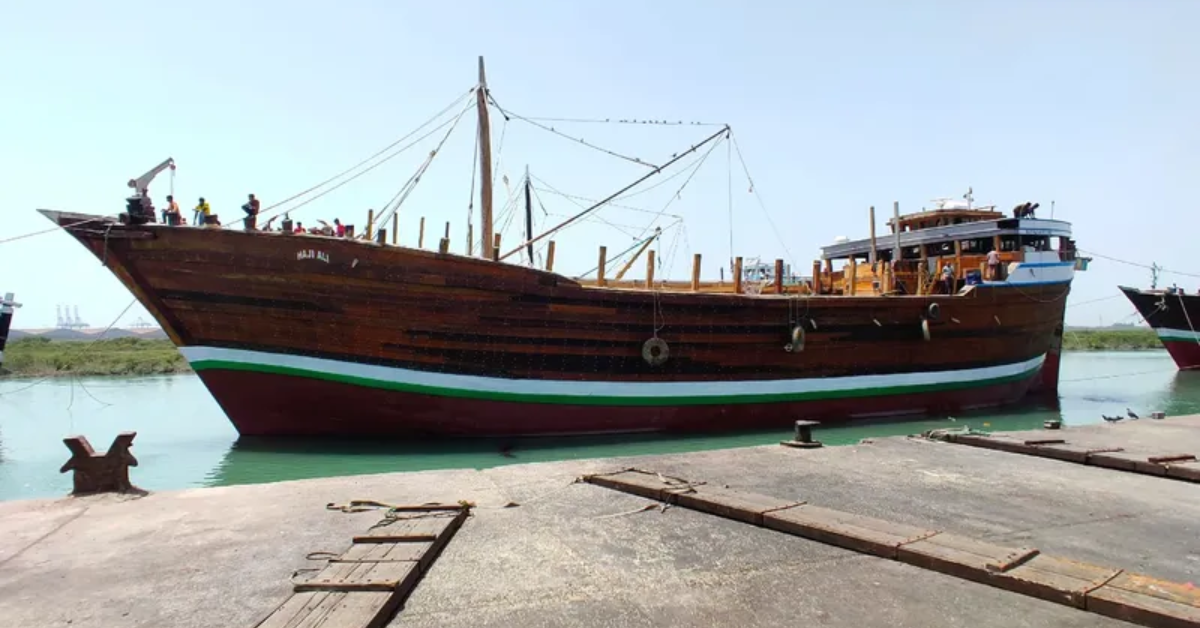

An Indian-flagged wooden cargo vessel — the dhow Haji Ali — caught fire and sank in Omani waters in the early hours of Wednesday after what is believed to have been a drone or missile strike, adding a fresh chapter to the maritime security crisis in the Gulf of Oman that has now lasted more than 11 weeks. India’s Ministry of Ports, Shipping and Waterways confirmed that all 14 crew members onboard were rescued safely by the Omani Coast Guard, who took the survivors to the port of Diba on Oman’s eastern coast. British maritime risk firm Vanguard assessed the blast as likely caused by a drone or missile strike, based on the nature of the damage and the circumstances of the incident.
The Haji Ali was sailing from Somalia to the United Arab Emirates at the time of the attack, carrying a livestock cargo. Its route — from the Horn of Africa northwestward toward the UAE — would have taken it through the broader Gulf of Oman maritime zone that has been heavily militarised since the US-Israel-Iran conflict began on February 28. The vessel’s Indian flag did not protect it from the attack, raising fresh questions about the consistent claim that India’s bilateral diplomatic engagement with Iran has secured meaningful protection for Indian-flagged vessels. Iran had explicitly used safe passage for Indian-flagged LPG carriers as a diplomatic gesture — but the Haji Ali sinking suggests that the protection is neither comprehensive nor guaranteed for smaller commercial vessels on non-energy trade routes.
India’s Condemnation — and the Shipping Line of Incidents
New Delhi has strongly condemned the attack and sinking, calling for restraint from all parties and underscoring that attacks on civilian and merchant shipping threaten global commerce, energy supply chains, and regional stability. The government emphasised the importance of freedom of navigation and the safety of commercial vessels in international waters — a statement that mirrors India’s condemnation of the IRGC’s April 18 firing on the VLCC Sanmar Herald and the Iranian Coast Guard’s warning shots at MT Siron on April 25.
The accumulation of incidents involving Indian-flagged or India-crew vessels now spans the full crisis period: the Sanmar Herald (fired upon April 18), MT Siron (warning shots April 25), MV Barakah (attacked May 5, 5 Indian crew), and now the Haji Ali (sunk May 14, 14 crew rescued). Each incident has produced a diplomatic condemnation from New Delhi, a Ministry confirmation of crew safety, and an intensification of the NUSI and seafarer welfare community’s calls for stronger protections. The Haji Ali sinking is the first Indian-flagged vessel to have been physically sunk during the crisis — the prior incidents involved damage, warning shots, or forced diversion. The escalation in severity underscores the fragility of the diplomatic protection that India’s bilateral Iran engagement has provided in practice.
The Oman Rescue: A Positive in a Dark Story
One clear positive in the Haji Ali incident is the speed and effectiveness of the Omani Coast Guard’s rescue response. All 14 crew members were recovered and brought safely to Diba — demonstrating the operational readiness of Oman’s maritime emergency services in a region where vessel incidents are now occurring with troubling regularity. Oman’s role as a search-and-rescue backstop for the Gulf of Oman incident zone — alongside its diplomatic mediation between Iran and the US — has made the Sultanate an indispensable partner in India’s Gulf crisis management, and the Haji Ali rescue reinforces the value of the India-UAE-Oman humanitarian maritime cooperation that India’s government has been strengthening since the crisis began.
 Join our WhatsApp channel for more updates:
 Subscribe to our YouTube channel for more updates: