



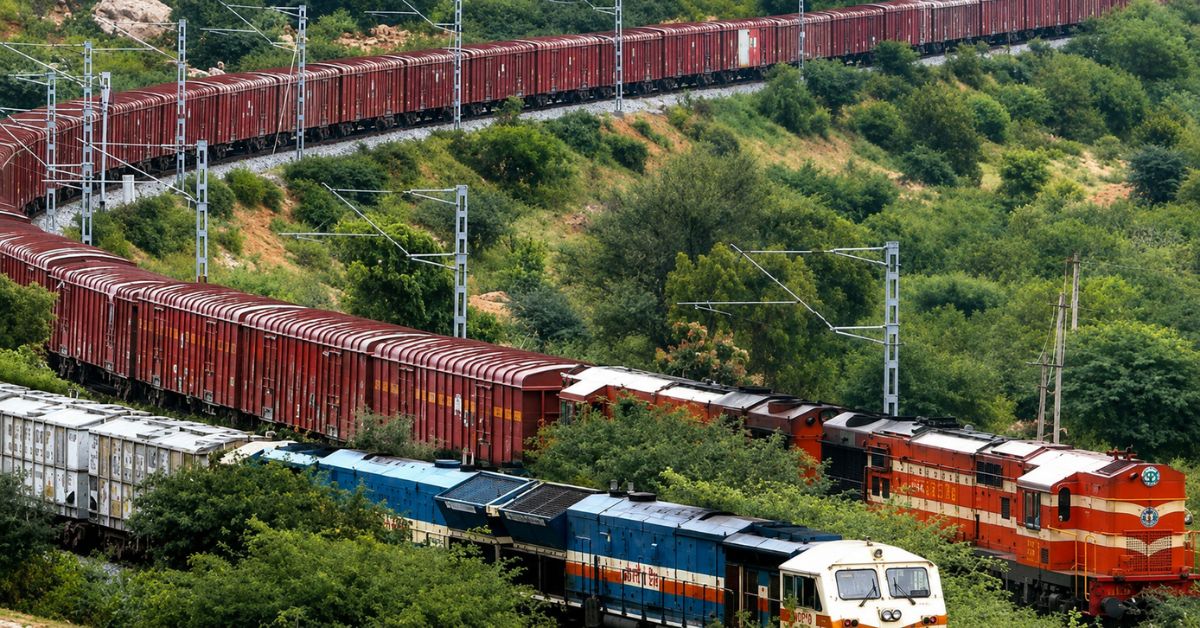

Indian Railways freight loading has climbed steadily from 1,098 million tonnes in 2014-15 to 1,670 million tonnes in 2025-26, with full-fledged Dedicated Freight Corridor operations and the Gati Shakti Cargo Terminal push driving sustained growth, Union Minister for Railways Ashwini Vaishnaw told the Rajya Sabha.
What strategy is driving this freight growth?
Indian Railways has adopted a multi-pronged approach spanning terminal development, wagon investment schemes and specialized parcel logistics to strengthen freight efficiency, regional connectivity and first-and-last-mile solutions. Under the Gati Shakti Multi-Modal Cargo Terminal policy, 142 GCTs have been commissioned so far with an estimated freight handling capacity of 224 million tonnes per annum, mobilising private investment of approximately Rs 10,000 crore. These terminals handled 146 million tonnes of freight during 2025-26 alone.
How has wagon investment expanded rail freight capacity?
Around 275 rakes of special purpose wagons and 397 rakes of general-purpose wagons are currently operational under various private investment schemes covering commodities such as cement, oil, steel and fly ash, expected to improve rail’s modal share in bulk commodities including iron ore and coal. A separate scheme for automobile transportation has around 54 industry-owned rakes in operation. Indian Railways is also expanding door-to-door logistics through its Joint Parcel Product-Rapid Cargo Service scheme, with CONCOR providing such services on the Delhi-Kolkata and Mumbai-Kolkata sectors along with a pilot project at Sonik goods shed.
How much has network capacity expanded over the past decade?
New track commissioning has nearly doubled, rising from an average of 4.2 km per day between 2009-14 to 8.32 km per day between 2014-26, with 36,429 km of new track added in the latter period compared to 7,599 km in the earlier one. As of April 1, 2026, Indian Railways has 514 sanctioned infrastructure projects spanning 40,000 km, comprising 169 new lines, 29 gauge conversions and 316 doubling projects, at a total cost of approximately Rs 8.31 lakh crore, of which Rs 3.05 lakh crore has already been spent covering 12,583 km commissioned.
What role are the Dedicated Freight Corridors playing?
Both the Eastern DFC, spanning 1,337 km from Ludhiana to Sonnagar, and the Western DFC, spanning 1,506 km from Dadri to Jawaharlal Nehru Port Terminal, have been fully commissioned, with around 443 trains operating daily across the corridors. The DFCs have shown robust operational performance, with higher average speeds, faster turnarounds and enhanced reliability, while freeing up additional paths on the conventional network by diverting freight traffic, allowing Railways to run more goods and passenger services. The corridors are expected to further enable Double Stack Container train movement, higher axle load trains and faster hinterland access from western ports. A new Dedicated Freight Corridor connecting Dankuni in the east to Surat in the west was announced in the Union Budget 2026, with preparation of its Detailed Project Report now underway.
What does this mean for Indian Railways’ global standing?
With freight loading reaching 1,670 million tonnes in 2025-26, up from 1,617 million tonnes the previous year, Indian Railways has become the second-largest freight-carrying railway system in the world, reflecting sustained investment across terminal infrastructure, network capacity and dedicated freight corridors over the past decade.
 Join our WhatsApp channel for more updates:
 Subscribe to our YouTube channel for more updates: