


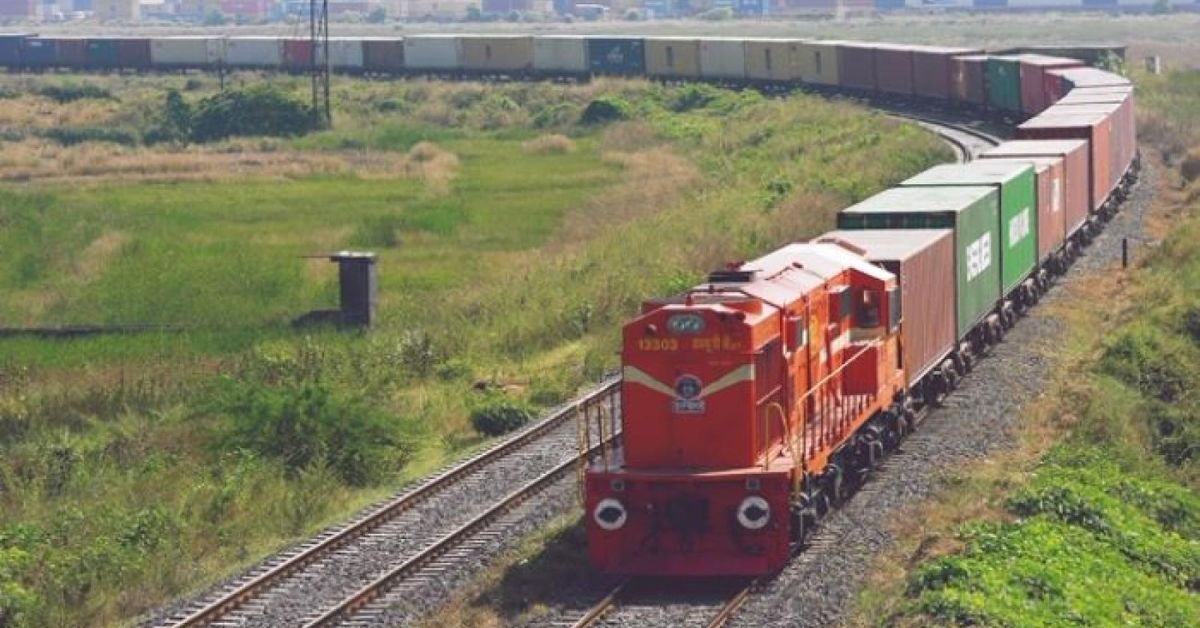

Indian Railways has achieved a record-breaking performance in freight transport during fiscal year 2025–26 (FY26), underscoring its central role in India’s logistics and industrial growth. Provisional figures show that total freight loading reached about 1,670 million tonnes (mt), surpassing last year’s levels and marking the highest-ever annual cargo movement on the rail network. This represents an increase of around 3.25 per cent over the previous fiscal, reflecting sustained demand from core sectors such as steel, cement, fertilizers and iron ore, alongside steady flows of coal and other bulk commodities.
Official data and sectoral reports indicate that the growth trajectory built up steadily through the year, with key monthly milestones achieved in the run-up to the year-end. Up to February 2026, Indian Railways had already handled 1,503.8 mt of freight, registering a 3.28 per cent increase over the corresponding period of the previous year. During February alone, the network moved 137.72 mt of cargo, up nearly 3.96 per cent year-on-year, signalling strong momentum in the closing months of FY26. By January 31, 2026, freight loading had touched 1,366.08 mt, a level the Ministry of Railways described as the “highest-ever” achieved up to that point in any fiscal, underlining the system’s heightened appetite for cargo.
The composition of this record freight basket points to broad-based industrial activity. Traffic in fertilizers, pig iron and finished steel rose by about 13 per cent, highlighting robust demand from agriculture support, construction and manufacturing segments. Iron ore loading recorded growth of 6.73 per cent, while cement volumes increased by 3.41 per cent, both of which are closely tied to infrastructure and real estate expansion. Coal, which remains the single largest commodity for Indian Railways, continued to provide a stable base load for power generation and industrial consumption, even as the network incrementally diversified its freight portfolio.
In value terms, freight transport has also contributed meaningfully to Railways’ financial performance. Up to February 2026, freight revenue stood at about ₹1.61 lakh crore, up from roughly ₹1.58 lakh crore in the same period a year earlier, reflecting growth of around 1.5 per cent. Earlier, Indian Seatrade and other platforms had reported that freight earnings in February alone were approximately ₹14,500 crore, supported by higher movement of coal, cement, foodgrains and fertilizers. While revenue growth has lagged volume growth due to competitive tariffs, concessions and commodity mix effects, the overall performance still strengthens the rail sector’s financial base and its capacity to invest in network upgrades.
Operationally, capacity augmentation and corridor development have been crucial enablers of this freight surge. The Dedicated Freight Corridor Corporation of India Limited (DFCCIL) has steadily ramped up train interchanges with Indian Railways, achieving a record 907 freight train interchanges on a single day on January 26, 2026, surpassing a previous high of 898 trains. This improved integration between the DFCs and the conventional network has enhanced throughput, decongested key routes and allowed faster, heavier freight trains to move more seamlessly across regions. Combined with operational measures such as longer rakes, higher axle loads, better timetable planning and digital monitoring, these interventions have boosted overall efficiency and capacity utilisation.
Looking ahead, projections suggest that freight volumes could continue to climb, with estimates indicating a potential increase to around 1,765 mt in FY27 if current trends hold. This anticipated growth is expected to be driven by ongoing infrastructure spending, rising steel and cement demand, and continued emphasis on rail-based evacuation of bulk commodities from mines, ports and industrial clusters. For India’s wider multimodal logistics ecosystem, the record FY26 performance of Indian Railways reinforces its position as the backbone of long-haul inland cargo movement, providing a lower-emission, cost-effective alternative to road transport and supporting the country’s transition towards more efficient and sustainable freight corridors.
 Join our WhatsApp channel for more updates:
 Subscribe to our YouTube channel for more updates: