




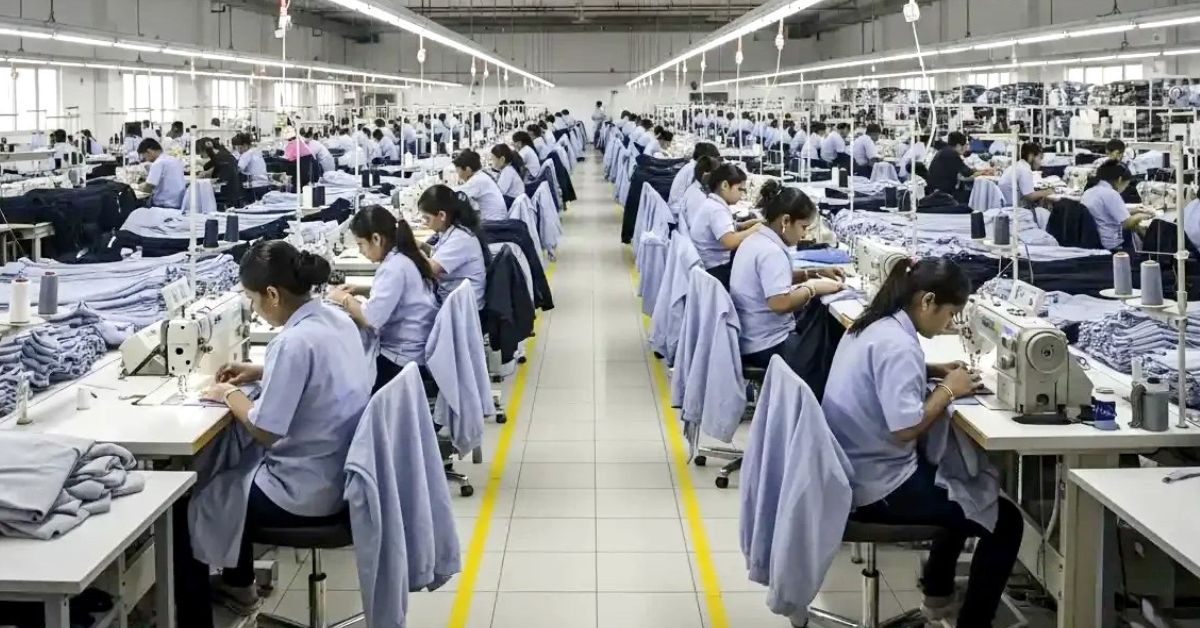

India’s textile and apparel exports increased 17.51% year-on-year to US$3.08 billion in September 2026, supported by growth across cotton textiles, garments and several other product categories. Data compiled by the Confederation of Indian Textile Industry (CITI) showed a stronger monthly performance, although cumulative growth for April–September remained modest at 2.38%.
Industry representatives linked the September improvement to stronger yarn demand and increased sourcing interest from overseas buyers. Gujarat’s textile clusters, particularly spinning mills, were among the beneficiaries of the improvement in orders.
Which textile export categories drove September growth?
Textile exports rose 19.87% to US$1.95 billion, while apparel exports increased 13.68% to US$1.13 billion.
Cotton yarn, fabrics, made-ups, and handloom products together recorded growth of 20.76%, reaching US$1.12 billion. Exports of man-made yarn, fabrics and made-ups increased 11.23%, while carpets grew 19.82%.
Handicrafts excluding handmade carpets recorded a sharper increase of 43.19%. However, jute manufactures, including floor coverings, declined 5.70%, indicating that the improvement was not uniform across the export basket.
Bharat Chhajer, former chairman of the Powerloom Development and Export Promotion Council (PDEXCIL), said cotton yarn exports had risen approximately 20% during September, supporting Gujarat’s spinning industry.
He also pointed to increased sourcing by international brands from Gujarat and other Indian manufacturing centres, linking this interest to India’s trade agreements. His assessment remained positive despite monthly fluctuations in garment exports.
Why does the first-half performance remain mixed?
During April–September 2026, textile exports increased 9.05% to US$10.87 billion. Apparel exports, however, declined 6.19% to US$7.28 billion.
Combined exports consequently reached US$18.16 billion, compared with US$17.74 billion a year earlier. September’s improvement therefore strengthened the overall performance without reversing the cumulative decline in apparel.
Currency denomination also changes the reported growth picture. Combined first-half exports increased 12.80% in rupee terms, substantially faster than their dollar-denominated growth.
For businesses assessing the recovery, the distinction between monthly growth and cumulative performance is important. A strong September does not establish that all manufacturing segments have returned to sustained expansion.
How does this compare with India’s wider export performance?
Commerce Ministry data showed that India’s total merchandise exports increased 23.04% in September and 18.51% during April–September. Textile and apparel exports therefore grew more slowly than overall merchandise trade over both periods.
The ministry nevertheless identified cotton yarn, fabrics, made-ups and handloom products among September’s principal export growth drivers, alongside electronics, petroleum products, chemicals and engineering goods.
For ports and logistics providers, these figures indicate changes in export value rather than a measured increase in container traffic. The data does not establish shipment weights, container volumes or the distribution of cargo between individual gateways.
Which overseas markets and policies support the sector?
The Ministry of Textiles reported in July that textile and apparel exports, including handicrafts, had expanded in more than 100 countries during FY2025–26.
The United States remained the largest destination in its published country table, followed by Bangladesh. Other major markets included the United Arab Emirates, the United Kingdom and Germany, demonstrating the sector’s exposure to both regional manufacturing supply chains and overseas consumer markets.
Government support includes integrated textile parks, production-linked incentives, the National Technical Textiles Mission and export tax-remission measures. The ministry has also identified 40 priority countries for focused export promotion and diversification. These initiatives provide the wider policy context for the sector’s recovery, although September’s figures alone do not quantify their individual contribution.
 Join our WhatsApp channel for more updates:
 Subscribe to our YouTube channel for more updates: