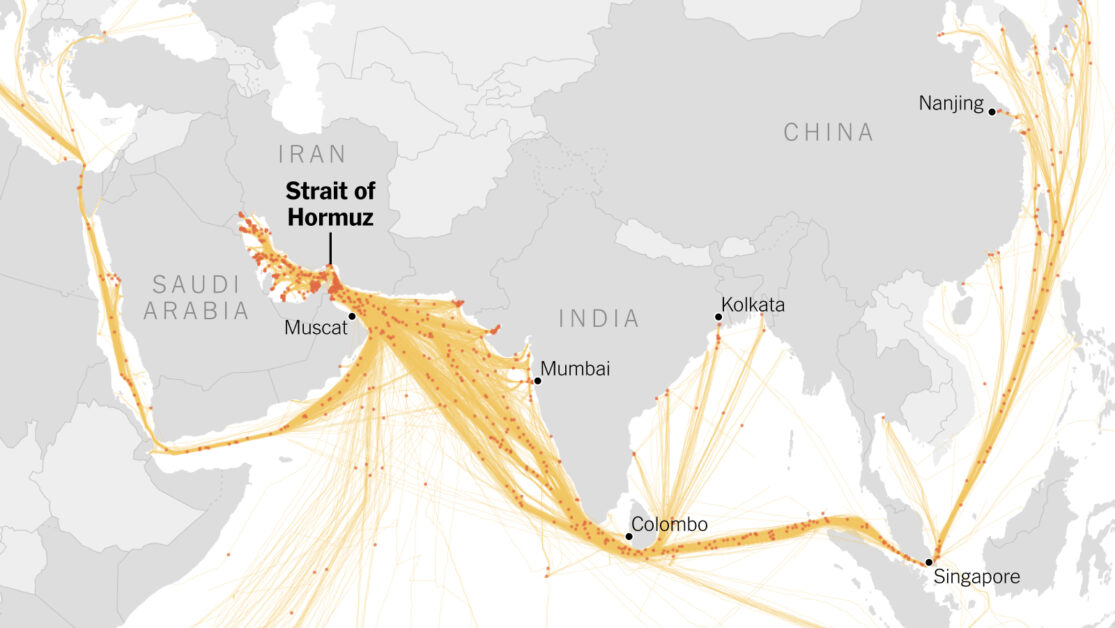

Iran has announced alternative routes for ships transiting the Strait of Hormuz, citing the risk of sea mines in the main channel of the strategic waterway and advising vessels to follow new entry and exit corridors during a temporary truce. The move, communicated by Iran’s Revolutionary Guards, comes as Tehran agrees to partially reopen the strait for a limited period under a two-week ceasefire arrangement linked to the ongoing confrontation with the United States.
According to statements carried by local media and international outlets, Iran has warned that parts of the conventional traffic lane in Hormuz constitute an “area of danger” due to possible sea mines, and has therefore designated alternative navigational routes for merchant vessels. Ships intending to transit the strait have been told to adhere to these updated routes to ensure compliance with maritime safety principles and to reduce the risk of collisions with mines or other hazards. The Revolutionary Guards have reportedly circulated detailed instructions and maps illustrating revised entry and exit lanes through the narrow passage.
The announcement is the latest twist in a crisis that has seen traffic through the world’s most important oil chokepoint drop sharply amid military tensions and attacks on shipping. While Tehran’s agreement to temporarily reopen Hormuz is framed as part of a ceasefire understanding, the introduction of alternative routes under Iranian guidance underscores ongoing security concerns and geopolitical signalling. Shipowners, charterers and insurers now face another layer of complexity in voyage planning, as they weigh compliance with Iranian advisories alongside flag-state guidance, war risk assessments and contractual obligations.
For global trade, any change in navigational patterns within Hormuz has ramifications beyond the immediate Gulf region, given that roughly a fifth of the world’s oil typically passes through the strait in normal times. Tankers and gas carriers in particular must evaluate whether the new routes are adequately surveyed, protected and recognized by key stakeholders, including naval coalitions and international maritime organisations. Questions also arise over how long such adjusted corridors will remain in place and what contingency plans exist if mine threats or hostilities escalate again after the ceasefire window.
For Indian and other Asian shippers, the evolving routing regime in Hormuz adds to an already challenging risk environment shaped by the Red Sea disruptions and increased insurance premiums. Companies will likely lean on updated security briefings, P&I club advisories and real-time traffic data to make routing decisions for crude, LPG and containerised cargoes. As the two-week truce unfolds, the effectiveness and safety record of Iran’s alternative routes will be closely watched by the maritime community and energy markets alike.
 Join our WhatsApp channel for more updates:
 Subscribe to our YouTube channel for more updates: