



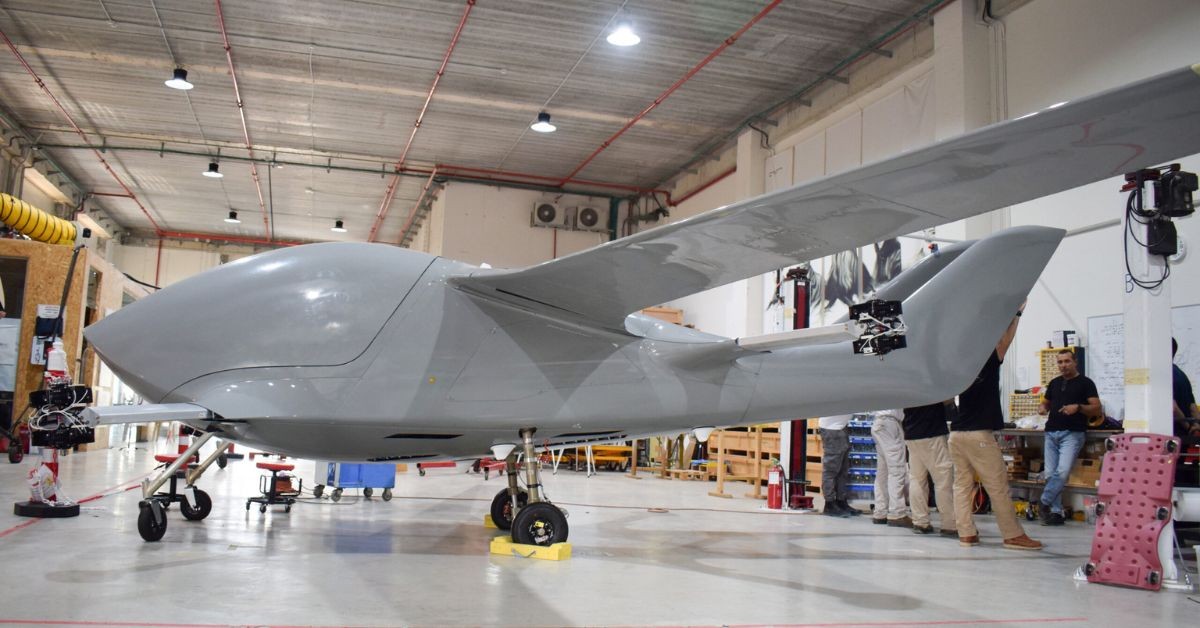

Israeli eVTOL developer Air has begun delivering production-ready electric vertical takeoff and landing aircraft for cargo operations, marking a shift from prototype development to early commercial deployment. The company this week revealed that a heavy-lift, uncrewed cargo eVTOL has already been delivered to an undisclosed customer and is operational.
Air expects to deliver 15 additional cargo eVTOLs in 2025, followed by 18 more units in 2026. Cargo operations have been a key revenue driver for the company, which generated around $1 million in revenue in 2023, largely from demand for its uncrewed platform.
At the same time, Air plans to begin addressing a substantial backlog of roughly 2,900 preorders for its piloted, two-seat Air One aircraft.
Cargo-first strategy
Air’s platform is designed as a dual-use aircraft, available in both piloted and uncrewed configurations. The cargo variant is capable of lifting up to 550 pounds vertically and is aimed at logistics, defense, and humanitarian missions.
The production aircraft features a redesigned airframe developed with EDAG Group, offering increased cargo volume, improved efficiency, and greater range. Foldable wings and motor arms allow for easier transport and deployment, while the shared architecture supports both crewed and uncrewed variants.
Power comes from electric motors supplied by Nidec Motor Corporation of Japan. Air said the production model integrates upgraded batteries, a new electrical and avionics architecture, and redundant navigation and communications systems designed to operate in GPS-denied environments. A fully updated avionics suite supports autonomous and remotely supervised operations.
Both the piloted and uncrewed Air One variants are designed for a top speed of 155 mph and up to one hour of flight time per charge.
Manufacturing and expansion plans
Aircraft are currently being assembled at Air’s 32,000-square-foot manufacturing facility in Israel, which is equipped with a full assembly line capable of producing up to six aircraft simultaneously. The company is also expanding its footprint in the United States following a $23 million funding round in August, aimed at scaling operations and establishing a second, automated production facility.
Although headquartered in Israel, Air has maintained a long-standing presence in Fort Worth, Texas, and continues to deepen its U.S. operations.
Years of operational testing
The newly announced delivery builds on extensive prior flight activity. In late 2023, Air quietly delivered a preproduction cargo eVTOL to a launch customer, which has been flying the aircraft for nearly two years. Those operations included beyond visual line of sight (BVLOS) missions, remote resupply tasks, and integration with ground logistics systems—experience that directly informed the final production design.
Earlier this year, Air also completed what it described as the first night operations of an uncrewed midsize eVTOL, with participation from the same customer. In parallel, the company has accumulated additional flight hours through collaboration with the U.S. Air Force’s Agility Prime program, part of AFWERX.
In September, Air received an FAA experimental airworthiness certificate for a U.S.-based prototype, enabling expanded flight testing in West Palm Beach, Florida.
Path to certification
Air said its first production-ready cargo aircraft will soon conduct a debut flight in Israel and is expected to become operational by early 2026. Subsequent units will be shipped to the U.S. for demonstration and certification activities prior to final delivery.
The company is also advancing certification plans for the piloted Air One, which it intends to certify as a light sport aircraft (LSA). Air has pointed to the FAA’s updated MOSAIC rule as a key enabler, allowing modern technologies such as electric propulsion and fly-by-wire flight controls to be incorporated into the LSA category.
With cargo deliveries underway and certification pathways taking shape, Air is positioning itself to be an early commercial player in the emerging eVTOL market.
 Join our WhatsApp channel for more updates:
 Subscribe to our YouTube channel for more updates: