


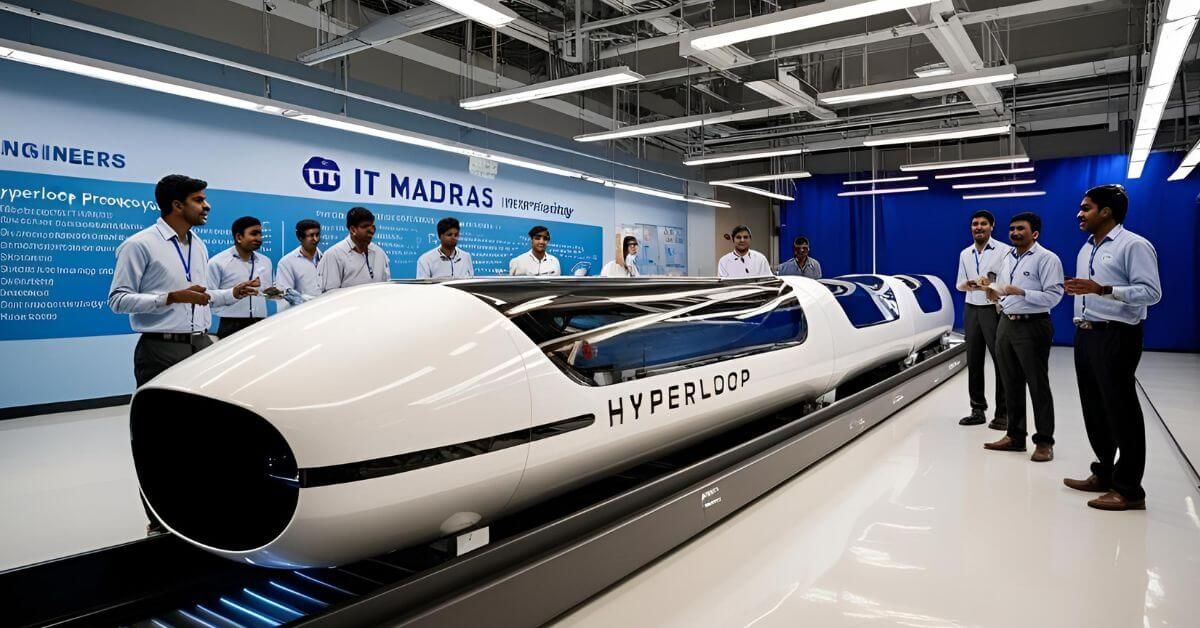

In a global first for hyperloop-based logistics, India has moved beyond pilots and prototypes to place a live commercial order for cargo transport using the emerging technology. The Deendayal Port Authority (DPA) at Kandla has awarded a ₹8.7 crore contract to TuTr Hyperloop, a startup incubated at IIT Madras, to deploy an ultra-fast internal freight movement system within the port.
Under the project, TuTr Hyperloop will develop and operate an electromagnetic cargo transport solution capable of moving 40-tonne containers directly from vessels at berth to internal loading and storage areas located several kilometres inside the port. The system is designed to operate at speeds of up to 200 kmph, significantly faster than conventional truck or rail movement within busy port premises.
Internal cargo evacuation has long been a bottleneck at Kandla, where containers and bulk cargo must travel between three and eight kilometres from quayside to road and rail interfaces. Congested truck movements and saturated rail sidings often slow turnaround times. The new system aims to bypass these constraints by creating a dedicated, high-speed cargo corridor within the port.
In its initial phase, the project will use linear induction motor (LIM) technology, where cargo pods are electromagnetically propelled along a physical guideway. While not yet levitating, the system eliminates conventional traction and is engineered to withstand harsh port conditions, including dust, salt exposure and vibration. Each pod will be capable of carrying between 40 and 100 tonnes, handling both standard containers and difficult-to-move break-bulk cargo such as timber.
Following successful commercial operations with LIM propulsion, TuTr Hyperloop plans to demonstrate full magnetic levitation at Kandla. The startup says the guideway and vehicle architecture are being designed to allow a seamless transition from wheeled LIM operation to contactless levitation, reducing long-term maintenance and mechanical wear.
The cargo pods will be battery-powered, with charging supported by solar installations within the port, aligning the project with DPA’s sustainability goals through lower emissions and reduced dependence on fossil fuels.
Encouraged by the Kandla contract, TuTr Hyperloop is already in advanced discussions with Jawaharlal Nehru Port Authority and Kolkata Port Authority to deploy similar systems. Successful implementation across ports with very different operating conditions would strengthen the case for wider adoption across India’s maritime network.
For Deendayal Port Authority, the project positions Kandla as the first Indian port to implement an indigenously developed electromagnetic cargo transport system validated through 3D scale model testing. Globally, hyperloop technology remains largely confined to experimental tracks and laboratory trials. With this contract, India has taken a decisive step toward real-world commercial deployment—well ahead of many international efforts that remain at the demonstration stage.
 Join our WhatsApp channel for more updates:
 Subscribe to our YouTube channel for more updates: