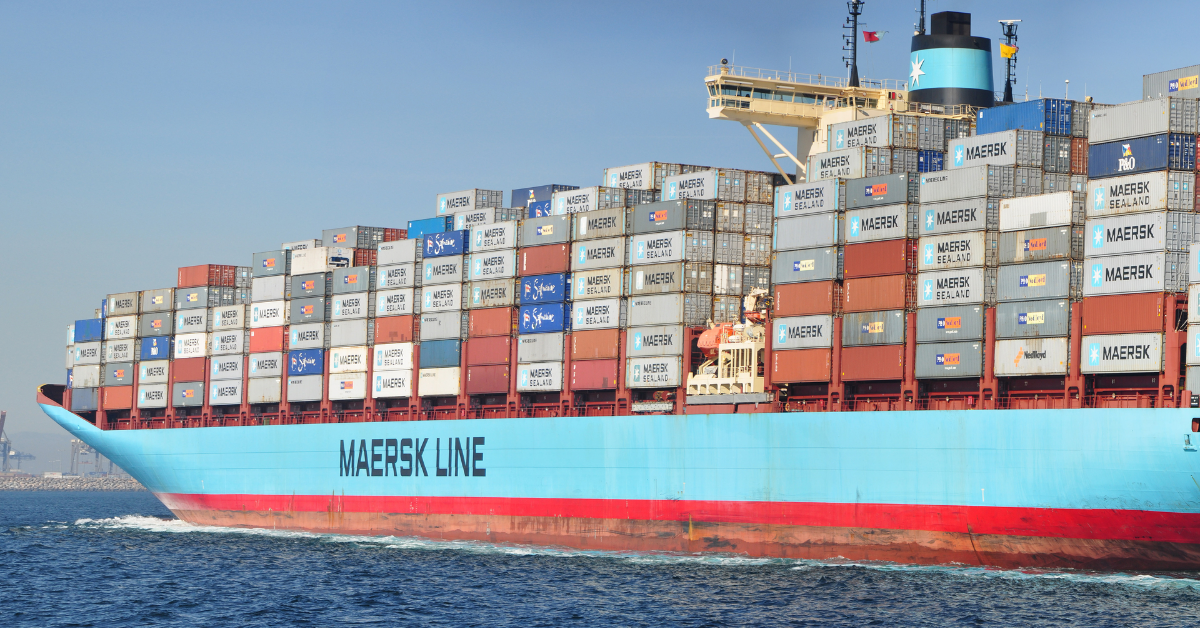

A.P. Moller–Maersk has issued an emergency operational alert to customers as the escalating conflict in the Middle East triggers widespread disruption across key sea and air corridors, including a suspension of sailings through the Strait of Hormuz and tightened restrictions on India–Gulf container flows.
In a series of advisories, Maersk confirmed it has suspended all crossings through the Strait of Hormuz, citing “escalation of security risks in the Middle East region and the effective closure of the Strait of Hormuz,” and warned that services to Arabian Gulf ports face delays, rerouting, or schedule changes. The carrier has also paused Trans-Suez sailings via the Bab el-Mandeb Strait and Suez Canal on select services, rerouting ships around the Cape of Good Hope, adding significant transit time for East–West trades.
For Indian shippers, the most immediate impact comes from Maersk’s decision to suspend all new bookings between the India Subcontinent (India, Pakistan, Bangladesh, Sri Lanka) and Upper Gulf markets including the UAE, Bahrain, Qatar, Iraq, Kuwait, and Saudi Arabia’s Dammam and Jubail, until further notice. At the same time, the line has stopped accepting reefer, dangerous and special cargo in and out of the UAE, Oman, Iraq, Kuwait, Qatar, Jordan, Bahrain, and Saudi Arabia, with limited exceptions for critical foodstuffs, medicines and essential goods.
Maersk also flagged knock-on effects across air and landside logistics, as countries such as the UAE, Qatar, Bahrain, Kuwait, Iraq and Iran temporarily close airspace, forcing flight cancellations and rerouting that could delay Sea–Air shipments and extend transit times. Warehouses in the UAE have been shut temporarily in line with local shelter advisories, and the company warned of potential border congestion and stricter security checks affecting trucking and rail.
The carrier said it is prioritising crew and cargo safety while deploying contingency routings and has introduced an emergency freight increase on affected Middle East routes to cover higher operating costs and constraints. Shippers to and from India, the Gulf and Europe now face longer transit times, higher freight and insurance, and significant schedule volatility as the security crisis reverberates across global container networks.
 Join our WhatsApp channel for more updates:
 Subscribe to our YouTube channel for more updates: