



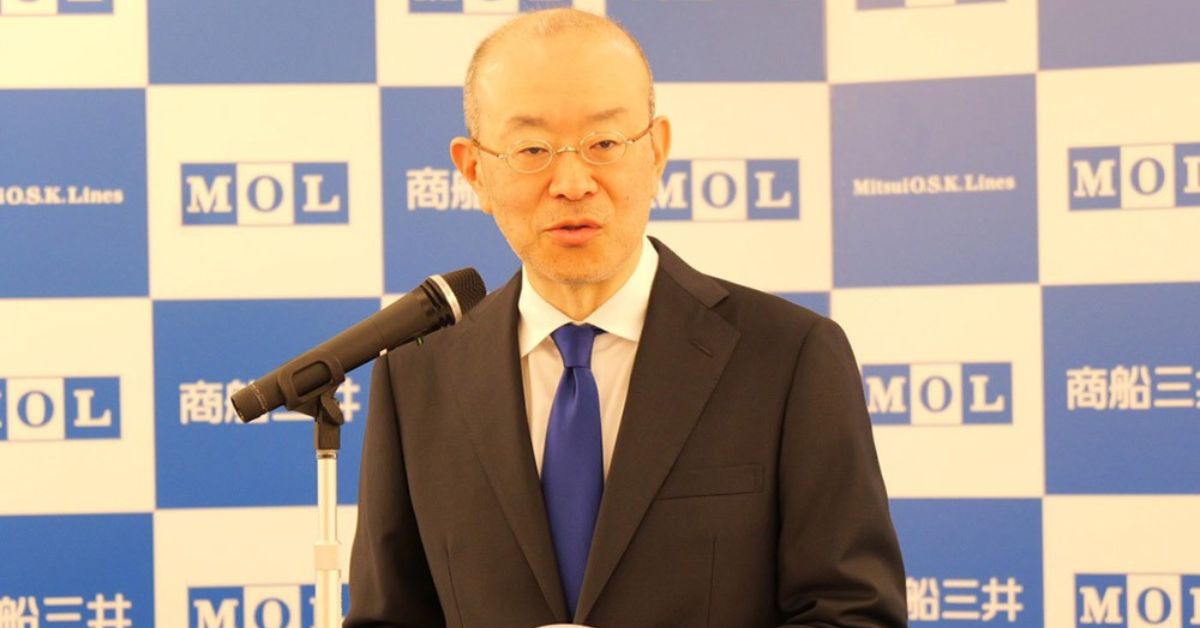

Phase 2 of BLUE ACTION 2035 aims to double profit to ¥420 billion by 2030, with stable revenues increasing from 17% to 30% of earnings.
Mitsui O.S.K. Lines (MOL), one of the world’s largest shipping conglomerates, is entering a new chapter. With Jotaro Tamura assuming the role of President and CEO on April 1, 2026, the Japanese shipping giant is now in the execution phase of a long-term transformation strategy that encompasses everything from LNG infrastructure and cruise terminals to refrigerated warehouses and green energy logistics. Tamura outlined this vision in a presentation at Singapore Maritime Week, offering the clearest picture yet of where MOL is headed under his watch.
A Fleet of Firsts
Any understanding of MOL begins with the sheer breadth of its fleet. The company operates 935 vessels spanning multiple segments. Its 339 dry bulkers rank fourth globally. It’s 211 tankers rank first in the world, a position that places the company squarely in the spotlight whenever Middle East tensions flare. Its 194 LNG carriers are, again, the largest fleet of their kind anywhere on earth. It’s 100 car carriers rank second globally.
Container shipping is handled separately through Ocean Network Express (ONE), the joint venture formed in 2018 alongside NYK and K Line, which operates between 240 and 270 vessels. MOL retains ownership of 30 vessels chartered out to ONE, a distinction Tamura was careful to draw.
Beyond the waterline, MOL has been methodically building businesses in energy infrastructure, offshore operations, real estate, cruise shipping, and air cargo. The fleet is the foundation, but the group’s ambitions now extend well beyond it.
The Plan: BLUE ACTION 2035, Phase 2
MOL’s long-term management blueprint, BLUE ACTION 2035, runs from 2023 to 2035 across three phases. Phase 2, spanning FY 2026 to FY 2030, began on April 1, the same day Tamura took the helm.
“The announcement came out March 31st, and then right after that, I took my new role and this management plan started,” he said. “It’s quite new.”
The plan organises MOL’s businesses into three revenue tiers. At the most volatile end sit market-driven businesses tied to spot and voyage charters. In the middle are hybrid businesses such as dry bulk, tankers, car carriers, and semiconductor logistics, which blend market sensitivity with some degree of income stability. At the most stable end are long-term contract businesses, including LNG carriers, FSRUs, and offshore infrastructure assets.
The main Phase 2 goal is to increase stable revenue businesses’ share from 17% of group profit in FY2025 to 30% by 2030, providing greater income security through a more stable base while retaining performance upside in cyclical segments.
The Numbers Behind the Ambition
MOL’s projected profit after tax for FY2025 is approximately ¥240 billion, with the final result due on April 30. The Phase 2 target is ¥420 billion by 2030, close to double the current level.
To get there, MOL has mapped out a five-year cash plan totalling roughly ¥2,880 billion across inflows and outflows. Core operating cash flow is expected to generate over ¥1,100 billion over the period, with asset disposals and external financing adding approximately ¥170 billion. On the deployment side, ¥830 billion in investments have already been committed, with a further pipeline bringing total planned Phase 2 investment to ¥1,510 billion. The priority within those committed investments is energy, particularly new LNG and LPG carrier newbuildings operating on long-term contracts.
Reflecting greater confidence in earnings predictability, MOL has also raised its shareholder return target. The total payout ratio moves from 30% to approximately 40%, with dividends starting at ¥205 per share in 2026 and rising progressively in line with performance.
“The basic idea is to have a stable return policy for the shareholders,” Tamura said.
Singapore and Southeast Asia: Building Beyond Shipping
A major theme in Tamura’s presentation was MOL’s focus on Southeast Asia as a central pillar of its growth strategy, particularly highlighting Singapore as a showcase of MOL’s expansion beyond traditional shipping.
Tamura was direct about the shift underway. “Ten to twenty years ago, a large portion of our business was still with Japanese customers in Japan. We have to put more effort into the areas where growth is expected. Southeast Asia is actually one of our targets.”
He pointed to three live examples of how that intent is being translated into reality.
The first is logistics infrastructure. MOL has partnered with local operators to develop two warehouses in Singapore. One is a refrigerated facility that Tamura described as the highest refrigerated warehouse in the world, now on the cusp of operations. The second is a fully automated, high-specification warehouse built on a JTC-leased site, designed to serve Singapore’s domestic consumer market. Both are structured as stable, recurring-revenue businesses, aligned precisely with MOL’s Phase 2 earnings strategy.
The second is energy infrastructure. MOL has secured a long-term contract with Singapore’s energy authorities to provide a Floating Storage and Regasification Unit for LNG storage and supply to the national grid. The facility is expected to enter service in 2029, supporting Singapore’s energy security agenda while providing MOL with a predictable long-term revenue stream.
The third, announced at Singapore Maritime Week itself, is a partnership with PSA International to develop a dedicated cruise terminal at Tanjung Pagar. As PSA relocates its container operations to the new Tuas mega-port by 2027, the existing Tanjung Pagar facilities will be repurposed. MOL and PSA will co-develop the site as a cruise terminal, to be branded the MOL-PSA Terminal, targeting a 2027 opening.
Taken together, these three investments offer a practical illustration of MOL’s broader strategic logic: enter adjacent, stable markets, anchor investments in long-term agreements, and build a local presence that reduces dependence on the volatility of pure shipping markets.
A CEO Who Inherits Momentum
Tamura inherits a group with equity capital already at the ¥2.5 trillion level, a clear strategic roadmap, and a portfolio of investments that are beginning to deliver returns. His task is not to redesign the architecture but to ensure the building gets finished on schedule.
The dual pressure he faces is real. On one side, geopolitical turbulence, including Middle East tanker route disruptions, shifting US trade policy, and China-related supply chain questions, continues to create operational complexity. On the other hand, the investments of Phase 1 are maturing, and stakeholders expect those assets to start converting into the stable profits the plan promises.
If Phase 1 was about planting, Phase 2 is about harvesting. Tamura understands both the opportunity and the weight of that responsibility.
 Join our WhatsApp channel for more updates:
 Subscribe to our YouTube channel for more updates: