



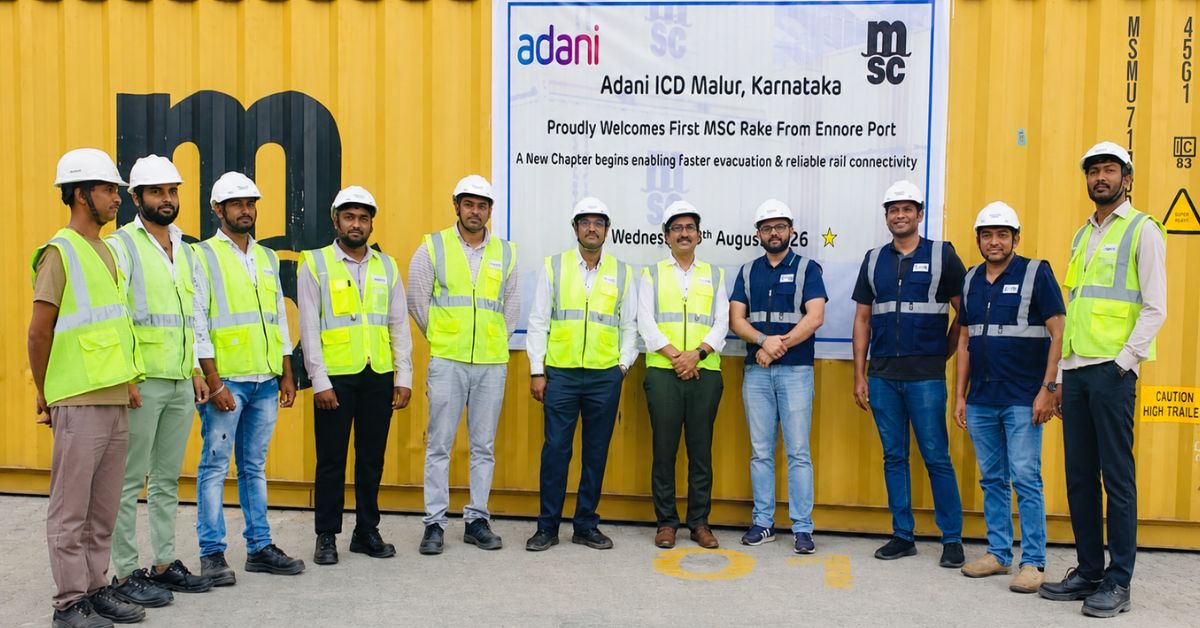

Mediterranean Shipping Company (MSC) has run its first import consignment through Adani’s newly commissioned Inland Container Depot (ICD) at Malur near Bengaluru, with the containers arriving as a single full train rake — a notable step forward for South India’s multimodal freight network.
Why this MSC–Adani milestone matters
The arrival is an operational marker for both carriers and signals rising industry confidence in Malur as an inland gateway for containerised EXIM cargo serving Bengaluru and the wider industrial belt across Karnataka and adjoining states. By moving imports as a complete rake rather than piecemeal, MSC underlines how rail-led inland haulage can offer a steadier, more predictable alternative to long-distance road trucking — precisely as South India’s appetite for rail-connected logistics infrastructure accelerates.
What makes Malur strategically placed as an inland gateway
Sitting on the Bengaluru–Chennai railway trunk line, the Adani ICD is built with a dedicated rail siding plus road access via NE7 and NH44. The depot spans roughly 30 acres, with a further 21 acres set aside for expansion, and carries terminal and gate operating systems, real-time control-tower oversight, warehousing and customs-clearance infrastructure. Adani Ports has folded Malur into its broader multimodal grid, connecting it by rail to gateway ports including Kattupalli, Ennore, Vizhinjam, Chennai and JNPT.
How this builds on Malur’s earlier track record
The facility had already shown its promise earlier in 2026, when it received an inaugural import block train of auto parts under a Maersk–Volvo Group tie-up linking Ennore Port to Malur. This latest MSC movement widens that base, positioning Malur as a shared, carrier-neutral platform able to serve multiple global lines and varied cargo profiles rather than a single-shipper terminal.
What it means for MSC’s inland footprint
For MSC, the first import run through Malur is more than another container train. It marks the line’s deepening inland presence in South India and its ability to link ocean freight directly with a terminal sited close to cargo owners. Full-rake movements help consolidate volumes, lift rail asset utilisation and add predictability to inland transport, while trimming the distance between port gateways and the factories ringing Bengaluru.
Why it matters for Bengaluru and South India’s logistics map
As a hub for manufacturing, automotive, electronics, aerospace and technology, Bengaluru generates steady demand for reliable import and export logistics. The MSC–Adani Malur milestone captures South India’s gradual shift away from purely port-centric cargo flows toward joined-up port, rail, road and inland-terminal networks — with Malur emerging as a key link between the region’s industrial core and global maritime trade.
 Join our WhatsApp channel for more updates:
 Subscribe to our YouTube channel for more updates: