



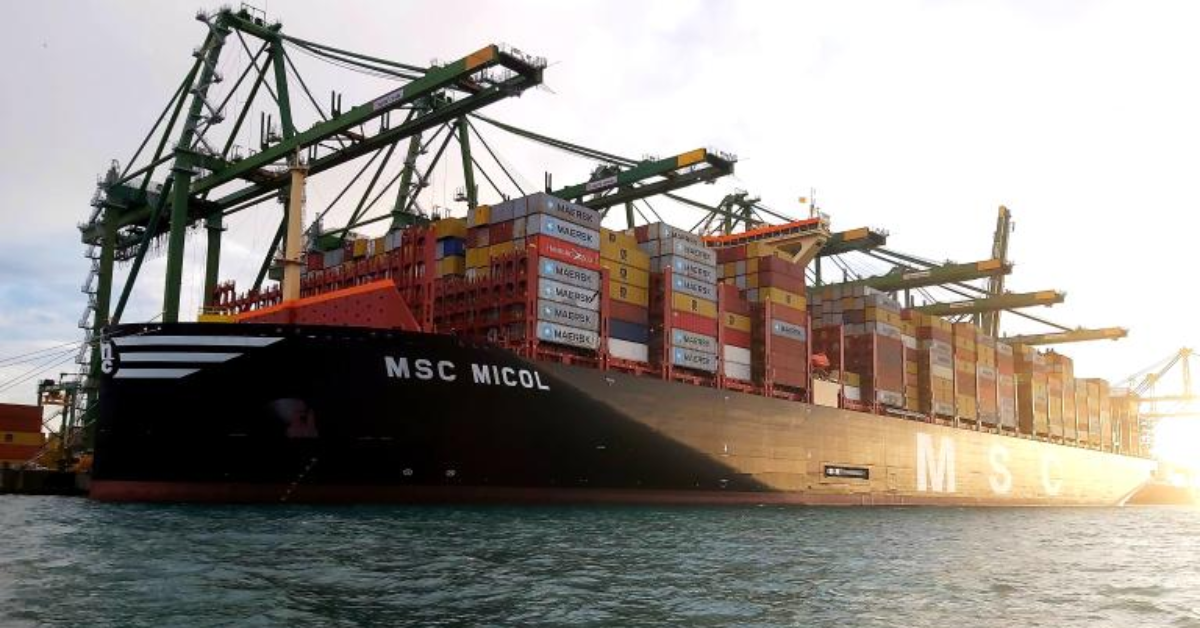

Vizhinjam International Seaport has received the MSC MICOL — one of the world’s largest container vessels, measuring 400 metres in length with a carrying capacity exceeding 24,000 TEUs — in a call that marks one of the most significant operational milestones in the port’s short but extraordinary history. The ultra-large container vessel arrived from Singapore and is scheduled to proceed to Tema in West Africa after completing transshipment operations, placing Vizhinjam in the same company as Colombo, Port Klang, and Singapore as a port capable of handling the world’s largest commercial vessels at mainline service speeds.
MSC MICOL belongs to the Megamax or Evergreen-class tier of Ultra Large Container Vessels — the category that represents the pinnacle of commercial container shipping’s push for economies of scale. At 400 metres, it is longer than four football pitches. At 24,000-plus TEUs, it can carry more than six times the cargo of the standard-size vessels that called at Indian ports just a decade ago. Successfully handling a vessel of this class requires not only the natural deep draft of over 20 metres that Vizhinjam’s geological formation provides, but also the quay crane outreach, yard management systems, tug capacity, and operational precision that allow the vessel to complete its port call within the tight schedule windows that MSC’s mainline East-West service demands.
Why This Call Matters Beyond the Numbers
The MSC MICOL call carries significance that extends beyond the impressive physical statistics. Vizhinjam’s commercial model is built entirely on MSC’s confidence in the port as a reliable, efficient mainline hub on the East-West trade lane between Singapore/Asia and the Mediterranean/Europe. Each successful ultra-large vessel call validates and deepens that confidence, making it progressively less likely that MSC would reverse or redirect its Vizhinjam commitment. The Colombo transshipment hub — which previously captured the vast majority of Indian Ocean transshipment that now flows through Vizhinjam — achieved its global reputation and commercial scale through exactly this kind of sustained ULCV handling track record, accumulated call by call over years.
The MICOL call also provides live operational data for Vizhinjam’s Phase II expansion planning, which APSEZ has fast-tracked in response to surging transshipment demand. The experience of handling a 24,000 TEU vessel — the logistics of positioning 400 metres of ship at the quay, managing the crane intensity across multiple positions, planning the yard movements for thousands of transshipment boxes, and coordinating the feeder vessel schedule that distributes those boxes onward to Indian and regional ports — directly informs the berth dimensions, crane specifications, and yard layout that Phase II will need to accommodate the vessel classes of the 2030s.
Singapore to Tema: Vizhinjam’s Emerging Role in India-Africa Transshipment
The MICOL’s routing — from Singapore, calling at Vizhinjam, then proceeding to Tema in Ghana — is commercially revealing. This is an East-West mainline vessel simultaneously serving the Asia-South Asia-Africa trade arc, using Vizhinjam as a hub where Indian Ocean and Indian subcontinent cargo is transshipped onto and off the mainline service. West Africa is India’s fourth-largest trade region by volume, and Indian exports to Ghana, Nigeria, Côte d’Ivoire, and Senegal — dominated by pharmaceuticals, textiles, machinery, and processed foods — can now route through Vizhinjam rather than through Colombo or Singapore, reducing transit times and improving logistics costs for Indian exporters to the African west coast. The MICOL call makes this routing commercially viable at mainline vessel scale.
 Join our WhatsApp channel for more updates:
 Subscribe to our YouTube channel for more updates: