



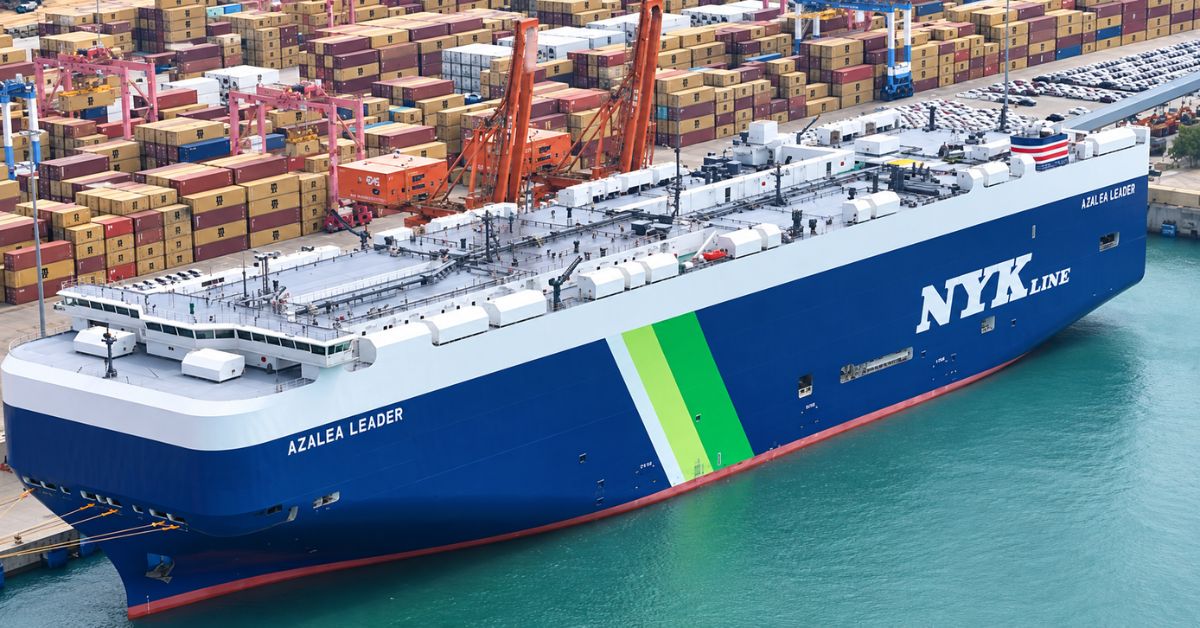

NYK’s Azalea Leader, a new-generation LNG dual-fuel Pure Car and Truck Carrier (PCTC), made its maiden call at Hambantota International Port (HIP) recently, marking another significant development in the port’s growing role as a regional automotive transhipment gateway.
Built in 2026 and sailing under the Liberian flag, the nearly 200-metre Azalea Leader arrived at HIP from Singapore, carrying 4,810 vehicles for transhipment and another 47 units for local discharge. The vessel has a maximum carrying capacity of 7,000 units and is among the latest generation of vehicle carriers entering service globally.
NYK operates regular services connecting Singapore and Hambantota, with Azalea Leader assigned to the route for this voyage. Its call comes as vehicle volumes routed through Hambantota to markets in the Middle East have grown significantly, reinforcing the port’s strategic position connecting automotive supply chains across Asia and the Middle East. The vessel also represents the shipping industry’s transition towards more efficient and lower-emission tonnage, powered by LNG dual-fuel technology and incorporating Exhaust Gas Recirculation (EGR) technology on its main engine to reduce nitrogen oxide (NOx) emissions.
Wilson Qu, CEO of Hambantota International Port Group (HIPG), said the maiden call of Azalea Leader is significant because shipping lines are increasingly deploying their newest and most sophisticated vessels through Hambantota, demonstrating the pivotal role HIP is developing in the regional RoRo sector and showcasing the port’s potential as automotive volumes continue to grow. He said handling vessels of this generation also demonstrates the operational capabilities HIP has developed, noting that customers need assurance that a sophisticated vessel will be handled efficiently, safely and without unnecessary idle time, and that the confidence to bring modern tonnage such as Azalea Leader to HIP reflects the capability of the port’s people, systems and infrastructure in meeting those expectations.
HIP has been steadily strengthening its position as a regional RoRo transhipment hub, leveraging its strategic location along major east-west shipping routes and its connectivity to automotive markets in the Middle East and beyond. The increasing volume of vehicles routed through the port has contributed to the growth of HIP’s overall vehicle-handling business.
Qu said that as international shipping moves towards larger, more efficient and environmentally advanced vessels, ports must evolve alongside them, adding that the ability to handle these vessels to international standards strengthens Hambantota’s visibility within global automotive logistics networks and supports the port’s long-term strategy of establishing HIP as a key gateway for regional vehicle transhipment.
 Join our WhatsApp channel for more updates:
 Subscribe to our YouTube channel for more updates: