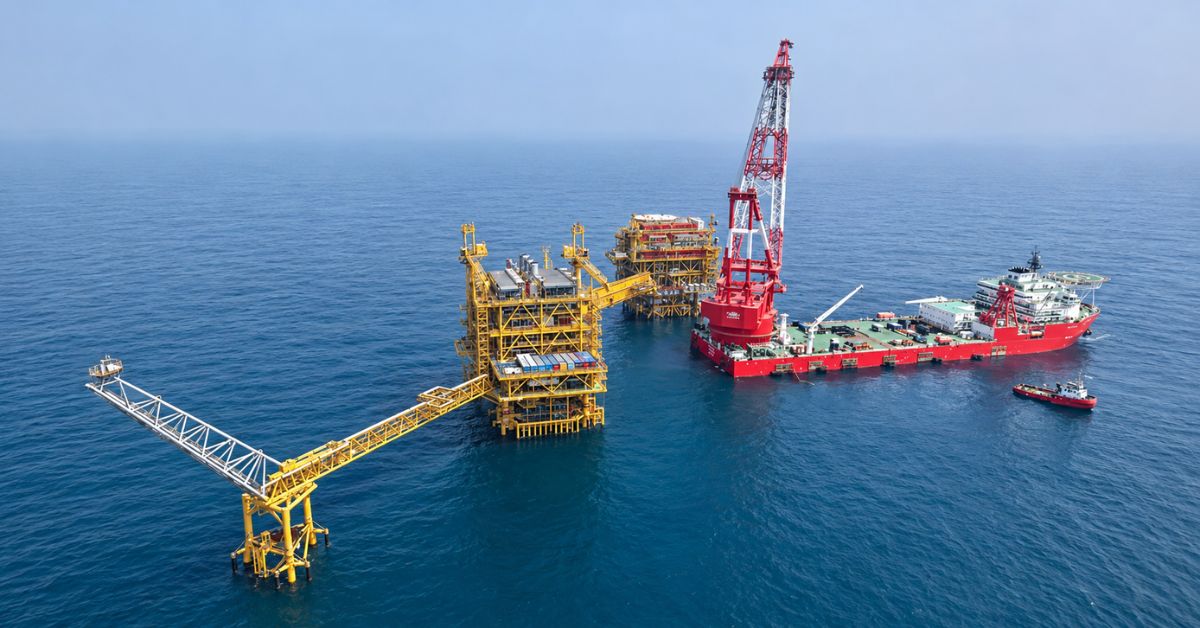

Oil and Natural Gas Corporation (ONGC), BP and Reliance Industries Limited (RIL) are reportedly examining a shared offshore infrastructure facility costing around US$1 billion in the Mahanadi basin. The proposal would support production and evacuation of natural gas and condensate from deepwater and ultra-deepwater discoveries off India’s east coast.
The discussions, reported on 9 November and attributed to two industry executives, remain preliminary. The Ministry of Petroleum and Natural Gas is understood to have proposed the initiative, with technical consultants expected to be appointed. The companies and ministry have not publicly confirmed the investment.
What infrastructure is being considered?
The proposed facility would allow operators to pool production rather than build separate infrastructure for individual discoveries, potentially improving the economics of smaller fields.
A decision has yet to be taken between a floating production, storage and offloading facility and a fixed offshore installation. Natural gas would be the principal product handled, alongside condensate.
The reported development estimate is at least three to four years, rather than a confirmed commissioning schedule. Under the model being considered, developers could jointly establish infrastructure and allow other producers to use it for a fee.
Why is the Mahanadi basin attracting attention?
ONGC’s recent exploration results provide context for the discussions. On 18 September 2026, the company discovered gas in well MN-DW18-1-H-D in the Mahanadi Offshore Basin, approximately 43 kilometres off Konark, Odisha.
Drilled under the Samudra Manthan initiative, the well reached a target depth of 1,623 metres and encountered gas in the 1,441–1,452-metre interval. ONGC subsequently reported encouraging flows and sustained reservoir pressure.
The company said proximity to the coast offered potential for early monetisation, subject to further appraisal and commercial evaluation. It specifically identified the discovery, together with other finds nearby, as a possible candidate for development through shared facilities.
Drilling began on 25 July 2026. ONGC’s September announcement did not establish a commercial production timetable, keeping appraisal and development decisions as separate stages.
How does this build on existing offshore cooperation?
ONGC and Reliance signed a separate resource-sharing agreement on 27 January 2026 covering deepwater exploration and production operations on India’s east coast, particularly the Krishna Godavari basin and Andaman offshore.
That agreement provides for potential sharing of processing facilities, drilling rigs, marine vessels, power infrastructure, pipelines, logging and well services. Its maritime scope includes tugs and platform supply vessels, alongside other offshore support assets.
The companies identified lower costs, reduced duplication and better utilisation of specialised equipment as intended benefits. They also envisaged faster mobilisation of scarce deepwater services and shared emergency-response and training capabilities.
Their joint announcement linked the arrangement to the infrastructure-sharing framework enabled by the Oilfields (Regulation and Development) Amendment Act, 2025. This existing agreement establishes a broader cooperation mechanism, but does not constitute approval of the proposed Mahanadi facility.
Where else are the three companies working together?
ONGC, BP and Reliance already have a joint operating agreement for exploration block GS-OSHP-2022/2 in the Saurashtra basin off India’s western coast.
Signed on 28 July 2025, that agreement covers approximately 5,454 square kilometres, with ONGC designated as operator. The block was awarded under the ninth bidding round of the Open Acreage Licensing Policy.
The Saurashtra partnership concerns exploration in a different basin. The Mahanadi discussions would extend cooperation into shared production infrastructure, if the technical assessment and subsequent investment decisions support development. For now, the proposal remains an option under examination rather than an awarded offshore construction project.
 Join our WhatsApp channel for more updates:
 Subscribe to our YouTube channel for more updates: