



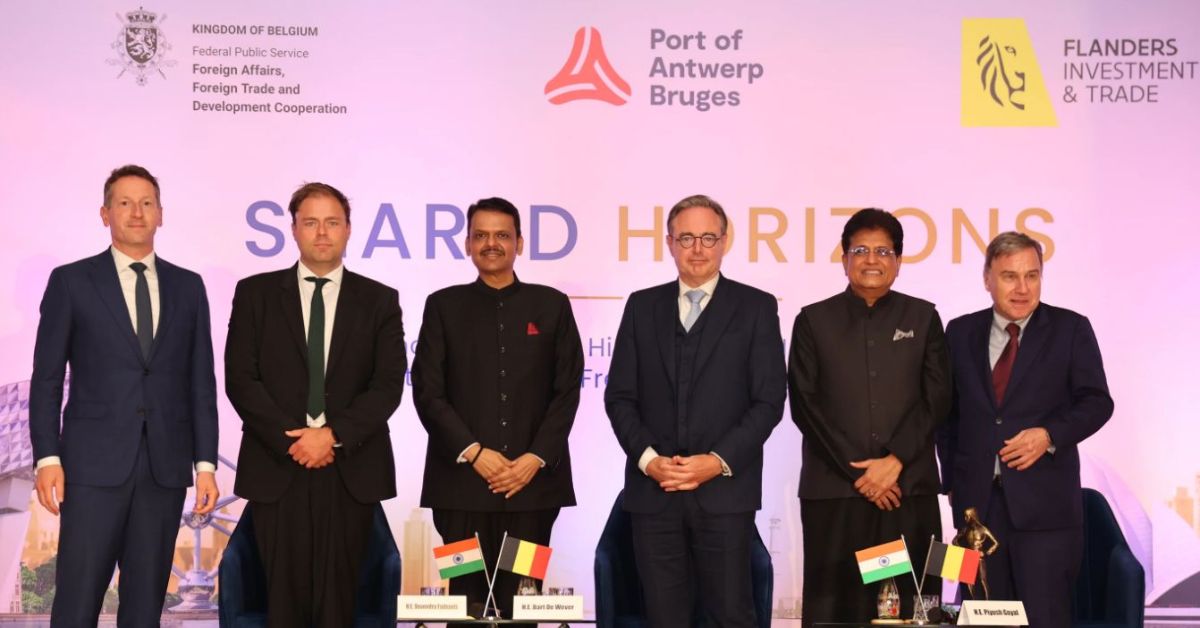

Belgian Prime Minister Bart De Wever pitched the Port of Antwerp-Bruges as a gateway for Indian exports into the wider European market, as the India-EU Free Trade Agreement opens up greater market access and lowers tariffs on goods traded between the two sides.
Addressing the India-Belgium High-Level Dialogue on the India-EU Free Trade Agreement in Mumbai, De Wever said Antwerp-Bruges’ location gives exporters access to a large share of the European market. “Two-thirds of the European purchasing power is in trucking range of Antwerp. What arrives in our city is not at the edge of the European market; it is inside the European market,” he said. He added that the trade agreement could provide the foundation for substantially expanding commercial links between India and Belgium.
De Wever highlighted the existing role of Antwerp-Bruges in handling Indian food and pharmaceutical shipments into Europe. “Almost all Indian shrimp entering Northwest Europe comes in through the port of Antwerp,” he said, adding that Belgium could become a wider entry point for Indian food products into the European market. On pharmaceuticals, he said Antwerp-Bruges offers specialised cold-chain infrastructure. “The port of Antwerp is the first port in the world to guarantee an unbroken cold chain. The entire logistics chain for medicines runs from quay to warehouse without a single interruption,” he said. He also identified maritime infrastructure, dredging and green hydrogen as areas with scope for greater cooperation, noting that India is opening maritime services and dredging further than in any previous trade agreement, and that Belgian dredging and infrastructure companies already have experience working in India.
In 2025, the Port of Antwerp-Bruges handled 6.3 million tonnes of goods originating from or destined for India, making it the third-largest trade partner for breakbulk and the seventh-largest for containers. The port has maintained a permanent presence in Mumbai since 2006 and is celebrating 20 years of operations in the country this year. Beyond cargo flows, the Port of Antwerp-Bruges also supports India’s port sector through training, knowledge exchange and expertise in areas including port management, digitalisation, nautical operations and sustainability.
William Demoor, Chief Customer Relations Officer at Port of Antwerp, said India has been a crucial trade partner for the Port of Antwerp-Bruges for many years, and that there is still significant potential to build on. He welcomed the agreement between Prime Minister Narendra Modi and De Wever to enhance cooperation between the Antwerp/Flanders Port Training Centre and the Jawaharlal Nehru Port Authority (JNPA). Maharashtra Chief Minister Devendra Fadnavis also proposed that the two sides explore a formal Mumbai-Antwerp economic partnership involving governments, ports, chambers of commerce and industry.
De Wever announced that a full delegation from the Antwerp-Bruges port community, including companies from terminals, logistics, chemistry and energy, would visit India in February next year. “We are not coming to discuss what we might do. We are coming to agree on what we are going to do together,” he said.
During Modi’s meeting with De Wever, the two countries set a target of doubling bilateral trade over the next five years. They also signed a Letter of Intent on Defence Cooperation and a separate MoU between the Belgian Security and Defence Industry Association and the Society of Indian Defence Manufacturers to strengthen industrial cooperation. India-Belgium bilateral trade stood at USD 10.92 billion in 2025-26, according to the Ministry of External Affairs.
 Join our WhatsApp channel for more updates:
 Subscribe to our YouTube channel for more updates: