




India’s Maritime Growth: A Sector at an Inflection Point
India’s Maritime Growth: A Sector at an Inflection Point. With expanding defence fleets, port infrastructure, increasing offshore activity and a renewed focus on indigenous shipbuilding, the scale of opportunity is significant in the maritime sector — but so is the complexity.
As this evolution unfolds, expectations from marine power systems are shifting decisively. The industry is moving beyond standalone equipment towards integrated, resilient and mission-critical solutions — designed not just to perform, but to adapt to increasingly dynamic operational and energy environments.
Evolving Expectations: Redefining Marine Power Systems
Modern vessels — across defence, offshore and commercial applications — are becoming more advanced, interconnected and performance-driven. This is driving multiple structural and fundamental shifts.
- The first is a move from main equipment to integrated systems, where propulsion, auxiliary power and control systems must function as a unified, intelligent ecosystem.
- The second is a shift from performance to lifecycle value, where uptime, maintainability and cost optimisation are as critical as output.
- The third is the transition from standardisation to customisation, with solutions increasingly engineered around specific mission profiles and operating conditions.
In parallel, evolving fuel and emission norms are adding a new dimension to marine power system design. Increasing regulatory focus is driving the adoption of cleaner fuels, advanced after-treatment technologies such as Selective Catalytic Reduction (SCR) and hybrid solutions — requiring systems to balance compliance with performance, efficiency and operational flexibility. Together, these shifts are redefining what it takes to deliver effective marine power solutions.
Defence Programs: Where Standards Are Defined
Nowhere are these expectations more rigorously tested than in naval applications. In such environments, reliability is absolute, compliance is stringent and performance must be consistent under the most demanding conditions. Defence programs, therefore, do not just reflect industry standards — they define them. Gmmco Marine’s role in the Diving Support Vessels (DSVs) project for the Indian Navy is a case in point.
To meet the shipyard’s requirement for a Propulsion System Supplier and Integrator (PSS&I), Gmmco delivered fully integrated propulsion and power solutions, including high-capacity Cat® DG sets of 2000 ekW and 3000 ekW units.
The project required adherence to stringent standards such as DEFSTAND, MIL standards, EMI/EMC compliance in line with applicable MIL standards, JSS55555 and Navy policy letters for stringent transient performance of diesel alternators — underscoring the level of engineering precision and execution discipline required. Leveraging Caterpillar’s proven technology, the propulsion system was fully designed, integrated and engineered in-house. Subsequent engagements across projects such as Next Generation Offshore Patrol Vessels (NGOPVs), Cadet Training Ships (CTSs), Retrofit projects for the Navy frigate and Fast Patrol Vessels (FPVs) further reinforce a broader shift from vendors supplying components to partners owning system-level outcomes.
From Complexity to Capability: Delivering at Scale
The demands of marine — particularly in defence — represent some of the most complex and exacting requirements for any power system. It is within this environment that true engineering capability is both tested and proven.
Delivering this level of precision consistently — and at scale — requires more than domain expertise; it demands the ability to operate seamlessly across systems, applications and industries. Gmmco’s strength lies in this integration. With capabilities spanning sectors such as oil & gas, data centres, industrial, pharmaceuticals, infrastructure, manufacturing and mining, Gmmco brings a cross-industry perspective that enables it to address power requirements holistically rather than in isolation.
This extends to hybrid energy solutions, where conventional power systems are integrated with Solar and Battery Energy Storage Systems (BESS). It also includes emission-compliant configurations with advanced after-treatment solutions — enabling greater efficiency, flexibility and resilience while supporting regulatory compliance in complex operating environments.
Backed by Gmmco’s legacy of engineering excellence, customer support and long-standing partnership with Caterpillar, Gmmco Marine reflects the company’s larger commitment to enabling progress through dependable, future-ready solutions. This capability is underpinned by a strong nationwide backbone that combines scale with deep technical expertise. Supported by over 50 years of experience, a workforce where 60% is dedicated to product support, 25% to engineering and design and state-of-the-art infrastructure integrated with advanced technologies, Gmmco delivers solutions that are engineered, executed and supported across their entire lifecycle.
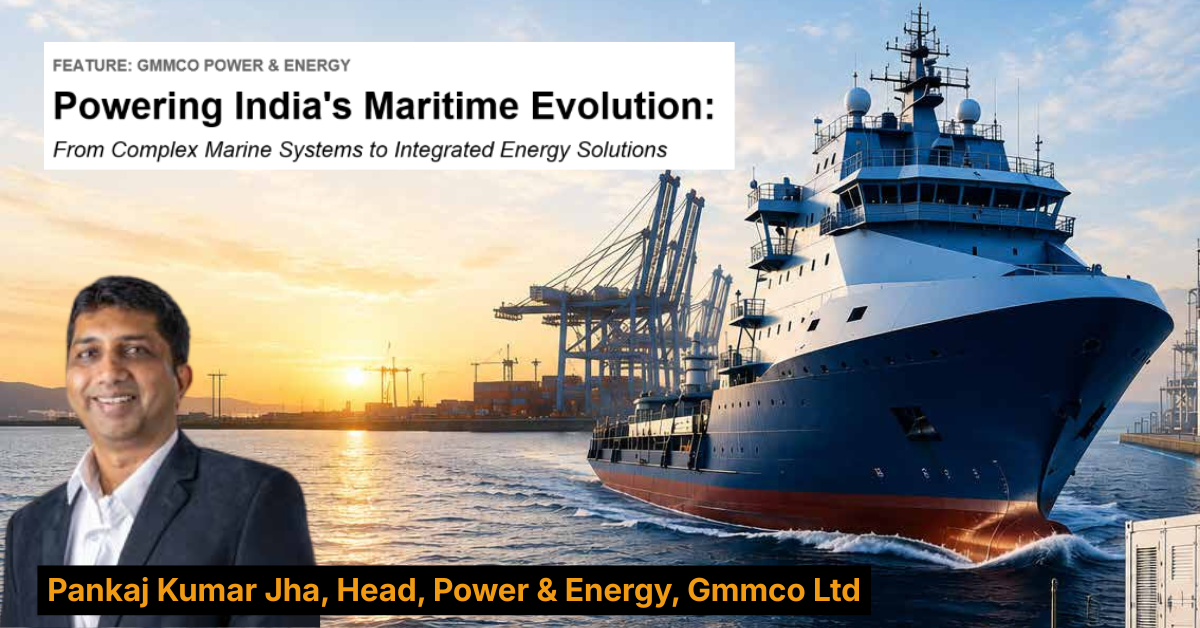
“In an industry where failure is not an option, the path forward is clear: moving beyond products to integrated, dependable and future-ready solutions that not only power operations but enable long-term performance and resilience.” – Pankaj Kumar Jha, Head, Power & Energy, Gmmco Ltd
Powering the Next Phase of Maritime Growth
As the maritime and energy landscape continues to evolve, expectations from solution providers will only become more demanding. The ability to combine engineering precision, system integration and execution at scale will define the next phase of industry leadership. Organisations that can deliver reliably in the most demanding environments — while adapting to changing energy dynamics — will shape the future of maritime operations and the broader industrial ecosystem.
 Join our WhatsApp channel for more updates:
 Subscribe to our YouTube channel for more updates: