


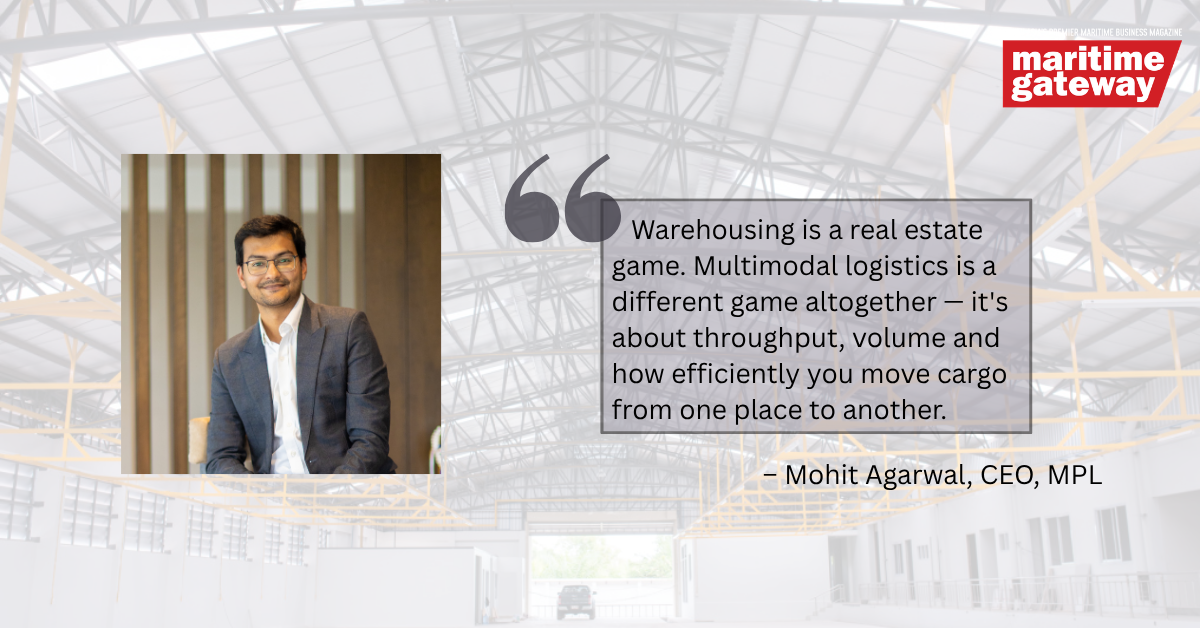

MPL CEO Mohit Agarwal, talks to Kalpana Pandey on why the Hyderabad–Vijayawada corridor is the missing spine of South India’s logistics map, why most multimodal logistics parks in the country underperform, and how the Chityal project aims to put Telangana’s farmers, exporters and industry on a rail-first, cold-chain-ready footing.
The Hyderabad–Vijayawada corridor is emerging as one of South India’s most closely watched logistics stretches — the link between Hyderabad’s manufacturing and consumption base and the ports of both coasts. MPL has staked much of its growth on it: a multimodal logistics park coming up at Chityal, on the South Central Railway line, built first for MPL’s own captive cargo and now being opened to the wider market. In this conversation, MPL’s CEO spoke about containerisation, the gap between government intent and ground infrastructure, why most multimodal logistics parks in India underperform, and what Chityal is designed to fix.
The Hyderabad–Vijayawada corridor is fast emerging as a key logistics spine in South India. How do you see freight flows evolving here over the next five to ten years, and what’s the biggest gap between policy and infrastructure today?
Hyderabad is actually a very big fit for a corridor in South India — it’s the eastern spine for the southern Deccan. Think of it as a peninsula play: a big node connecting a landlocked region to the ports, linking Hyderabad’s consumption and manufacturing base to the east coast. Today the flow is predominantly road-based and very fragmented — one or two units here, one or two there, nothing co-located.
Over the next five to ten years I expect that to change. First, containerisation will rise sharply once ICD facilities and the logistics infrastructure that’s currently missing come up — that includes containerisation of domestic cargo like foodgrains, wheat, granite, stone and steel, all of which are dominant in eastern Telangana. Second, rail’s modal share will increase, so railway earnings should start doubling, and with the line itself being doubled, traffic handling will be smoother and faster. Third, the aggregation base — which today sits on the western side because of the natural trade flow to JNPT — will shift east as well. We’ll see multiple aggregation hubs in key production and consumption areas, and that’s essentially what we’re trying to build at Chityal.
On policy: the Telangana government is pushing hard for logistics infrastructure, but by the LEADS (Logistics Ease Across Different States) report, it’s still behind states like Haryana and Delhi-NCR, which are far more robust. Telangana is learning from them, and I think that gap will close.
Bhogapuram airport is increasingly being talked about as a potential air-freight base, especially for pharma exports. Could it play a role similar to what Navi Mumbai plays on the west coast?
Absolutely — that’s exactly what’s being attempted, and it would help a great deal with pharma exports out of the region.
MMLPs elsewhere in the country have often underperformed or stayed underused. What structural shifts are needed to move from a warehousing-led model to a truly integrated multimodal logistics ecosystem?
There’s a basic misunderstanding between investors and developers here. Warehousing is typically a real estate game. Multimodal logistics is not — it needs someone who understands the business of moving goods from one place to another and providing value-added services around it. That’s a completely different skill set, and it’s one of the reasons many MMLPs across India aren’t fully operational: they’re being developed by real estate players, and the operating mindset that multimodal logistics demands just isn’t there.
A few structural shifts need to happen. One is aligning rail-adjacent industrial land parcels — the Telangana government is actually working on this; two weeks after our first industry conference, I was called in to help think through a similar facility for another logistics-industrial project the state was building. Second, securing the right regulatory licences: the government has been proactively helping us pursue our ICD licence, and we’ve signed an MoU with the state for a multimodal logistics park worth roughly ₹700 crore over the next five years. It took time for that file to move through Delhi, but it happened, and it adds real weight to our proposal.
Telangana is a naturally viable location — it connects to both the eastern and western ports, and land here is cheaper than in the west, which matters because land cost is what makes or breaks the viability of an industrial or warehousing project. The government is also now aligning new industrial land allocations alongside railway infrastructure, which will bring logistics costs down further.
Eastern Telangana is dominated by agriculture and MSMEs. How critical is integrated infrastructure — cold chain, ICDs — to unlocking supply chain efficiencies there?
Telangana is dominated by agricultural exports, much like Punjab — a lot of rice and wheat moves out of here, and today growers truck it hundreds of kilometres to Kakinada, Visakhapatnam or Chennai because there’s no facility within even 100 kilometres, even within the state. That’s why we set up at Chityal — we’re in the rice bowl of Telangana, Nalgonda district, where the bulk of the state’s rice is grown. Once our ICD is up and running, a small farmer will know his produce can be sold there within a day. Today he has to go through a big aggregator, who trucks it to Kakinada and waits on vessel schedules — sailings there are infrequent, so cargo has to be aggregated in bulk before export. Cutting that distance and that dependency gives farmers real price realisation and removes a lot of middlemen from the chain. They’re the backbone of India and deserve that.
It’s the same story on cold chains. Chillies and pharma cargo both need temperature control, and this region exports a few lakh tonnes of chillies a year without world-class cold storage — what exists is fragmented, over-utilised and below export standards. Quality suffers as a result, and that’s part of why we’ve seen produce like mangoes returned on inspection by overseas buyers. Integrated cold chain facilities closer to the production areas would fix a lot of that and materially improve exporters’ competitiveness.
With ports and existing ICDs facing rising congestion, how can inland logistics hubs help reshape cargo movement out of Hyderabad and Telangana?
Dry ports and ICDs were designed precisely to decongest ports — you move the processing inland, and containers go straight to the ship’s side. Telangana is actually export-oriented rather than import-oriented, so there’s a structural imbalance: more containers going out than coming in, which makes container availability a real challenge. Dry ports let shipping lines rebalance empty container inventory across multiple ports, which matters a great deal for a landlocked state.
A lot of Hyderabad’s export cargo travels 500–600 kilometres to Chennai, Mumbai or even Mundra — and beyond roughly 500 kilometres, rail becomes considerably cheaper and more economical than road. That’s also where the sustainability case for rail comes in: Indian Railways has the largest rail network in the world, with close to 100% electrification — an advantage even China doesn’t have.
Digitalisation and sustainability keep coming up as the defining themes right now. From your seat as CEO, what capabilities are becoming decisive for a customer choosing a logistics partner?
Digitalisation isn’t the future anymore, it’s the present — companies that don’t invest in it aren’t going to get anywhere. I’m a third-generation family business entrepreneur, and I’ve watched our own business move from manual processes to real dashboards and MIS reporting that drive day-to-day decisions.
In logistics specifically, visibility is the whole game. Customers want to know where their cargo started, where it’s stopped, when it’s expected to reach the destination, and when it’ll be delivered — the same reassurance you’d want tracking a parcel. Rail actually gives you more of that: you can track a wagon movement much like you’d track a PNR. These are now baseline expectations — any large multinational you want to work with requires this level of digitalisation, alongside ESG commitments. As we build out Chityal, we’re layering in solar power for the warehouses, and we’re seeing a real uptick in EV trucks over the last six months as fuel costs have risen. We’re also targeting IGBC Gold certification for the logistics park as part of that push.
Let’s talk about Chityal itself. How does it fit into MPL’s broader network, why this location, and what should customers expect?
Chityal started as a project to serve our own captive cargo — we didn’t set out to build for the public. Our land parcel sits directly on the South Central Railway line, which serves most of Telangana and parts of Andhra Pradesh. We’ve already built two kilometres of rail siding, with a large land bank for phased development — warehousing, plug-and-play industrial units, an ICD, open yards for steel and other commodities, cold storage and customs-bonded facilities.
We chose this stretch because it’s cost-efficient — land here is cheaper than in the more real-estate-driven markets — but the real driver was our captive cargo. Then Indian Railways’ 2022 cargo terminal policy came along while we were mid-application, and that’s when we decided there was no reason to restrict this to ourselves — the public could benefit too.
Telangana doesn’t currently have a facility robust or scalable enough to serve the whole state, so we’re positioning Chityal as that backbone — reaching areas existing terminals don’t. We’ve already handled 100-plus rakes, and building out the ICD and warehousing will only add to that.
We’re doing this in phases, and every phase is underpinned by actual, convertible cargo volumes. We prepare just ahead of demand, so we’re there exactly when a client needs us. The customers we’re built for are the ones who want a real ICD, customs bonding and cold storage in one place — not just square footage.
 Join our WhatsApp channel for more updates:
 Subscribe to our YouTube channel for more updates: