



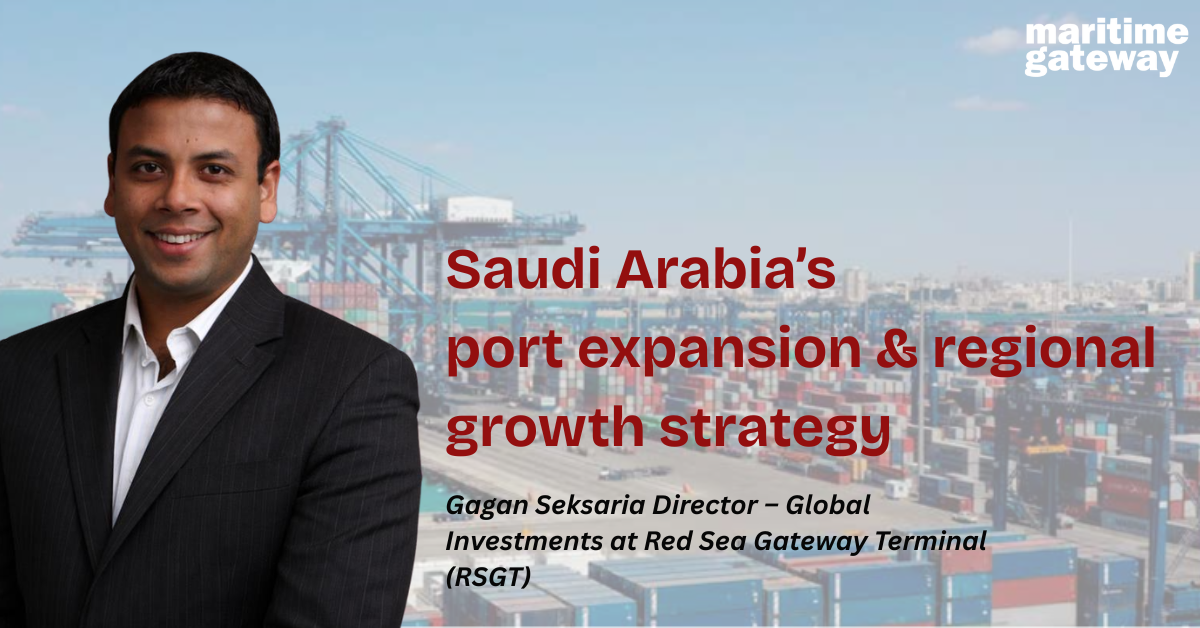

In this article, Gagan Seksaria, Director – Global Investments at Red Sea Gateway Terminal (RSGT), outlines how Saudi Arabia is emerging as a global logistics hub through Vision 2030, PIF-backed port expansion, and multimodal connectivity.
Saudi Arabia is redefining its role in global trade. Once primarily recognised as an energy powerhouse, the Kingdom is now emerging as a major logistics and maritime hub driven by large-scale port expansion, sovereign-backed investment and a clear long-term vision. According to Gagan Seksaria, Director – Global Investments at Red Sea Gateway Terminal (RSGT), Saudi Arabia’s approach reflects a rare blend of state leadership, private-sector efficiency and global ambition.
“Saudi Arabia is no longer just expanding ports – it is re-engineering its entire trade architecture in line with Vision 2030 and the realities of modern supply chains,” said Seksaria. At the heart of this transformation is the Public Investment Fund (PIF), Saudi Arabia’s sovereign wealth fund which now manages assets exceeding $1 trillion.
With PIF as a key shareholder, the country’s leading terminal operators have the ability to scale quickly both domestically and internationally. Having the Public Investment Fund as our shareholder gives us more than just access to capital – it gives us strategic stability, long-term vision, and the confidence to invest at scale,” noted Seksaria. “It allows us to take a much longer view of value creation than traditional investors can afford.
Accelerating capacity on the Red Sea coast In mid-2025, four major terminals along the western coast of Saudi Arabia came under unified management. These include two terminals in Yanbu, a facility in Jazan, and expanded operations at Jeddah Islamic Port. Combined, they represent a massive 100 million tonnes of total handling capacity. Historically centred on container operations at Jeddah, Red Sea Gateway Terminal has now expanded its operational mandate into multi-cargo terminals, integrated services, and end-to-end logistics solutions even as it continues to expand its operations on the container side as evidenced by the signing of a non-binding term sheet between RSGT and CMA CGM in October 2025 setting a clear pathway for the negotiation of a sub concession agreement for operating Terminal 4 at Jeddah Islamic Port under RSGT’s existing concession in the port with a planned investment of $450 million.
These do not just represent capacity or geographic expansion, they form key components of a strategic, long-term expansion,” said Seksaria. “By strengthening our footprint on the west coast, we are reinforcing Saudi Arabia’s role as a critical bridge between Asia, Africa and Europe. The Red Sea’s importance to global shipping, however, has also made it vulnerable to geopolitical disruptions—sparking the need for innovative contingency planning. Building alternatives to traditional trade routes Recent instability in the Red Sea has underscored the risks of overdependence on a single maritime corridor.
In response, Saudi stakeholders are working together to build alternative inland and regional trade pathways. A centrepiece of this strategy is the proposed land bridge rail corridor connecting Jeddah and Riyadh, which would allow cargo arriving at the Red Sea to be transported across the country to the eastern ports for onward shipment. “The land bridge is not merely a logistics project; it is a strategic lifeline,” Seksaria explained. “It creates redundancy in the system and gives us the flexibility to redirect cargo during times of maritime disruption.” During earlier periods of disruption, cargo movement via road networks provided a workable solution. The future rail corridor is expected to significantly enhance speed, cost efficiency and sustainability. In parallel, Saudi Arabia is also exploring regional partnerships, including the use of Omani ports as supplementary gateways. The modern logistics network is not built on competition alone, but on smart collaboration,” remarked Seksaria. “By linking with regional ports, we can help create a more resilient and efficient supply chain for the entire Gulf region. First international milestone: Chittagong, Bangladesh Saudi Arabia’s first major international terminal investment was secured in December 2023 when Red Sea Gateway Terminal signed a 22-year concession to equip and operate a terminal at Chittagong Port, Bangladesh. Despite political turbulence in the region, the terminal has been successfully operationalised. With an investment commitment of $240 million, the project represents a strategic entry into one of the world’s fastest-growing export economies.
“Bangladesh is a compelling market – young, dynamic and export-driven,” said Seksaria. “Our presence in Chittagong not only captures growth, but also positions us at the intersection of South and Southeast Asian supply chains.” The success of Chittagong has prompted further exploration of opportunities across:
• South Asia, including further larger scale investments in Bangladesh
• East Africa and the Horn of Africa, with its untapped trade potential
• South Africa, where privatisation initiatives are gaining momentum
• Southeast Asia, a rising global manufacturing and consumption hub with a strong focus on Indonesia and Vietnam in particular
Several of these projects are currently under evaluation, in some cases in partnership with international financial institutions or local partners. “Our strategy is simple but disciplined – identify high-growth corridors, partner with the right stakeholders, and deploy capital where it can make the most transformative impact,” added Seksaria. The road to 30 million TEUs Looking ahead, Red Sea Gateway Terminal has set an ambitious goal of a a multi million TEU portfolio across Saudi and internationally over the next five years, potentially increasing overall volumes by several times.
“We are not looking at In mid-2025, four major terminals along the western coast of Saudi Arabia came under unified management. These include two terminals in Yanbu, a facility in Jazan, and expanded operations at Jeddah Islamic Port. Combined, they represent a massive 100 million tonnes of total handling capacity. incremental change. This is a generational scale-up that requires planning, partnerships and precision in execution,” explained Seksaria. This growth is aligned with Saudi Arabia’s expanding consumer base of more than 34 million people, along with rising demand for food security, raw materials, manufactured goods and e-commerce-driven imports. A new era for Saudi maritime power Under the umbrella of Vision 2030, Saudi Arabia is transitioning from an energy centric economy to a diversified powerhouse. Ports and logistics are key pillars of this transformation. Through strategic consolidation, global expansion, and infrastructure-led resilience planning, Saudi Arabia is positioning itself as a cornerstone of global maritime stability.
 Join our WhatsApp channel for more updates:
 Subscribe to our YouTube channel for more updates: