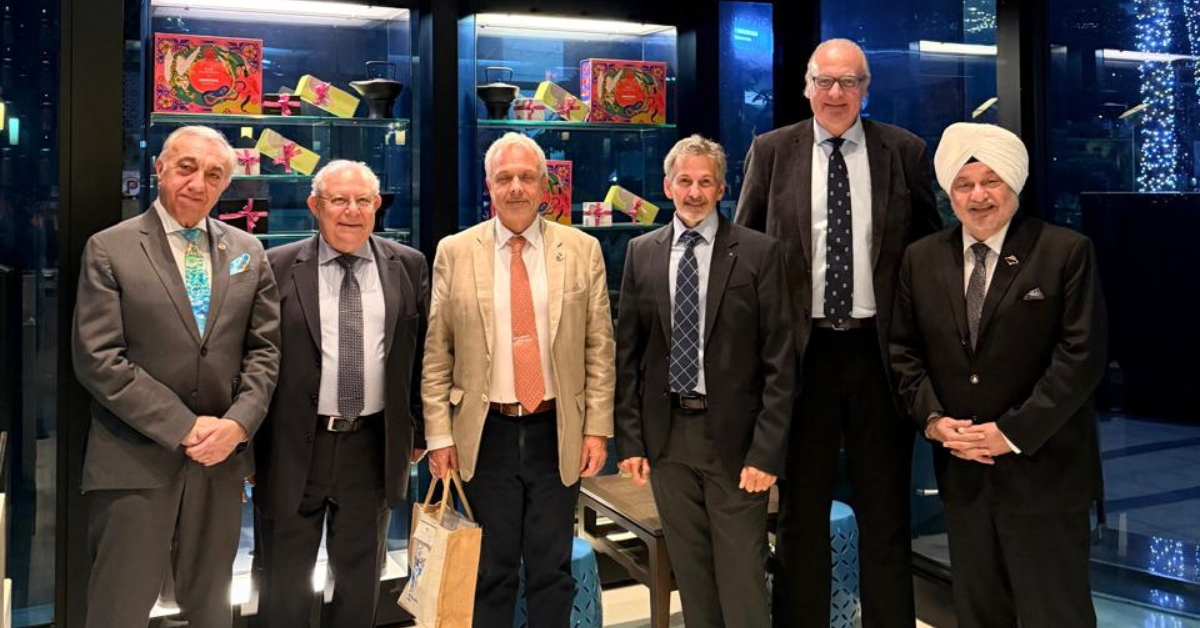
Maritime Gateway spoke with Fulvio Carlini, President of FONASBA — the World Federation of Ship Agents and Brokers — during his visit to Mumbai. With him was Javier Dulce (Immediate Past President), and what unfolded was a candid, warm, and surprisingly personal conversation about representation, trust, geopolitics, and the enduring power of knowing the face across the table.
For those encountering FONASBA for the first time, how would you describe what it does?
FONASBA was born as a federation of national associations — primarily in Europe — at a time when the world was far less connected than it is today. The idea was to bring together countries active in shipping under one roof. But the world has changed dramatically, and so has FONASBA’s thinking.
“More than being only national associations, what we look for today are companies, countries, and all people or associations who can give a contribution to shipping,” says Carlini. “Shipping is international. And what FONASBA can do — on one side it’s difficult and on the other it’s easy — is be the voice of a part of shipping that often doesn’t get enough attention: agencies and broking.”
He makes the distinction simply: ship agents represent vessels in ports; brokers connect cargo interests with ships. Both are essential connective tissue in global trade, and FONASBA gives them a collective identity and a platform.
Javier adds a point that resonates in today’s trade environment: “Ship agents are not only local. We are local, regional, and international. And FONASBA covers our representation at the international level.”
When you say international representation — what does that actually mean in practice?
This is where Carlini’s answer becomes significant. FONASBA is not a talking shop. It holds consultative status at the IMO (International Maritime Organization), sits within the International Chamber of Shipping alongside major shipowners, and is a member of BIMCO’s documentary committee — the body that drafts the contracts underpinning global trade.
Javier highlights another lesser-known but critical seat: the World Customs Organization’s private sector group. “Customs is something basically for ship agents,” he says. “And FONASBA has a seat there — the only place where private companies can interact with the WCO directly.”
For members, this translates into something tangible: their interests are represented where rules are written, not just where they are applied.
In times of crisis — the Red Sea, geopolitical conflicts — how does FONASBA support its members?
Carlini is candid about the limits of what FONASBA can and should do. “We are not politically oriented. We have nothing to do with politics.” But within that constraint, there is real value being delivered.
“We keep our associates informed of what’s going on with information we get from everyone,” he explains. “Yesterday we had an international discussion with people from ports, from shipowners — just talking about what’s going on.”
He offers a telling example: FONASBA’s network includes the Iranian Shipping Federation of ship agents. “At the end of the day, they are there to do their job, and agents are there to do their job in any time.” It’s a pragmatic, non-partisan stance — and perhaps the only sustainable one in a politically fractured world.
Javier frames it elegantly: “The ship agent or broker has local knowledge. No one can tell you more exact information than those on the ground. We collect that information and share it — not with opinions. Just facts.”
“Just info without opinions,” Carlini echoes, with a nod.
You have a quality standard — FQS. What is it, and why does it matter?
The FONASBA Quality Standard, launched in 2007 and currently being updated, is perhaps the federation’s most practical gift to the industry. “All we want is to make sure that our customers — owners, charterers, merchants — have certainty about the quality level of the people they are employing,” Carlini says.
It doesn’t set a ceiling for excellence. It establishes a floor. An FQS-certified agent meets a defined minimum standard of professionalism and operational competence. In an industry where a ship agent in a port you’ve never visited is trusted with your vessel and cargo, that baseline matters enormously.
“Otherwise, this agent is not an FQS certified agent. That is the sense.”
Does a smaller member country feel as heard as a large one?
Carlini’s answer here is quietly principled. Within FONASBA’s council, voting is one country, one vote — regardless of fleet size, trade volume, or economic weight. “You may be the USA, you may be China, you may be Hungary — a landlocked country — and you still have one vote.”
The federation is now working on how to extend representation to company members in countries that lack national associations. But the philosophical underpinning remains unchanged.
“In shipping, it’s an international world,” Carlini says. “You can’t just bail out the others because you’re bigger. At the end of the day, even the smallest country can count. Many countries, you learn a lot from the smaller than from the bigger.”
What brings you to India — and what excites you about this market?
Carlini’s enthusiasm here is genuine, even if he cheerfully admits some geographic ignorance at first. “India is in this moment the country in the world with the biggest population — and that’s already a good reason.” He learns mid-conversation that India’s coastline stretches over 11,000 kilometres. “I come from Italy and we think we have a very long one — with about four thousand kilometres. So this tells you a lot.”
Beyond geography, it’s the trajectory that matters. “India is growing. Shipping is becoming more and more important here — I was seeing people trying to find ships to move cargo between Indian ports because it’s cheaper, faster, and more secure than rail or truck.”
What FONASBA sees in India is a knowledge exchange, not a transactional relationship. “India can give a good contribution to FONASBA — not in terms of money, but in terms of knowledge. The world needs to know what India is doing and India needs to know what the world is doing. That is the equation.”
What is your advice to Indian ship brokers?
Carlini pauses, then speaks with the conviction of someone who has lived this profession for decades.
“Never give up.”
He continues: “We ship brokers all work for the same commission. There are no brokers who are cheaper or more expensive. But there are brokers with better knowledge of the market, a wider knowledge of shipowners. And I can tell you — people are not choosing us because of money. They are choosing us because they know us.”
This brings him to something more personal and emphatic — a defence of relationship-driven commerce in an era of digital everything.
“Ship broking, like ship agency, is still a profession where networking counts. I like to know the face of the other one. Even on Teams or Zoom — it’s not the same. It’s just not the same. That’s a feeling. And this is why we’re here.”
He gestures at the room. “Here, and not on Teams.”
Finally — what are FONASBA’s priorities for the next few years?
Carlini laughs. “Thanks to God, I will only be there for another year and a half — so I can’t say much about three to five years.” But his answer, even in jest, reveals his focus.
“We need to be in stronger connection with our members — members of our members. We need to give them something in exchange for their confidence in us.”
Javier adds the strategic dimension: “Visibility. If you have visibility, your voice is going to be heard — at a higher level.”
And it’s here, perhaps, that the Mumbai visit becomes most meaningful. When asked whether Maritime Gateway heard of FONASBA before this meeting, this interviewer had to admit — despite nearly two decades covering Indian shipping — that the answer was no.
Carlini doesn’t flinch. “This tells you a lot,” he says simply. “We need to be known.”
 Join our WhatsApp channel for more updates:
 Subscribe to our YouTube channel for more updates: