




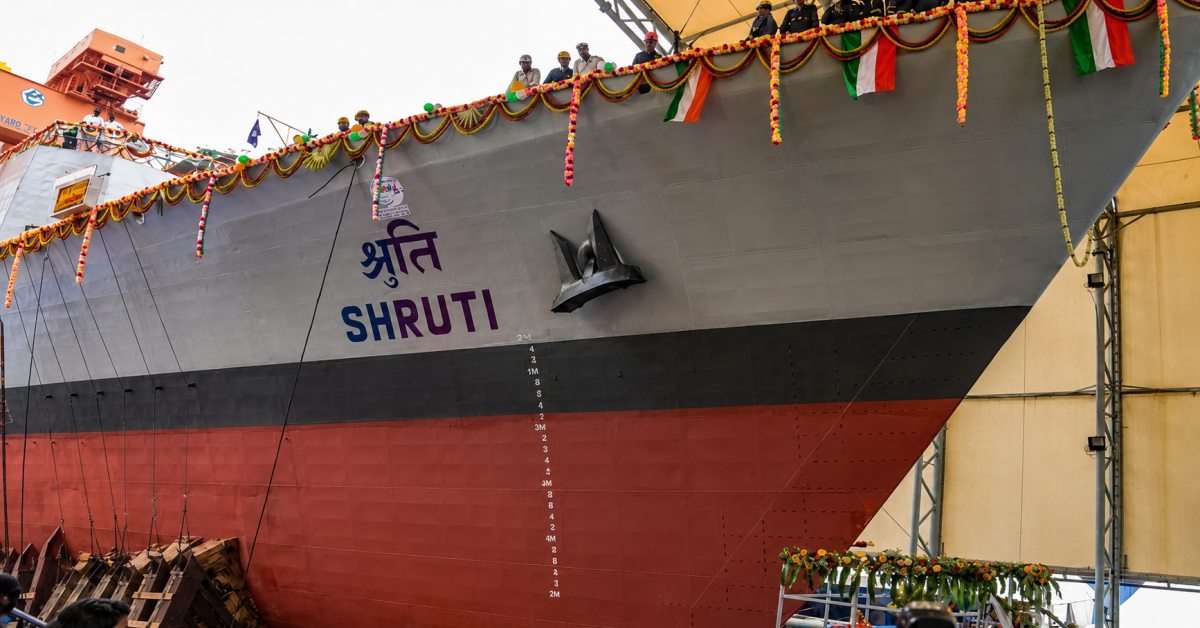

Garden Reach Shipbuilders & Engineers Ltd has launched “Shruti,” the second Next Generation Offshore Patrol Vessel built by the shipyard for the Indian Navy, adding another milestone to its indigenous warship building programme.
When was the vessel launched and how does it fit into the broader NGOPV programme?
The launch took place in Kolkata on August 11, coming less than three months after the launch of Sanghmitra, the first NGOPV from GRSE, on May 20. GRSE is constructing four NGOPVs as part of the Indian Navy’s larger 11-ship NGOPV programme, with the pace between the two launches reflecting steady momentum in executing the prestigious project.
Who launched the vessel and who attended the ceremony?
Shruti was formally launched by Smt Manika Sadhu, wife of Vice Admiral Sanjay Sadhu, Controller of Warship Production and Acquisition, Indian Navy, amid traditional rituals and the chanting of Vedic shlokas. Vice Admiral Sadhu attended as Chief Guest, along with Commodore PR Hari, Chairman and Managing Director of GRSE, and other senior officials from the Indian Navy and the shipyard.
What does the name ‘Shruti’ signify?
The name Shruti means “that which is heard.” In Indian tradition, the term refers to the four Vedas, ancient scriptures preserved through oral tradition over generations and central to India’s cultural and spiritual heritage.
What capabilities will the NGOPVs offer?
The NGOPVs are significantly larger and more capable than earlier Offshore Patrol Vessels, offering enhanced endurance, firepower and operational versatility. Measuring about 113 metres in length and 14.6 metres in width, with a displacement of 3,000 tonnes, the vessels will achieve speeds of up to 23 knots and carry an endurance of 8,500 nautical miles at a cruising speed of 14 knots. They are designed for coastal and offshore asset protection, maritime interdiction, surveillance, visit-board-search-and-seizure operations, mine warfare and special operations, alongside roles in anti-piracy, counter-infiltration, humanitarian assistance and disaster relief, search and rescue, and support for hospital, COMINT and fleet maintenance functions.
What did Vice Admiral Sadhu say about GRSE’s role in India’s shipbuilding journey?
Vice Admiral Sadhu said the Navy’s responsibility extends beyond national defence to ensuring freedom of navigation, security of sea lanes and the uninterrupted flow of energy and essential goods to and from India. He noted that GRSE delivered India’s first indigenously built platform, INS Ajay, in 1961, and has since delivered more than 110 warships to the Navy while building over 800 ships and platforms in total. He said GRSE’s Navratna status, conferred in June 2026, recognises the shipyard’s consistent vision and commitment, calling the launch of Shruti a reflection of Team GRSE’s professionalism and competence.
What did GRSE’s Chairman and Managing Director say about the shipyard’s plans?
Commodore PR Hari highlighted GRSE’s expansion plans and its commitment to Atmanirbharta and self-reliance, noting that unlike the earlier Sukanya class or indigenously built Saryu class OPVs, the NGOPVs are considerably larger, with longer endurance and state-of-the-art equipment, sensors and weapon systems. He said the shipyard delivered eight warships and launched one vessel last year, and expects to deliver five warships and launch four vessels this year.
What does this mean for GRSE’s broader shipbuilding legacy?
GRSE remains the only Indian shipbuilder with four distinct shipyards and can undertake concurrent construction of 28 ships at a time. The company has built over 800 platforms, including 118 warships for the Indian Navy, Indian Coast Guard and friendly foreign countries, the highest number delivered by any Indian shipyard to date, reinforcing its position at the centre of India’s indigenous defence shipbuilding ecosystem.
 Join our WhatsApp channel for more updates:
 Subscribe to our YouTube channel for more updates: