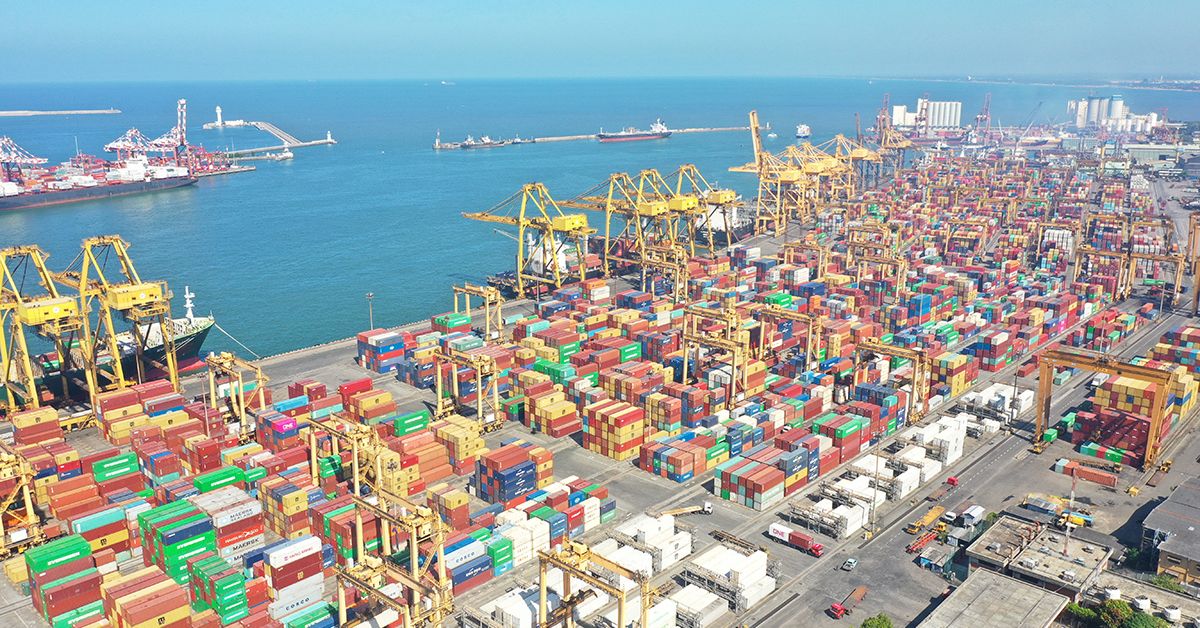

Container traffic at the Port of Colombo posted solid growth during the first ten months of 2025, underpinned by a sharp rise in domestic cargo movements, while transhipment continued to form the backbone of the port’s operations, according to data released by the Central Bank of Sri Lanka (CBSL).
Between January and October, the port handled a total of 6.92 million twenty-foot equivalent units (TEUs), marking a 7.1 per cent increase over the same period last year. Although transhipment volumes grew at a relatively measured pace, they remained the dominant contributor to overall throughput, reinforcing Colombo’s position as a key regional hub.
Transhipment container traffic climbed 5.1 per cent year-on-year to 5.52 million TEUs, compared with 5.25 million TEUs in the corresponding period of 2024. This segment accounted for nearly 80 per cent of all containers handled during the period.
Domestic container activity expanded at a much faster rate. Volumes linked to Sri Lanka’s import and export trade rose 13.9 per cent to 1.1 million TEUs, up from 0.96 million TEUs a year earlier. The stronger growth in domestic cargo reflects improving trade flows tied to local economic activity, even as the port remains structurally reliant on regional transhipment traffic.
Growth momentum accelerated in October. Total container handling for the month reached 744,792 TEUs, an increase of 10.8 per cent compared with October 2024. Transhipment volumes rose 7.9 per cent to 578,930 TEUs, while domestic containers surged 16.5 per cent to 123,962 TEUs, highlighting the continued outperformance of local trade-related cargo.
Ancillary port activity also strengthened. Re-stowing volumes increased 22.8 per cent year-on-year to 0.31 million TEUs over the January–October period, with October alone recording a 44 per cent jump compared with the same month last year.
In terms of overall cargo handled, the Port of Colombo processed about 105 million metric tonnes in the first ten months of 2025, representing a 4.4 per cent rise from a year earlier. Cargo discharged grew 4.7 per cent to 58 million metric tonnes, while cargo loaded increased 3.9 per cent to 47 million metric tonnes.
Beyond Colombo, maritime activity across Sri Lanka’s major ports also showed an uptick. Vessel arrivals at the ports of Colombo, Galle, Trincomalee and Hambantota rose 12.5 per cent year-on-year to 4,251 ships during the period. In October alone, ship calls increased nearly 13 per cent to 459, underscoring a broader recovery in maritime traffic across the country.
 Join our WhatsApp channel for more updates:
 Subscribe to our YouTube channel for more updates: