



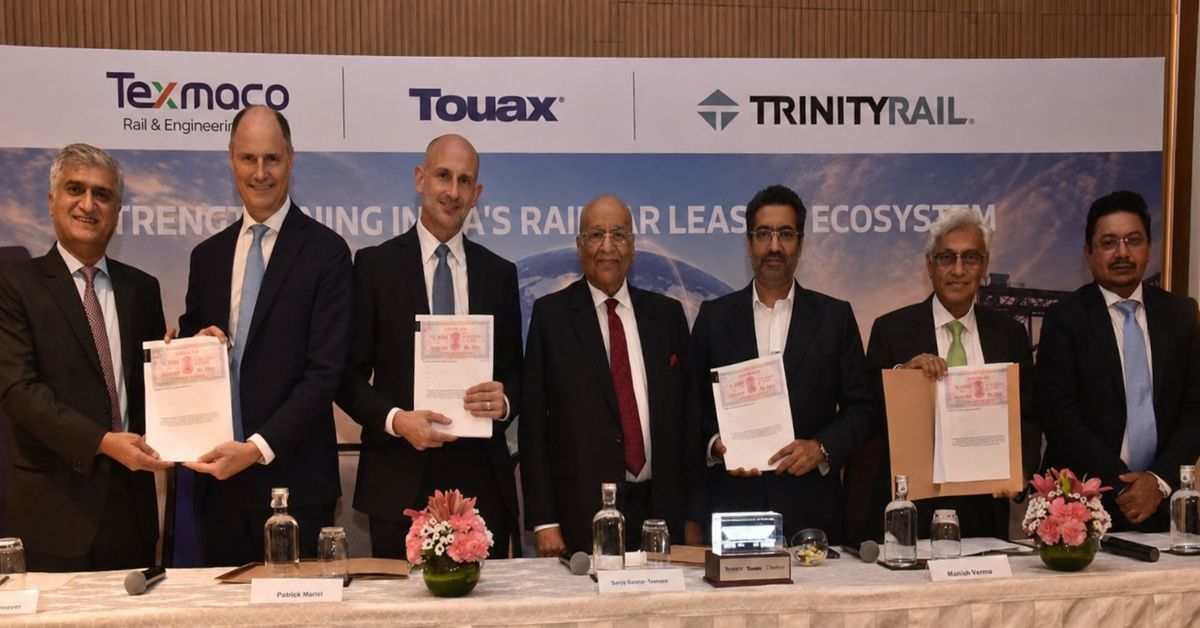

Texmaco Rail & Engineering Limited, Touax Group and Trinity Rail have announced plans to invest in 100 new rakes over the next three to five years, an investment estimated at around Rs 1,800 crore at current market prices, as India pushes to expand its rail freight capacity.
What is the structure of this new rail leasing partnership?
The new arrangement builds on the existing Touax-Texmaco Railcar Leasing platform, established to introduce globally benchmarked freight wagons in India under liberalised wagon investment and leasing schemes. With Trinity Rail joining as a partner, the platform gains additional technological depth, financial strength and access to global best practices in rail leasing.
Why is demand for rail car leasing expected to grow?
Backed by infrastructure initiatives such as PM Gati Shakti, the National Logistics Policy and the expansion of Dedicated Freight Corridors, demand for modern, flexible and capital-efficient freight transportation solutions is expected to rise significantly. As India aims to increase rail’s share in freight movement from 27 percent to 45 percent under the National Rail Plan, about 1.4 lakh new wagons will be required by 2030.
What did company leadership say about the partnership?
Saroj Kumar Poddar, Chairman of Texmaco Rail & Engineering Limited and Adventz Group, said the need for innovative, technology-led rail solutions has never been greater as India works toward its rail freight targets. He said the collaboration strengthens indigenous design capabilities, brings global expertise to India, and supports the vision of Viksit Bharat by making the country’s rail logistics more efficient, competitive and future-ready.
What does this mean for India’s rail freight ecosystem?
The partnership combines global leasing expertise, advanced rail technology, manufacturing excellence and lifecycle asset management within a single integrated platform, positioning it to support the development of a robust railcar leasing ecosystem as India’s railway policies evolve and freight mobility demand continues to grow.
 Join our WhatsApp channel for more updates:
 Subscribe to our YouTube channel for more updates: