



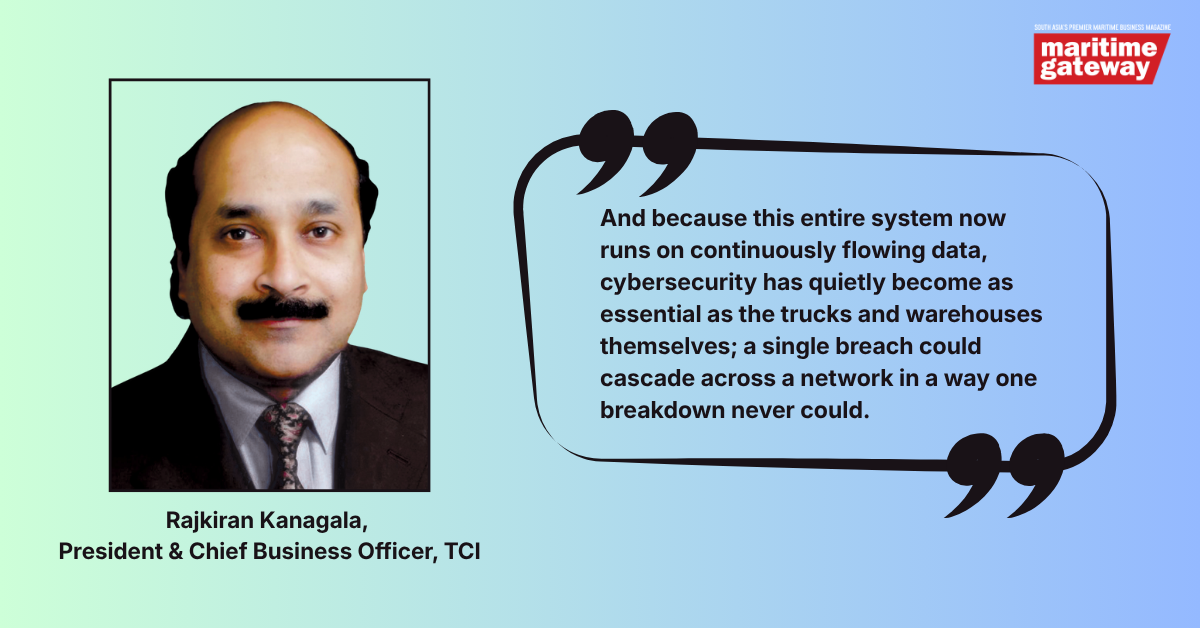

Rajkiran Kanagala, President & Chief Business Officer, TCI walks us through the sensors, algorithms, and control towers turning India’s messiest logistics problem into a single, trackable story
A container leaves a factory in Ahmedabad by truck. It reaches an inland container depot, transfers onto a rail rake, crosses half the country, changes hands at a hub outside Kolkata, and arrives at a customer’s doorstep days later — three modes of transport, a dozen handoffs, and countless small decisions along the way. A decade ago, following that journey meant phone calls, paper waybills, and a fair amount of guesswork. Today, it means a single dashboard showing exactly where the container is, what condition it is in, and when it will arrive, almost to the hour.
That difference is not incremental. It is a rewiring of how freight moves in a country that is trying to bring logistics costs down from among the highest in the world as a share of GDP, under the push of the National Logistics Policy and the PM Gati Shakti master plan. As one of India’s large-scale multimodal logistics operators — running road, rail, air, sea, warehousing, and last-mile delivery under one network — we watch this transformation unfold every day, one shipment at a time. This is that shipment’s story, and what it reveals about where Indian logistics is headed.
The Moment It Leaves the Factory
The instant the container is sealed, it starts generating data. IoT sensors and GPS-enabled telematics track its location continuously, while condition sensors log temperature, humidity, and shock throughout the journey — critical for the pharma and perishable cargo that now make up a growing share of Indian freight. As 5G rolls out, that data stream is becoming near-instant even on long highway stretches, so the shipment stops being a black box in transit and becomes a live, continuously updating signal.
Riding the Rails: Tracking Every Rake in Real Time
Once the container transfers onto a rail rake, it enters a tracking system of its own. Indian Railways’ Freight Operations Information System (FOIS) tracks the movement using the 11-digit Freight Number Record (FNR) printed on the Railway Receipt, the same number our own control tower feeds into its live view of the shipment. Anyone can look up live GIS updates on the FNR Enquiry portal or send an SMS with the FNR to a designated number and get an instant status update on their phone. Within FOIS, the Rake Management System monitors individual wagons and train formations as they move, while the Terminal Management System handles booking, delivery, freight charges, demurrage, and e-invoicing at each terminal. For maritime-bound containers, FOIS’s Logistics Data Bank integration adds RFID-based tracking across ports, highways, and rail, stitching the sea leg and the rail leg into one continuous, visible chain rather than two separately tracked journeys.
The Decision No Human Could Make Fast Enough
Long before the truck reaches the depot, an AI-driven planning engine has already worked out the smartest way to move this container — weighing cost, deadline, cargo sensitivity, and live conditions like rail slot availability or weather, across thousands of shipments at once. Above it, a control tower watches the entire network — every truck, rail leg, port, and warehouse — catching a port delay or highway disruption early enough to reroute before it costs a day. Machine learning-driven forecasting pre-positions trucks, rakes, and warehouse capacity ahead of demand, cutting two of Indian freight’s most persistent inefficiencies: empty return trips and idle assets.
The Handoff That Used to Take Hours
At the rail-to-road transfer point, automation takes over. Warehouse and transport systems are tightly integrated, so the container is identified, cross-docked, and loaded onto the right outbound truck with minimal manual intervention. Autonomous yard vehicles shuttle pallets between docks and storage, while a drone overhead audits inventory in the yard far faster than a manual count could. Dwell time, historically the biggest source of delay in a multimodal chain, shrinks from hours to minutes, and that saving compounds across every hub the network touches.
The Trust Layer Nobody Sees
Every shipment drags paperwork behind it — customs declarations, bills of lading, insurance certificates — each a potential dispute. Blockchain-based platforms, now piloted across Indian ports, replace that trail with a single tamper-proof record every party can trust at once, speeding up customs clearance and cutting reconciliation delays. Once delivery is confirmed, a smart contract can trigger invoicing and release payment automatically, a meaningful shift for the small trucking operators who form the backbone of Indian road freight and for whom working capital delays are a constant strain.
The Network That Rehearses Disaster Before It Happens
None of this matters if the network itself is fragile. Digital twins let operators simulate disruption — a congested port, a flooded highway — before it happens, not after. Predictive maintenance flags a failing truck engine days before it strands a shipment. And because this entire system now runs on continuously flowing data, cybersecurity has quietly become as essential as the trucks and warehouses themselves; a single breach could cascade across a network in a way one breakdown never could.
Why It Matters Beyond the Shipment
Multiply this one journey by the millions moving across India every day, and the impact stops being about logistics alone. Fewer empty trucks and a rail-first push on long-haul routes cut fuel use and emissions. Unbroken cold chains mean medicines and food arrive intact instead of spoiled. Faster clearance and automated payments free up working capital for the businesses that depend on it. And as private networks plug deeper into public platforms like PM Gati Shakti and FOIS, the whole system starts planning off one shared, accurate picture instead of many partial ones.
That is the real story behind this one container’s journey from Ahmedabad to Kolkata: not just smarter trucks, trains, and warehouses, but a country that moves better, because the systems carrying it have finally learned to think as one.
 Join our WhatsApp channel for more updates:
 Subscribe to our YouTube channel for more updates: