




The Western Dedicated Freight Corridor is cutting transit times, slashing logistics costs, and building a new backbone for India’s export supply chains, with the port connection at its heart
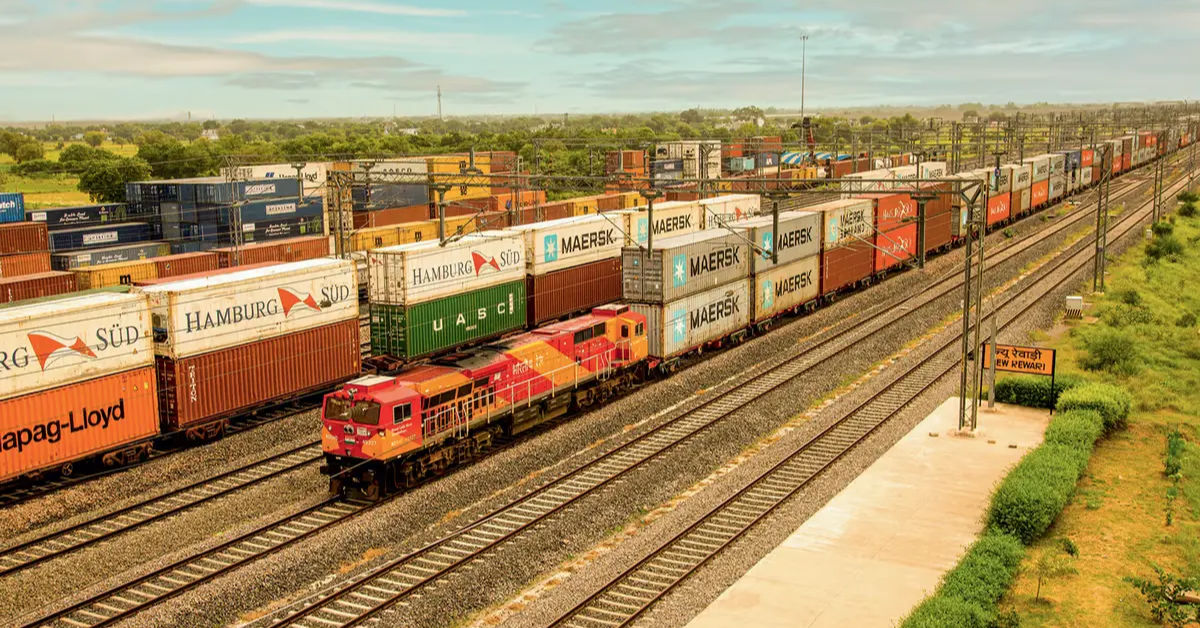
India’s freight transportation ecosystem is in the midst of a structural transformation, driven by the rapid expansion of the Western Dedicated Freight Corridor (WDFC). This 1,506-kilometre dedicated cargo railway runs from Dadri in Uttar Pradesh to Jawaharlal Nehru Port Authority near Mumbai, threading through some of India’s most productive industrial and agricultural heartlands.
The WDFC is not just an infrastructure project. It is a fundamental rethink of how India moves goods from factory to port, from farm to market, and from supplier to consumer, at scale, reliably, and economically. For decades, India’s freight trains shared tracks with passenger services on the Indian Railways network, resulting in slow speeds, unpredictable schedules, and a logistics system that was a drag on competitiveness. The WDFC changes that equation dramatically.
Freight trains on the WDFC can run at up to 100 kilometres per hour, compared to an average speed of around 25 km/h on the old mixed network. They can carry double-stacked containers, significantly increasing capacity per train movement. And because the dedicated tracks are used exclusively for freight, schedules are more reliable. The combination of speed, capacity, and reliability is transforming the economics of rail freight for Indian industry.
The impact is being felt across sectors. Textile exporters in Gujarat, Rajasthan, and Punjab are routing cargo via WDFC to Mundra and JNPA more efficiently. Auto component manufacturers in Haryana and Uttar Pradesh are finding new logistics cost windows. Agricultural produce — cotton, spices, pulses — is moving faster and with less damage from India’s northern belt to western ports for export. Pharmaceutical companies in Baddi and Ankleshwar are also reportedly exploring WDFC options for time-sensitive export shipments.
India’s logistics cost as a share of GDP stands at approximately 13–14%, compared to the global average of around 8%. This gap costs Indian exporters dearly in international competitiveness. Government estimates suggest that the WDFC alone could reduce logistics costs by 1–2% of the value of goods transported, translating into billions of dollars of annual savings at the national level. PM GatiShakti — the government’s integrated infrastructure planning framework — has placed the WDFC at the centre of its multimodal connectivity ambitions.
A notable milestone this week illustrated the corridor’s potential in a new way: logistics technology startup Zipaworld Innovation Pvt. Ltd. flagged off its first dedicated warehouse-stuffed full train service from ICD Dhirpur in Kurukshetra, Haryana, to Mundra Port in Gujarat. The service — which integrates warehousing, stuffing, and rail movement into a seamless product — demonstrates how private logistics players are innovating on top of the WDFC infrastructure to create end-to-end solutions for exporters.
The Eastern Dedicated Freight Corridor (EDFC) is also coming online, with its own transformative potential for East India trade. Together, the two corridors will form the backbone of India’s multimodal logistics network, connecting it to major ports on both the west and east coasts. For a country with ambitions to double its merchandise exports and become a $10 trillion economy, the dedicated freight corridor network may prove to be one of the most consequential infrastructure investments of this generation.
 Join our WhatsApp channel for more updates:
 Subscribe to our YouTube channel for more updates: