
The second phase of expansion at Vizhinjam International Seaport is set to commence in the second week of January, Kerala Ports Minister V N Vasavan said following a high-level review meeting held on Tuesday. The minister noted that the exact start date will be finalised after discussions with Chief Minister Pinarayi Vijayan and the project concessionaire, Adani Ports and Special Economic Zone Ltd. (APSEZ).
According to Vasavan, all preparatory work for the next stages of construction has been completed, clearing the way for the large-scale expansion. The upcoming phase forms part of a ₹10,000-crore investment programme by APSEZ aimed at significantly scaling up the port’s capacity and operational capabilities.
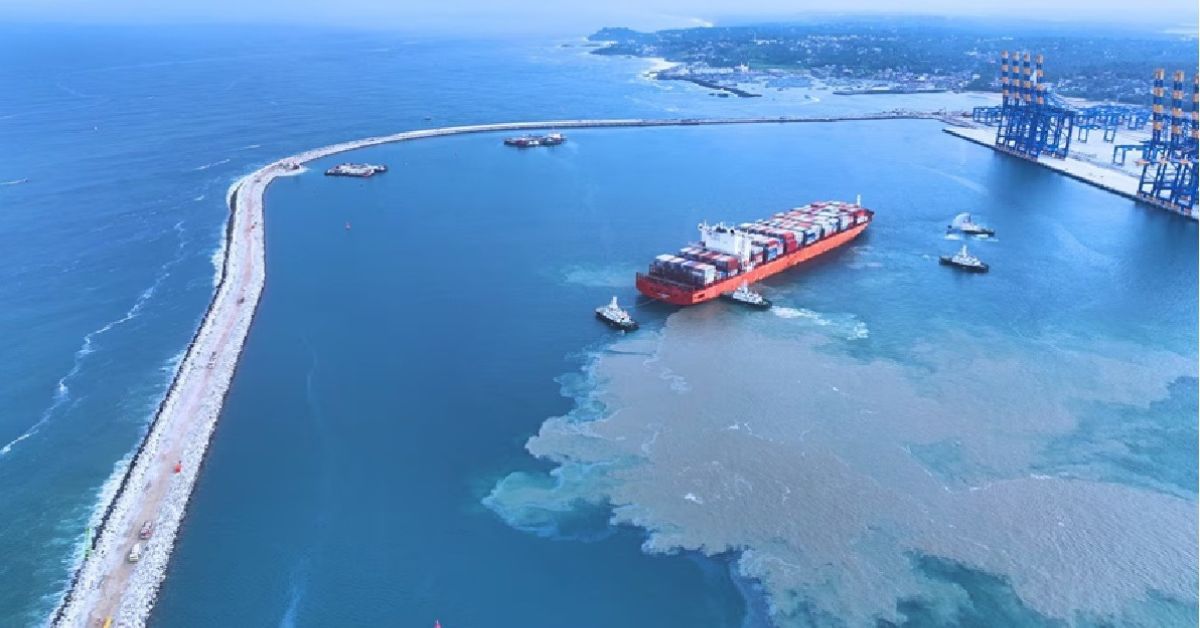
A key component of the expansion is the extension of the existing 800-metre container berth by an additional 1,200 metres, creating a 2,000-metre continuous berth. This will allow Vizhinjam to handle multiple ultra-large container vessels simultaneously, strengthening its position as a major transshipment hub on India’s southern coast.
The project also includes a major upgrade to maritime protection infrastructure. The breakwater, currently measuring 2.96 km, will be extended by 920 metres, taking its total length to more than 3.9 km. Under the revised concession agreement, Phases II to IV must be completed by 2028, significantly accelerating the development schedule compared with the earlier completion target of 2045.
On the connectivity front, the minister said a temporary approach road has been completed and will be inaugurated in January, enabling the start of road-based cargo movement. Vizhinjam has also recently been accorded Inland Container Port/Depot (ICP) status, placing it alongside ports in Gujarat and Kolkata and opening opportunities for expanded logistics and tourism-linked activities in coordination with the state’s tourism department.
To support cruise operations, the government plans to acquire around 50 hectares of land for yard development, customs facilities, security infrastructure, and related services. Dredging works required for berth construction will be carried out directly from the sea.
Rail connectivity is also on the agenda, with plans for a 10.7-km railway line, including a 9.2-metre tunnel, to link the port to the broader rail network. Land acquisition for the rail corridor is progressing, and construction is expected to begin shortly.
In addition, road connectivity to the national highway network has already received approval, including a cloverleaf interchange designed to support high traffic volumes and large-scale commercial operations.
With Phase II poised to begin and timelines brought forward, Vizhinjam is entering a critical stage in its transformation into a globally competitive deepwater port.
Vizhinjam completed its first year of commercial operations on December 3. Against a target of 1 million containers, the port handled 1.325 million containers through 616 ships. As of Tuesday, 636 ships had docked, pushing the total to nearly 1.4 million containers. The port became the first in India to handle more than 40 ultra-large container ships measuring 399 metres in length.
More than 155 ships exceeding 300 metres and 45 ships with drafts over 16 metres also arrived at Vizhinjam. The government earned Rs 97 crore in tax revenue from operations. A standout achievement has been Vizhinjam’s ability to attract vessels that had never docked in Asia before, including some of the world’s largest ships such as MSC Turkiye, MSC Irena and MSC Verona.
Existing 800-m berth to be extended by 1,200 m to create a 2,000-m berth, enabling multiple ultra-large vessels to load and unload simultaneously 2.96-km breakwater to be lengthened by 920m.
Revised contract says phases II-IV must be completed by 2028, advancing it from the original 2045 deadline.
 Join our WhatsApp channel for more updates:
 Subscribe to our YouTube channel for more updates: