



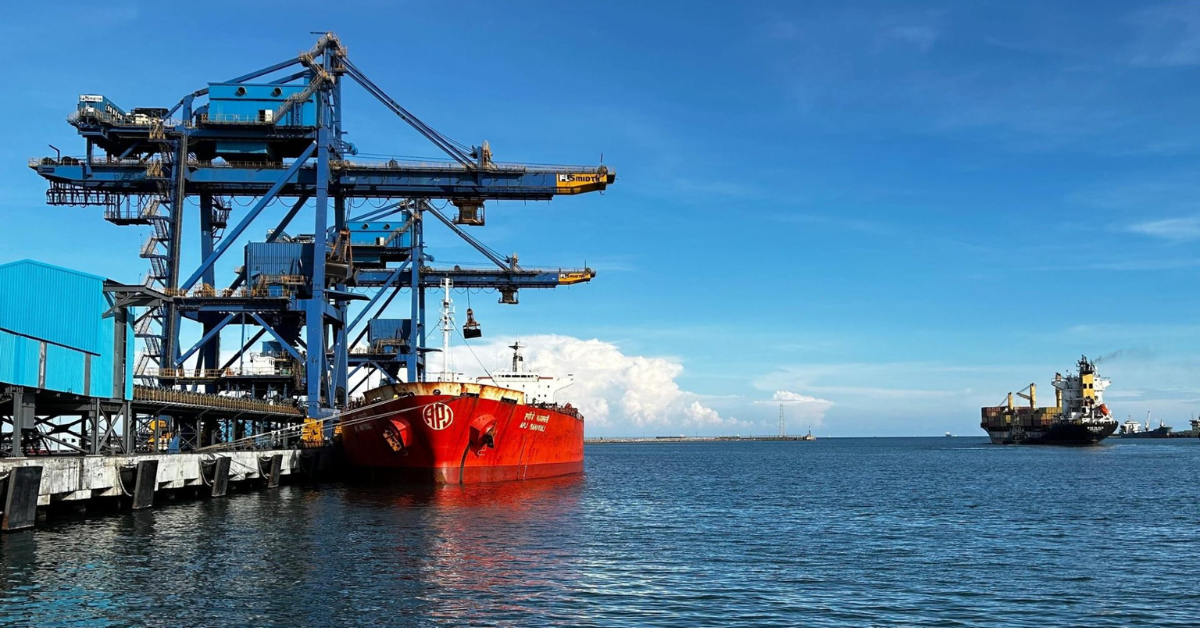

Tuticorin port unveils 2026 report highlighting green hydrogen milestones, near-total renewable energy shift, and carbon neutrality target for 2026
V.O. Chidambaranar Port Authority (VOCPA) has launched its Sustainability Report 2026, titled “Towards a Green Maritime Future,” becoming India’s first Major Port to publish a dedicated sustainability report. The launch was held in the presence of Union Minister of Ports, Shipping and Waterways Sarbananda Sonowal; Secretary, Ministry of Ports, Shipping and Waterways Vijay Kumar, IAS; VOCPA Chairperson Susanta Kumar Purohit, IRSEE; and VOCPA Deputy Chairperson Rajesh Soundararajan, IAS.
The report documents the port’s progress across clean energy adoption, decarbonisation, green hydrogen and green ammonia development, low-carbon maritime infrastructure, safety, community development and governance, positioning sustainability as a strategic driver of resilience and competitiveness rather than a compliance obligation.
A Green Hydrogen Hub in the Making
A central highlight of the report is VOCPA’s formal recognition as one of India’s three Green Hydrogen Hubs under the National Green Hydrogen Mission. The port became India’s first to produce green hydrogen in September 2025, with plans for commercial-scale development by 2029. Hydrogen production is being scaled from approximately 8 kg/day to over 600 kg/day, supported by a planned 2 MW electrolyser, and is being aligned with applications in port mobility, clean energy use and downstream fuel development.
The port is also developing an integrated green fuel ecosystem, including a 1,500 m³ green methanol bunkering facility targeted for 2026, and has allocated 206 acres for green ammonia production. VOCPA is advancing the Kandla–Tuticorin Green Shipping Route and is strategically positioned along the Rotterdam–Singapore corridor, with its location just 100 nautical miles off the international East–West shipping route — compared to roughly 700 nautical miles for competing ports such as Kandla.
Renewable Energy Coverage Reaches 94%
VOCPA’s renewable energy share in total electricity consumption rose from 5% in FY2022–23 to approximately 94% in FY2025–26. Renewable energy generation reached 15.5 GWh during the year, and in the last four months of FY2025–26, renewable generation exceeded internal consumption, achieving 102% renewable electricity coverage and enabling net-zero Scope 2 emissions for that period.
The port’s Scope 1 GHG emissions for FY2025–26 stood at 10,707 tCO2e and Scope 2 emissions at 12,029 tCO2e, with net emissions after renewable offset at 11,442 tCO2e. Approximately 50% of carbon emissions were offset through renewable energy. VOCPA has committed to achieving carbon neutrality by 2026, targeting Scope 1 and 2 reductions while progressively addressing Scope 3 emissions through electrification, renewable energy and alternative fuels.
The port has also deployed around 40 hydrogen-powered heavy-duty trucks for inter-carting operations, with plans to scale the fleet to 80 vehicles, and has been a pioneer in shore-to-power implementation in India since 2016. It holds certifications including ISO 50001, ISO 9001:2015, ISO 14001:2015, ISO 45001:2018, IGBC Platinum Rating and Shunya Plus BEE rating.
Strong Operational Performance
In FY2025–26, VOCPA handled 43.31 million tonnes (MMT) of cargo — up from 41.72 MMT the previous year — along with 8.60 lakh TEUs of container traffic and 1,907 vessels, while maintaining an operating ratio of 31.88%, among the lowest of India’s Major Ports. The port recorded ₹1,058.59 crore in total income. Average pre-berthing detention time improved from 16.80 hours to 9.12 hours, and berth occupancy reached 60.30%. The year also saw a single-day cargo-handling record of 2.16 lakh tonnes and the highest single-day container volume of 5,068 TEUs.
In June 2025, VOCPA was declared India’s first single-use plastic-free port on World Environment Day. The port also handled the longest container vessel of the year, M.V. MSC Michaela, measuring 304 metres, in December 2025.
Investing in People and Communities
The report highlights VOCPA’s people-centric initiatives, with a total workforce of 369 employees as of April 1, 2026, alongside support for 3,587 pensioners. The port conducted 43 training programmes covering 474 participants during the year and maintains welfare infrastructure including a 62-bed hospital, a Zone B dispensary, three first-aid centres and four ambulances.
VOCPA’s CSR spending during FY2025–26 was directed primarily toward healthcare, education and infrastructure, along with investments in women’s livelihood initiatives such as pink autos. The port also supports three port-linked schools through the V.O. Chidambaranar Port Educational Agency and has earmarked 765 acres for a Coastal Employment Unit under the Sagarmala Programme, of which 206 acres were allotted during the year for green hydrogen, green ammonia and edible oil refinery projects.
Governance and Safety Framework
The report outlines VOCPA’s governance structure, anchored in the Major Port Authorities Act, 2021, with oversight provided by the Board of Directors alongside dedicated bodies including the Green Cell, Safety Committee, Investment Committee and Land Allotment Committee. The port’s occupational health and safety framework is certified to ISO 45001:2018, and its Safety Committee — comprising port officials, DGFASLI representatives, terminal operators, trade unions and other stakeholders — meets quarterly. During the year, the Port Fire Service attended 53 fire calls and 52 rescue calls, and 35 mock drills were conducted involving port employees, industrial partners and the Coast Guard.
Looking Ahead
The report notes that VOCPA is moving from an initiative-led approach to a more integrated, measurable model of sustainability, with cargo volumes and revenue increasing even as emissions remain broadly stable — reflecting what the port describes as a decoupling of growth from environmental impact. Looking ahead, VOCPA plans to add approximately 17 MW of wind capacity along with 5 MWh of Battery Energy Storage System (BESS) capacity, while continuing to build capabilities in green hydrogen, green ammonia, methanol bunkering, and electrification of mobility and marine assets, aligned with the Maritime Amrit Kaal Vision 2047 and Harit Sagar Guidelines.
 Join our WhatsApp channel for more updates:
 Subscribe to our YouTube channel for more updates: