



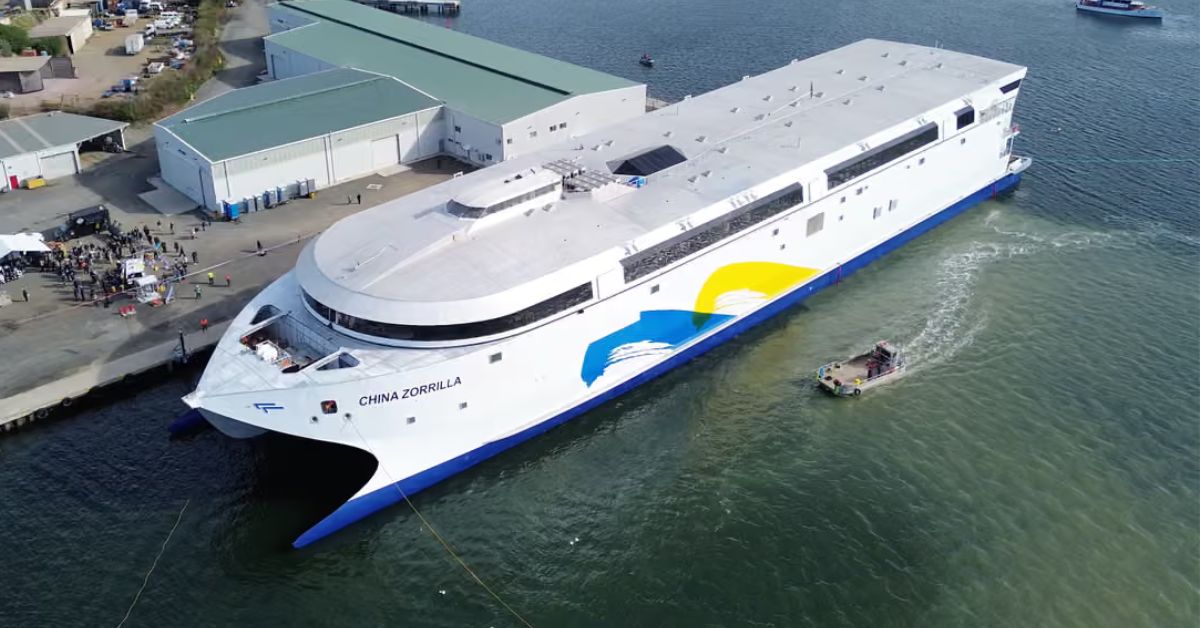

The world’s largest battery-electric ship, Hull 096, has departed Tasmania aboard the giant heavy-lift vessel Black Marlin, beginning a 40-day voyage to South America in what has been described as one of the most complex maritime operations ever undertaken in Tasmania.
How was the electric ferry loaded onto the heavy-lift vessel?
The semi-submersible Black Marlin, one of the world’s largest heavy-lift ships, partially submerged its cargo deck to allow Hull 096 to be manoeuvred into position above it. Once the 130-metre ferry was correctly positioned, Black Marlin pumped out its ballast water, gradually lifting the vessel clear of the waterline for transport. The operation took place on the River Derwent, with Black Marlin, a 217-metre semi-submersible operated by Boskalis, having sailed from South Africa to Tasmania specifically for the delivery.
What are the specifications of this record-breaking vessel?
Built by Australian shipbuilder Incat Tasmania in Hobart, the ferry carries more than 250 tonnes of batteries with over 40 megawatt-hours of energy storage supplied by Corvus Energy, making it comfortably the largest battery-electric vehicle of any kind built to date. The vessel has a passenger capacity of 2,100 and can carry 225 vehicles, powered by electric motors driving a waterjet propulsion system with electrical integration by Wärtsilä.
Where is the ferry headed and who will operate it?
Hull 096 will be delivered to the River Plate region, where it will be unloaded, commissioned and prepared to enter regular service with ferry operator Buquebus on routes between Buenos Aires, Argentina, and Colonia, Uruguay. The vessel will bear the name China Zorrilla once it enters commercial service.
What did Incat leadership say about this milestone?
Incat Chairman Robert Clifford described Hull 096’s departure as a proud day for the company, calling it a defining moment not only for Incat but for the future of sustainable maritime transport. He said the project has been the biggest and most ambitious in the company’s history, reflecting the skill, dedication and innovation of Incat’s entire workforce.
How did regional maritime disruption affect the delivery timeline?
The departure came months later than originally planned, with Black Marlin’s arrival delayed by disruption at the Strait of Hormuz, illustrating how the broader conflict affecting global shipping routes has rippled into delivery schedules even for vessels built specifically to move the industry away from fossil fuels.
What does this mean for Incat’s future shipbuilding programme?
With Hull 096 now departed, Incat Tasmania is turning its full attention to its aluminium electric shipbuilding programme, announced late last year, which will see five large sustainable aluminium vessels built at the company’s Hobart shipyard, reinforcing Tasmania’s role in advancing large-scale battery-electric propulsion technology for commercial maritime operations.
 Join our WhatsApp channel for more updates:
 Subscribe to our YouTube channel for more updates: