




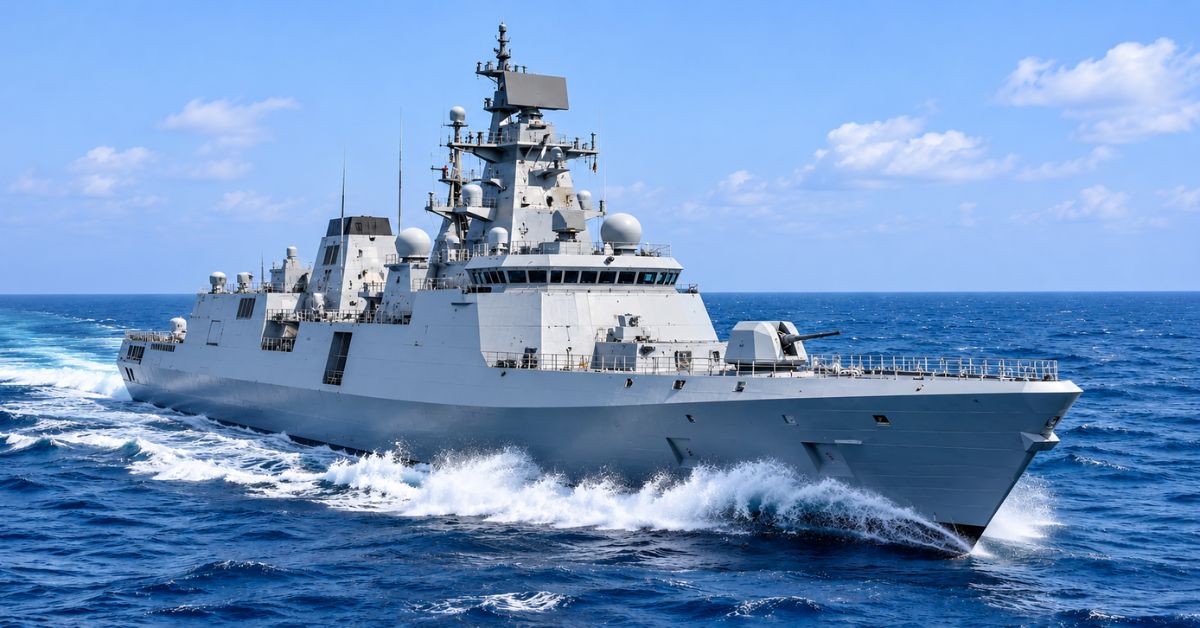

The Cabinet Committee on Security (CCS), chaired by Prime Minister Narendra Modi, has reportedly approved a programme worth more than ₹40,000 crore to build eight next-generation corvettes for the Indian Navy. Garden Reach Shipbuilders & Engineers (GRSE) and Goa Shipyard Limited (GSL) are expected to construct the vessels, with formal contracts to follow.
The clearance was granted at the committee’s meeting on 28 October 2026, according to government officials cited in reports. The first vessel is targeted for delivery by 2030. The approval advances a procurement programme that received its initial clearance in June 2022.
Which shipyards are expected to build the corvettes?
Kolkata-based GRSE is expected to construct five vessels, with Goa Shipyard building the remaining three.
GRSE’s stock exchange disclosure dated 21 May 2025 confirmed that it had emerged as the lowest bidder when the Ministry of Defence opened commercial bids for the eight-ship programme in New Delhi.
The filing stated that the lowest bidder would receive five corvettes at a likely value exceeding ₹25,000 crore. That figure represented the company’s expectation at the bidding stage, rather than a signed contract value.
The reported CCS clearance is therefore a further procurement milestone. Final contracts will establish the shipyards’ binding obligations, agreed prices and delivery schedules.
What missions will the new corvettes undertake?
The Next Generation Corvette (NGC) programme is intended to provide versatile surface combatants for surveillance, escort duties, deterrence, search-and-attack missions and coastal defence.
The Ministry of Defence’s original procurement announcement also identified operations within a Surface Action Group, a formation of warships operating together, among the planned roles.
The vessels are to be based on a new design developed in-house by the Indian Navy, using contemporary shipbuilding technology. This indigenous design approach was specified when the programme received its initial approval.
Current reports describe vessels of approximately 2,000 tonnes displacement, capable of speeds of around 30 knots. These particulars remain reported programme specifications pending detailed contractual disclosures.
How has the procurement programme progressed?
On 6 June 2022, the Defence Acquisition Council (DAC), chaired by Defence Minister Rajnath Singh, granted Acceptance of Necessity (AoN) for the corvettes at an estimated cost of approximately ₹36,000 crore.
The decision formed part of a wider ₹76,390-crore package of capital acquisition proposals involving domestic procurement categories.
AoN established the requirement for the acquisition. The programme subsequently progressed to commercial bidding, with GRSE confirming its lowest-bidder position in May 2025. The latest reported approval brings it closer to contract execution, more than four years after the initial decision.
What experience does GRSE bring to the project?
GRSE has previously built several corvette classes for the Indian Navy.
In its May 2025 announcement on the bidding outcome, the company listed six missile corvettes of the Khukri and Kora classes and four Kamorta-class anti-submarine warfare corvettes among its deliveries.
That experience provides a relevant industrial foundation for the proposed new vessels, although the NGC programme involves a separate design and procurement process.
What happens after the approval?
Formal contract signing will be the next substantive milestone. It will clarify the final commercial terms and the construction programme across the two shipyards.
The reported 2030 target concerns the first vessel, rather than completion of all eight ships. Subsequent disclosures will be needed to establish the full delivery sequence, detailed equipment configuration and construction milestones.
For India’s shipbuilding sector, the programme represents a substantial prospective workload spanning hull construction, machinery integration, onboard systems and testing. Its execution will depend on coordinated design, procurement and production across the participating yards.
 Join our WhatsApp channel for more updates:
 Subscribe to our YouTube channel for more updates:




