





Summary
The 21st Maritime State Development Council, its first meeting as a statutory body under the Indian Ports Act, 2025, concluded in Mumbai on October 13. Chaired by Union Minister Sarbananda Sonowal, the Council set a March 2027 deadline for One Nation One Port Process reforms and Sagar Setu integration across all ports, mandated electronic tariff publication and launched two credit risk insurance products for shipbuilders.
Article
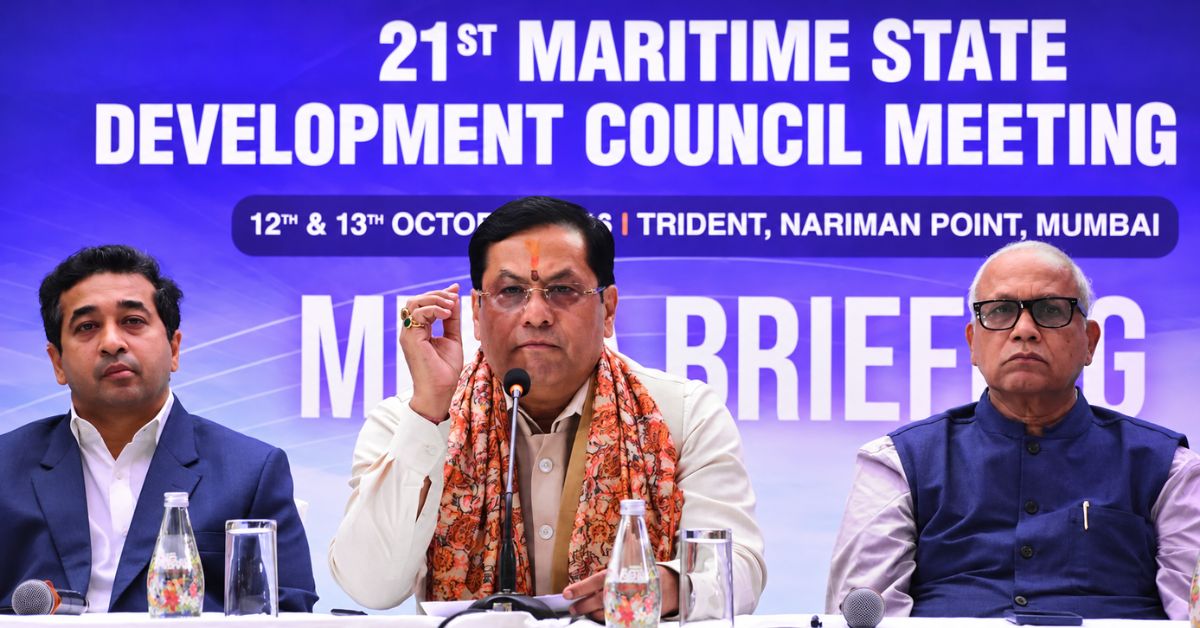
Mumbai: The 21st Maritime State Development Council (MSDC) concluded in Mumbai on October 13, 2026, with the Centre and coastal states agreeing on deadlines for port process reforms, digital integration and port-led industrial development.
It was the first meeting of the Council since it became a statutory consultative body under the Indian Ports Act, 2025, notified on May 15, 2026. Originally constituted in 1997, the MSDC now has an enhanced mandate covering integrated maritime growth, coordinated policy and planned infrastructure development.
Who attended the meeting?
Union Minister for Ports, Shipping and Waterways Sarbananda Sonowal chaired the meeting. Participants included Gujarat Finance Minister Kanubhai Desai, Goa Ports Minister Digambar V. Kamat, Maharashtra Fisheries and Ports Development Minister Nitesh Rane and Puducherry Minister Malladi Krishna Rao.
Maritime board heads from Andhra Pradesh, Odisha, West Bengal, Karnataka, Tamil Nadu and Kerala attended, along with chairpersons of major ports including Deendayal, JNPA, Mumbai, Cochin, Chennai, Visakhapatnam, Paradip, SMP Kolkata, Kamarajar and Mormugao. The meeting was preceded by visits to the Mumbai Port cruise terminal and JNPA.
What deadlines were set?
The Council resolved that One Nation One Port Process (ONOP) reforms, including One Nation One Documentation, port process re-engineering and inter-ministerial reforms, be implemented across all ports by March 2027. All ports must also integrate with the Maritime Single Window, Sagar Setu, by the same date.
Electronic publication of port tariffs was made mandatory. Sonowal launched a Ready Reckoner for implementing ONOP at major and non-major ports, referencing circulars from CBIC, MHA and MoHFW.
States and Union Territories were instructed to notify subordinate rules under Section 77 of the Indian Ports Act within three months. The Council also approved draft MSDC regulations and guidelines on port data and tariff transparency.
What did the Council decide on planning and industry?
The Council adopted the targets of Maritime India Vision 2030 and Maritime Amrit Kaal Vision 2047, which cover more than 500 initiatives. States were urged to prepare Port Master Plans for non-major ports, using the standard template adopted by major ports.
It endorsed the National Perspective Plan and asked states to fast-track multimodal connectivity through road, rail, inland waterways, pipelines and conveyors. States will work with the ministry to develop port-linked industrial clusters with plug-and-play infrastructure and faster approvals.
The Council also backed Sagarmala connectivity projects, the National Coastal and Inland Shipping Strategic Plan, a modal shift to coastal shipping, shipbuilding, ship-repair and recycling clusters, and cruise infrastructure at major and non-major ports.
What are the new shipbuilding insurance products?
Sonowal launched two credit risk insurance products under the Shipbuilding Development Scheme:
- Shipbuilding Project Credit Risk Insurance Policy (SbPCP), developed by ECGC Ltd for export projects
- Business Credit Shield Policy–Shipbuilders (BCSPS), developed by The New India Assurance Co. Ltd for domestic projects
The government will subsidise premiums and provide direct support to insurers when shipyards file claims. Sonowal said “a single missed milestone payment could stall an entire shipyard’s operations,” and that the policies would give yards a safety net against delayed payments and market shocks.
The products are part of the ₹69,725 crore shipbuilding and maritime package approved by the Union Cabinet in September 2025. That package includes the ₹19,989 crore Shipbuilding Development Scheme, which provides for risk coverage and insurance support, along with a ₹25,000 crore Maritime Development Fund.
Why does it matter?
Giving the MSDC statutory backing turns Centre-state coordination into a structured process with binding timelines. For port users, a uniform ONOP rollout and full Sagar Setu integration by March 2027 could cut documentation, standardise processes across major and state ports, and improve tariff transparency.
The insurance products target one of the biggest risks for Indian shipyards: payment delays on long, capital-intensive projects. Lowering that risk could improve yards’ access to finance and their ability to bid for larger domestic and export orders.
FAQs
What is the Maritime State Development Council?
It is a Centre-state body formed in 1997 to coordinate maritime development, now a statutory consultative body under the Indian Ports Act, 2025.
What is the ONOP deadline?
One Nation One Port Process reforms must be implemented across all ports by March 2027.
What is Sagar Setu?
It is India’s Maritime Single Window, which all ports must integrate with by March 2027.
What shipbuilding insurance products were launched?
SbPCP by ECGC for export projects and BCSPS by New India Assurance for domestic projects, with government-subsidised premiums.
What must states do under the Indian Ports Act?
States and Union Territories must notify subordinate rules under Section 77 of the Act within three months.
 Join our WhatsApp channel for more updates:
 Subscribe to our YouTube channel for more updates:



