




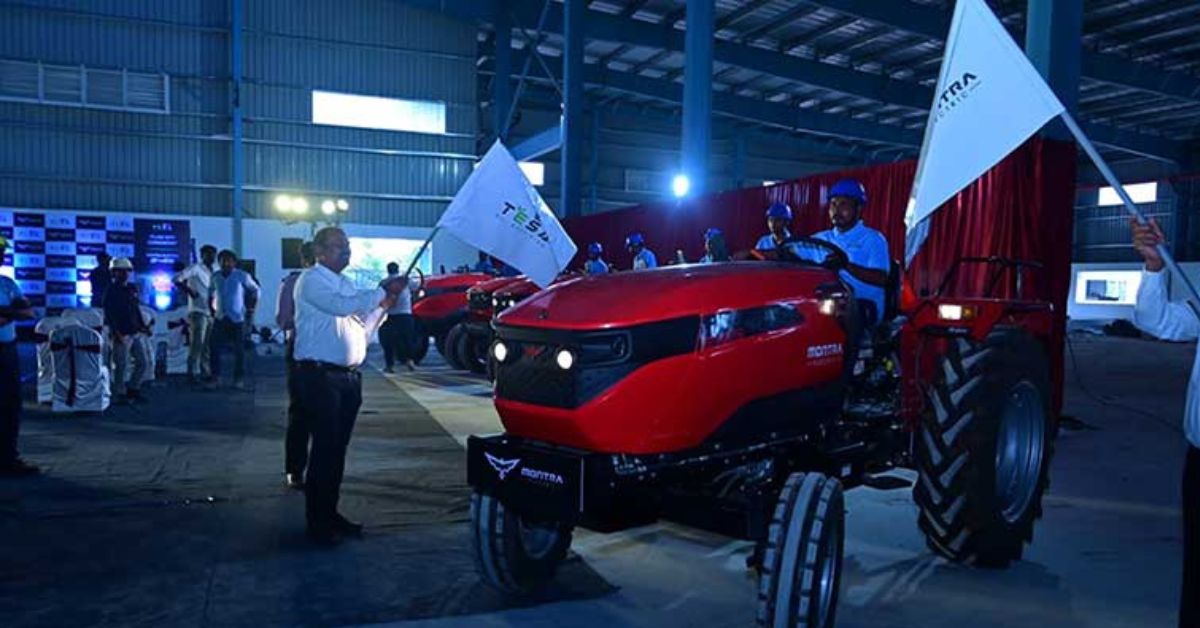

Montra Electric has deployed seven E-45 electric tractors at Action TESA’s manufacturing facility in Visakhapatnam, Andhra Pradesh, to support material movement within the plant. Announced on 5 November 2026, the deployment introduces electric vehicles into the company’s medium-density fibreboard (MDF) operations as an alternative to diesel-powered equipment.
The initiative focuses on internal industrial logistics, allowing Action TESA to assess the tractors’ performance, reliability and suitability for routine material-handling duties.
What savings are expected from the deployment?
Company estimates put potential annual diesel savings at approximately 50,000 litres, with avoided tailpipe carbon dioxide emissions of 131 tonnes. The deployment is also projected to reduce annual operating expenditure by around ₹40 lakh.
These figures are forecasts rather than reported savings from a completed year of operation. The emissions estimate specifically concerns tailpipe carbon dioxide and does not represent a full lifecycle assessment.
Montra Electric managing director Jalaj Gupta identified the MDF and plywood industries as potential markets for electric material-handling equipment. Action TESA managing director Vivek Jain said the company was evaluating alternatives that could reduce diesel dependence while maintaining operating performance.
How does the deployment fit Action TESA’s expansion?
The tractor deployment follows the commissioning of Action TESA’s manufacturing facility at Ramabilli, Visakhapatnam, in October 2026. According to the company, the new plant doubled its annual production capacity and was developed to strengthen its presence across southern and eastern India.
Action TESA, established in 2009 as part of the Action Group, also operates a manufacturing facility at Sitarganj in Uttarakhand. Its products serve the furniture and interiors industries, with a portfolio covering MDF, particle boards, specialised engineered-wood panels and flooring.
The Visakhapatnam investment therefore provides the manufacturing setting for the electric tractor deployment, with internal cargo movement forming part of the plant’s operating requirements.
What production infrastructure supports the new plant?
As part of the Visakhapatnam project, Action TESA selected Austrian technology group ANDRITZ to supply a pressurised refining system for MDF production.
Announced in November 2025, that order specified fibre-processing capacity of 33 tonnes per hour. The equipment package included a plug screw feeder, an S1056 refiner, a pressurised digester and a material-feeding system.
The refining equipment and electric tractors perform different roles: the former supports fibre production, while the latter is being introduced for material movement within the facility. Together, they illustrate the separate production and logistics requirements associated with commissioning the plant.
How is Montra developing its electric tractor business?
Montra Electric, backed by the Murugappa Group, includes tractors within a wider commercial electric vehicle portfolio.
Its tractor development programme also involves transmission engineering. In March 2026, Carraro India announced a contract with TI Clean Mobility, the company behind Montra Electric, to industrialise an electric transmission system for a new generation of agricultural tractors.
That agreement concerns product development and does not establish the transmission specification of the seven E-45 units supplied to Action TESA. It nevertheless provides background to Montra’s investment in electric tractor technology beyond individual customer deployments.
What will determine the operational outcome?
The immediate task is to establish how the seven tractors perform under the plant’s daily workload. The announcement does not provide independently verified operating results or sufficient information to calculate a payback period.
For Action TESA, the deployment creates a basis for assessing diesel displacement and operating expenditure against actual utilisation. The projected savings will depend on the vehicles’ performance in service and the costs associated with charging and maintaining them.
 Join our WhatsApp channel for more updates:
 Subscribe to our YouTube channel for more updates:




