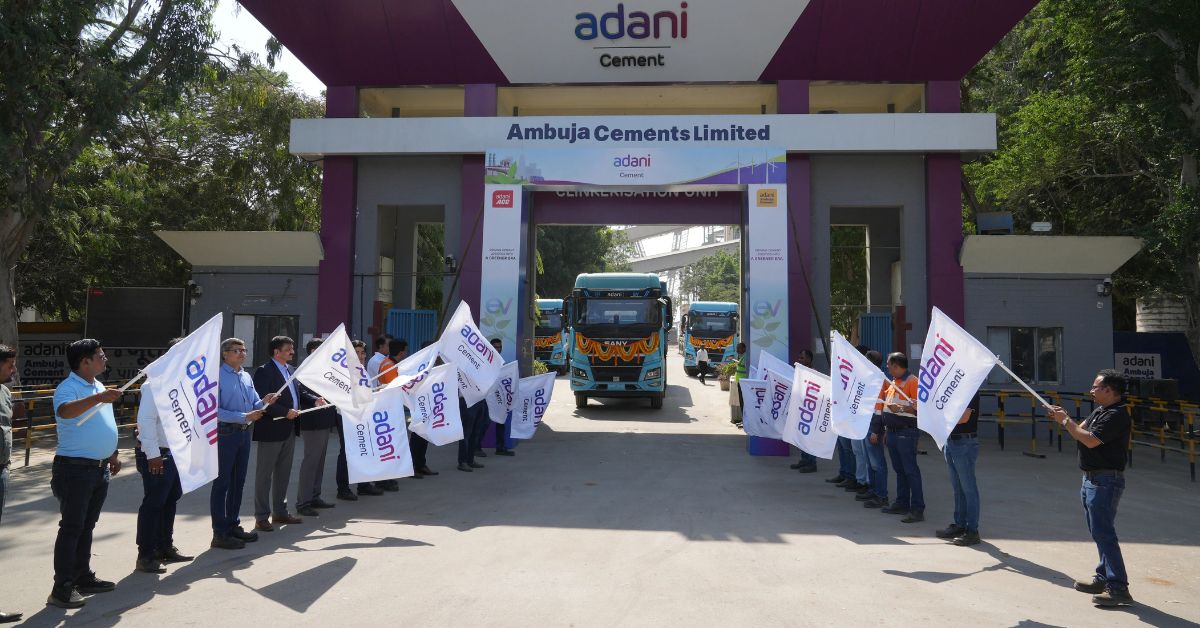

Adani Cement has begun deploying heavy-duty electric trucks at its Sanghi plant in Gujarat, launching a programme to electrify clinker and cement transportation. Announced on 18 November 2026, the first phase targets 410 electric vehicles by March 2027, with further deployment planned across other plants and routes.
The company aims to move 10% of its road logistics volume through electric trucks by 2030, supported by a fleet exceeding 2,000 vehicles.
What will the first phase deliver?
Adani Cement projects that the planned 410-truck fleet will reduce carbon dioxide emissions by more than 25,000 tonnes annually and displace approximately 11 million litres of diesel consumption each year.
These figures represent expected benefits from the planned fleet, rather than measured savings from the initial Sanghi deployment.
Vinod Bahety, Chief Executive Officer of Adani Group’s cement business, said the company had identified additional routes for electric transport. “Every truck we electrify reduces our carbon footprint and insulates our logistics cost base from diesel price volatility,” he said.
Why are electric trucks becoming more competitive?
The company cited changing fuel and technology costs as drivers of its decision, pointing to higher diesel prices alongside falling battery costs and solar tariffs over the past decade.
The International Energy Agency’s (IEA) Global EV Outlook 2026 provides a wider perspective on the economics. Electric trucks remain two to three times more expensive to purchase than diesel vehicles, but their total cost of ownership is already competitive in China and is declining in other markets.
This distinction matters for freight operators: the purchase price is only one component of a vehicle’s lifetime cost. Energy expenditure and the practical arrangements for charging also influence the commercial case.
The IEA identifies overnight charging at private depots as generally the most attractive option for electric buses and trucks because of its lower power requirements and typically lower cost. However, the suitability of that approach depends on operating schedules and the time vehicles spend at their depots.
What policy support exists for heavy freight electrification?
India introduced dedicated electric truck incentives in July 2025 under the PM Electric Drive Revolution in Innovative Vehicle Enhancement, or PM E-DRIVE, scheme.
At launch, the programme provided for incentives of up to ₹9.6 lakh per eligible truck, depending on gross vehicle weight, with support intended for approximately 5,600 vehicles. The Ministry of Heavy Industries identified cement, ports, steel and logistics among the sectors expected to benefit.
The eligibility framework covered trucks weighing more than 3.5 tonnes and up to 55 tonnes. For articulated vehicles, assistance applied to the tractor unit. It also required the scrapping of older trucks to qualify for incentives.
Manufacturer-backed warranties formed another part of the framework. Batteries required coverage for five years or 500,000 kilometres, whichever came first, while the vehicle and motor required five years or 250,000 kilometres of coverage. These provisions were designed to address reliability concerns as operators adopted electric heavy vehicles.
How does the rollout fit the wider freight transition?
The Sanghi deployment comes as electric trucks gain a larger role in global freight investment. Under current policies, the IEA projects that electric vehicles will account for at least 20% of worldwide truck sales by 2035, with China leading adoption.
That outlook highlights the importance of matching vehicle investment with charging infrastructure. For industrial operators, fleet expansion involves coordinating transport schedules, electricity supply and charging availability alongside vehicle procurement.
Adani Cement’s phased targets place those operational requirements at the centre of its move from an initial plant deployment towards a larger road freight fleet.
 Join our WhatsApp channel for more updates:
 Subscribe to our YouTube channel for more updates: