




Aderco is giving ship owners a way to monetise the dry dock investments. The approach is straightforward, the methodology is certified, and the numbers are compelling
In the crowded and compliance-heavy world of maritime decarbonisation, most conversations begin with cost. The cost of new technology. The cost of compliance. The cost of retrofitting a fleet that was built for a different regulatory era. Aderco begins the conversation differently. It begins with revenue.
The 2055G+ programme combines advanced fuel treatment with a carbon monitoring and verification service designed to generate measurable financial value.
Aderco brings more than 45 years of experience in developing and supplying liquid fuel treatment solutions to the global maritime industry. Through its partnership with Adi Terra, a specialist in MRV (Monitoring, Reporting and Verification) services for energy efficiency and carbon credit projects, operational performance data can be transformed into independently verified emissions reductions that are eligible for certification under recognised carbon standards.
Esteve Servajean, Aderco’s Head of Marine says that the 2055G+ programme was built directly using observations made over decades of operational deployment across thousands of vessels.
“We provide a range of additives and treatments for any kind of liquid fuels, from distillate, residual, and even biofuels. They include Aderco 2055G, whose main purpose is to homogenise the fuel, clean and protect components, maximise the energy potential and minimise emissions, and to solve fuel-related problems before, during and after combustion.”
Introducing Aderco 2055G fuel additive helps shipowners make fuel savings and improve vessel performance in ways that also align with regulatory goals for decarbonisation, says Esteve. The additional opportunities to realise benefits as carbon credits are verified using the 2055G+ programme.
THE CARBON PROJECT
Esteve, describes the platform as a way to systematically convert operational efficiency gains into certified financial instruments.
“Greater fuel efficiency is always desirable but owners can also monetise their retrofit using 2055G+, with the first step involving establishing a dry dock cycle of historical consumption data based on noon reports. Once we have this data – what we call the baseline of the ship – we can then establish the average consumption of that ship.”
The baseline is constructed from five years of noon report data, the same data source that ship operators already generate for EU ETS compliance and IMO DCS reporting. There is no new reporting burden.
Once the baseline is established, the 2055G+ project period begins. After Aderco’s 2055G fuel additive is introduced, actual fuel consumption is monitored, with improvements in efficiency expressed as a percentage reduction against the established average consumption.
A minimum of six months of monitoring is required before results can be assessed, but the programme is designed for long-term continuous monitoring. Esteve explains why this deliberate preference for longer windows is a methodological advantage, rather than a limitation.
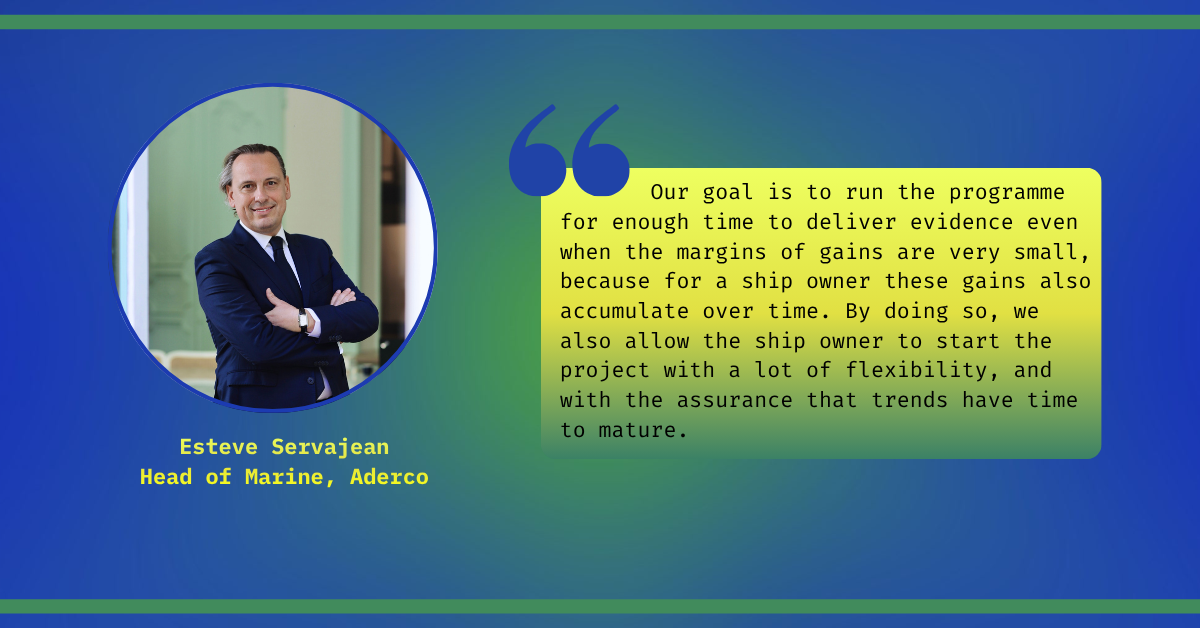
“Our goal is to run the programme for enough time to deliver evidence even when the margins of gains are very small, because for a ship owner these gains also accumulate over time. By doing so, we also allow the ship owner to start the project with a lot of flexibility, and with the assurance that trends have time to mature.”
To ensure integrity, strict operational filters are applied to the noon report data. The vessel must be underway for at least 23 hours in any given day for that day to count. Only laden voyage conditions are included. Any day on which the Beaufort sea state exceeds Force 6 is excluded. These filters eliminate outlier operating conditions and ensure that only genuinely comparable sailing data is used to calculate the efficiency ratio.
CERTIFICATION AND CREDIBILITY
The fuel-efficiency gains achieved through the 2055G+ programme are independently analysed and reported by Adi Terra, converting operational performance data into verified emissions reductions that can be monetised as carbon credits. For Aderco clients, this data is assessed against the requirements of the Gold Standard, one of the most respected and widely recognised certification bodies in the voluntary carbon market. Credits certified under the Gold Standard typically command premium pricing and benefit from stronger market demand and liquidity than lower-tier voluntary credits.
Aderco’s collaboration with Adi Terra has already gained significant traction in the retrofit market. The underlying methodology has also undergone independent validation by leading classification societies. Data from two vessels within Adi Terra’s monitoring programme was submitted to RINA and ABS respectively, with both organisations validating the methodology and certifying the results. This provides a critical layer of independent technical assurance and credibility.
According to Esteve, the first full certification cycle is now nearing completion. Thanks to the programme’s retroactive structure, vessels enrolled in 2055G+ are already accumulating carbon credits prior to final certification.
“We are finalising the certification, and once we have it, ships enrolled in the programme will already have generated carbon credits virtually, thanks to the two-year retroactive period. Vessels that have been using the product or participating in the programme for the past year are already building up a carbon credit position.”
THE FINANCIAL CASE
The numbers that sets out for a standard Capesize bulk carrier make the commercial argument with little need for elaboration.
“A standard Capesize vessel, the new generated carbon credits will be in the range of 30,000 to 40,000 dollars per year in new revenue. Plus, let us say three percent fuel savings over 220 sailing days per year at current HFO prices, which is around 270,000 dollars in fuel savings. So in total, around 300,000 dollars per year.”
Critically, this entire benefit accrues to the ship owner at no direct cash cost. The 2055G+ programme covers the monitoring, data analysis, and certification service, with a portion of the generated carbon credits retained as fees.
“Virtually there is no cost,” Esteve explains. “The ship owner is getting the carbon credits. with a portion withheld to cover all the costs. So virtually there is no money going outside. There are only benefits.”
SCALE AND AMBITION
Aderco currently operates with over 100 vessels in its 2055G+ monitoring pool, concentrated in VLCCs, Capesize bulk carriers, and large container ships. Where fuel treatment is concerned, Aderco offers support to approximately 4,000 to 5,000 vessels globally, working with Anglo-Eastern, Bernard Schulte, Fleet Management, Synergy Marine, Hafnia, Bergshav, and Evergreen, among others. That commercial footprint represents an immediate pipeline for growth.
One of the other important aspects of the 2055G+ methodology is its breadth. Because noon report data cannot isolate the impact of any single device or upgrade in isolation, the methodology takes a holistic view and captures the aggregate efficiency improvement from all retrofit measures implemented since the last dry dock.
“We are on the market for 45 years. We work with the big guys, but we are treating today, in total, something like 4,000 to 5,000 vessels. We can do much more. We are a simple drop in the ocean of shipping.”
The ambition is to triple or quadruple the monitoring pool within the next twelve months. As the first certification cycle completes and credits begin to be issued and traded, the company expects the demonstration effect to accelerate commercial uptake significantly.
For an industry searching for decarbonisation solutions that add financial value rather than simply adding cost, the 2055G+ retrofit proposition arrives at precisely the right moment. Ship owners are already doing the work. Aderco is simply making sure they secure a return on investment.
 Join our WhatsApp channel for more updates:
 Subscribe to our YouTube channel for more updates: