



Aegis Logistics, a prominent Indian oil and gas importer, storage and distribution firm, is in advanced talks to acquire UAE-based Tristar, West Asia’s biggest privately held liquid logistics enterprise, in a deal valuing the target at around $1.5 billion, according to a report by The Economic Times.
Why is this deal significant amid the ongoing Iran-US conflict?
The potential transaction represents a major consolidation within an industry facing intense volatility driven by the ongoing conflict, with the two companies currently holding bilateral negotiations under a pre-agreed exclusivity period. People aware of the development said talks could still fall apart before a definitive agreement is reached.
What does Tristar’s global footprint look like?
Tristar operates across more than 30 countries spanning Europe, the Americas, the Pacific, Asia, Africa and West Asia, providing transportation and storage services to major clients including Abu Dhabi National Oil Company, Total SA and Dow Inc. Tristar was the second-biggest controlled entity within parent group Agility’s portfolio, accounting for 28 percent of overall revenue and 5 percent of the workforce, according to Agility’s 2025 annual report. Tristar’s own revenue rose 14.4 percent to $1.4 billion, with controlled EBITDA holding steady at $257 million despite margin pressures in its maritime segment.
Who owns Tristar and what is its background?
Ownership is split among three main shareholders: Kuwait-based Agility Public Warehousing Company holds 65.21 percent, Gulf Investment Corp owns 19.6 percent, while founder and CEO Eugene Mayne controls the remainder. Tristar started in 1998 as a road transport operation before evolving into a comprehensive energy logistics provider for the downstream oil and gas sector. The company had previously attempted an $880 million IPO on the Dubai stock exchange in 2021 but withdrew the offering, which Mayne attributed to a mismatch in valuation expectations and investor education. Bloomberg reported in 2024 that the company had mandated deNovo Partners to run a formal sale process.
How does this fit into Aegis’s broader growth strategy?
Aegis, controlled by the East African billionaire Chandaria family through investment vehicles Huron Holdings Ltd and Trans Asia Petroleum Inc holding a 58.10 percent stake, has embarked on a major capex cycle. The company plans to invest $1.2 billion cumulatively through March 2027 and an additional Rs 5,000 crore by March 2028, with a broader investment opportunity of around $5 billion through December 2030. Management described the 2026 financial year as a “breakout year” on its June Q1FY27 earnings call, noting LPG distribution margins near Rs 7,000 per tonne are expected to remain sustainable. CFO Murad Moledina said the capex plan would be backed by a “war chest” combining equity, internal accruals and debt, while maintaining a “fortress balance sheet.”
How would the acquisition be financed?
Aegis plans to structure the $1.5 billion acquisition through a mix of debt and equity, intending to roll over or refinance Tristar’s existing $600 million debt load and secure an additional $400-500 million in fresh borrowing, with the remainder equity-financed. Tristar recently strengthened its own balance sheet, completing an $800 million syndicated financing in June backed by a consortium of Middle Eastern regional and global lenders. With a market capitalisation of Rs 45,156.15 crore, Mumbai-headquartered Aegis has begun talks with European and Indian private sector lenders to finance the buyout.
What does this mean for Aegis’s existing operations in India?
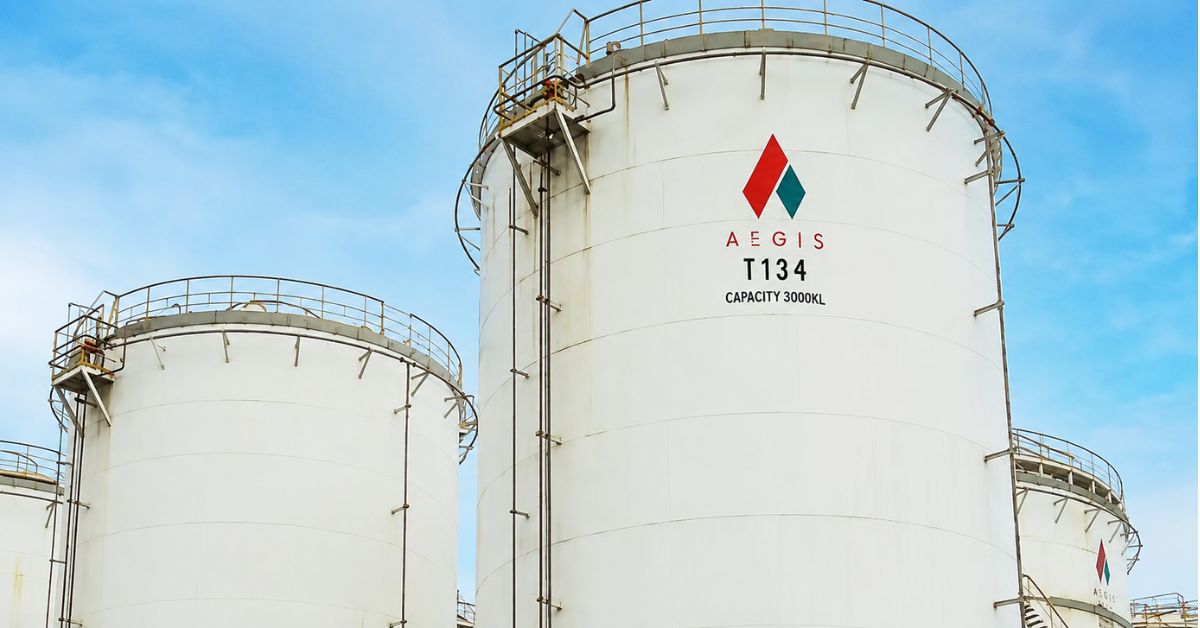
Aegis operates liquid and LPG storage terminals across key Indian ports including JNPT, Mangalore, Kandla, Kochi, Pipavav, Haldia and Mumbai, most of which are currently undergoing expansion. Its Gas Division generated approximately 90 percent of total revenue in FY25, while its higher-margin Liquid Division, handling edible oils, chemicals and petroleum goods, contributed the remaining 10 percent but serves as the primary profitability driver. A Tristar acquisition would significantly diversify Aegis’s global footprint beyond its India-centric operations into a truly international energy logistics platform.
 Join our WhatsApp channel for more updates:
 Subscribe to our YouTube channel for more updates: