
Summary
Amazon and Tata Motors have announced plans to deploy 3,000 electric trucks across Amazon’s Indian transportation network over three years. Beginning with 20 vehicles in Delhi, the programme will extend electrification into freight movement between facilities, supported by carrier partners, charging infrastructure and proposed expansion along major highway routes.
Delhi rollout begins with 20 trucks
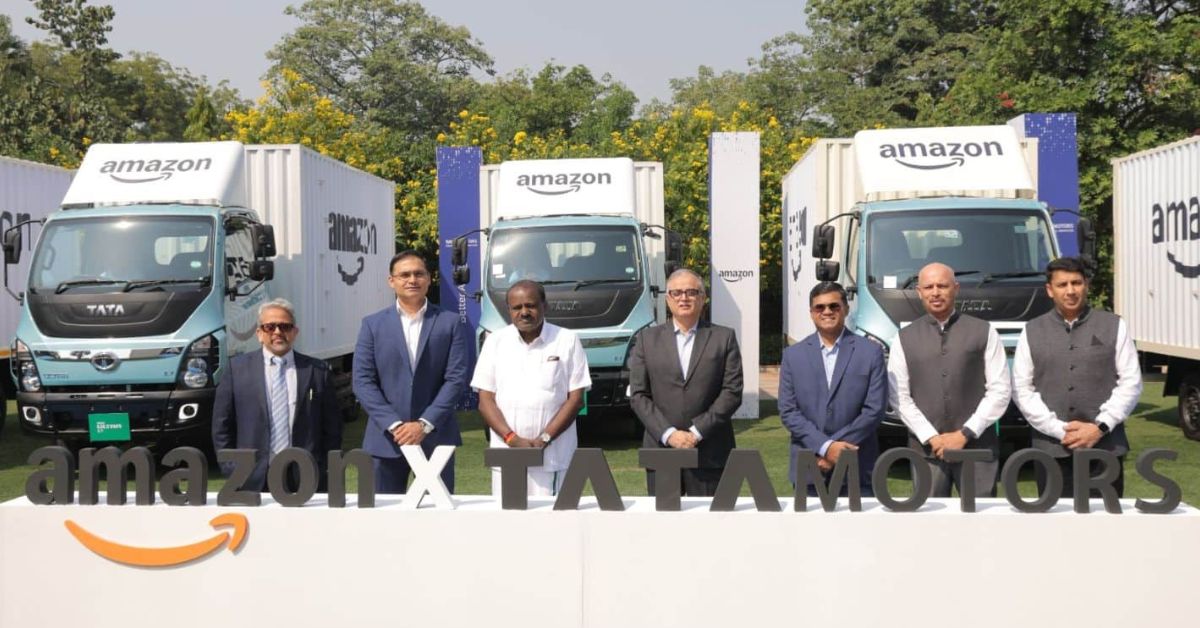
The Amazon electric trucks programme began in New Delhi on 27 October 2026, when the first 20 Tata Ultra E.7 vehicles were flagged off by Union Minister for Heavy Industries and Steel H. D. Kumaraswamy.
The collaboration envisages deploying 3,000 electric trucks within three years. The companies described it as the largest electric-truck deployment announced by an e-commerce business in India.
Initial operations will support freight movement during the festive season, when shipment volumes place additional demands on transport networks. The vehicles will carry goods between logistics facilities and support movements within cities.
The development broadens the role of electric vehicles in e-commerce logistics. Alongside vehicles delivering individual parcels, trucks moving consolidated shipments between facilities represent another opportunity to reduce dependence on diesel.
Carrier partners will own and operate vehicles
Tata Motors will supply the trucks, while Amazon’s carrier partners will purchase and operate them across its transportation network.
This structure places fleet ownership with transport operators, with Amazon providing the freight requirement around which deployment can be organised. The arrangement makes carrier participation central to the programme’s execution.
For operators, the commercial assessment extends beyond the purchase price. Vehicle utilisation, electricity costs, charging access, maintenance and financing will influence whether electric trucks can meet delivery schedules competitively.
Predictable movements between established logistics facilities offer a useful starting point. Departure times, loading requirements and available charging windows can be planned together, although performance will ultimately depend on each route’s operating conditions.
Highway expansion forms the next phase
After the initial urban deployment, the companies intend to expand electric trucking across major freight routes.
Their stated ambition includes electrifying the approximately 2,800-km Delhi–Bengaluru–Chennai corridor along National Highway 48. The proposed corridor spans seven states and connects six major e-commerce regions.
Charging infrastructure will support that expansion, including hubs being developed with commercial-vehicle charging provider Yahhvi. Amazon’s earlier work with Yahhvi includes 10 charging yards across India.
The highway programme is a network development objective. It will require vehicles, charging locations and operating schedules suited to the distances involved.
For logistics businesses, corridor infrastructure can be as important as vehicle availability. Reliable charging at appropriate locations helps determine which routes can be electrified and how vehicles can be scheduled without disrupting cargo movement.
Ultra E.7 supports initial operations
The first batch comprises Tata Ultra E.7 light-duty electric trucks.
Tata’s published specifications list a gross vehicle weight of 7.5 tonnes, a 14-foot load deck and a payload capacity of 3.1 tonnes with a container fitted.
The vehicle uses a 96 kWh lithium iron phosphate battery and has a stated range of up to 130 km. Features include CCS2-compatible DC fast charging, regenerative braking, an integrated electric axle and connected fleet-monitoring capabilities.
These specifications are relevant to planning urban distribution and movements between nearby facilities. Actual operating range will depend on payload, traffic, driving conditions and energy use.
The initial model’s range also underlines why the broader highway ambition requires separate planning for vehicle selection and charging infrastructure.
Earlier freight trials provide background
Amazon has previously participated in electric freight trials beyond last-mile delivery.
Under Laneshift, a zero-emission freight initiative associated with The Climate Pledge, the company piloted long-range heavy-duty electric trucks on the 350-km Bengaluru–Chennai corridor with industry partners.
That earlier work provides relevant experience for the wider deployment, while the new agreement creates a larger requirement for vehicle supply, servicing and charging support.
For India’s logistics sector, the programme signals growing interest in electrifying regular commercial freight movements. Its progress will be measured through vehicles entering service, dependable fleet availability and the development of charging capacity alongside cargo demand. The three-year rollout gives the partners a defined period to demonstrate that the operating model can scale.
FAQs
How many electric trucks are planned?
Amazon and Tata Motors plan to deploy 3,000 electric trucks within three years.
Has deployment already started?
Yes. The first 20 Tata Ultra E.7 trucks were flagged off in Delhi on 27 October 2026.
Who will own and operate the trucks?
Amazon’s carrier partners will purchase and operate them, with Tata Motors supplying the vehicles.
Which highway corridor is being targeted?
The expansion ambition includes the approximately 2,800-km Delhi–Bengaluru–Chennai corridor along NH48.
Who is supporting charging infrastructure?
Yahhvi is developing charging infrastructure to support the expansion.
 Join our WhatsApp channel for more updates:
 Subscribe to our YouTube channel for more updates: