




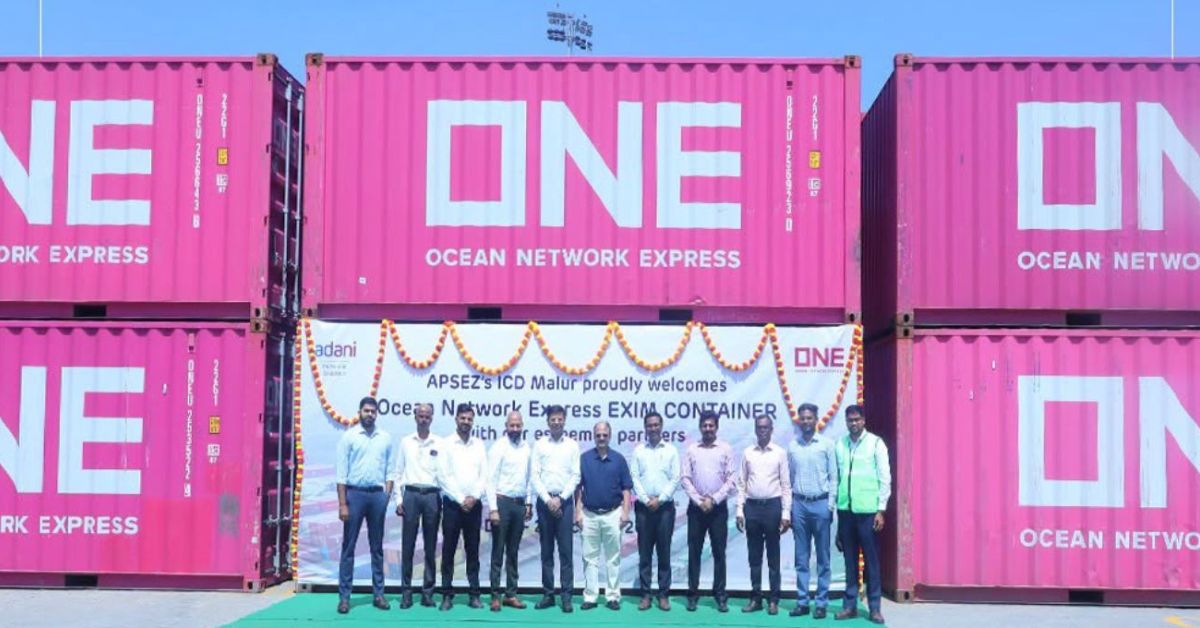

Adani Ports and Special Economic Zone (APSEZ) has launched export-import (EXIM) container movement between its Inland Container Depot (ICD) at Malur, near Bengaluru, and Adani Kattupalli Port in collaboration with Ocean Network Express (ONE).
The initiative connects the inland facility in Karnataka with the Tamil Nadu maritime gateway, aiming to improve access to international shipping services for businesses in the Bengaluru region. Participants include ONE, Emmvee Group, Guangzhou Uniglobal Logistics Malaysia and other stakeholders.
According to the announcement, the collaboration is intended to improve supply-chain efficiency through coordinated inland logistics and port services. It did not specify the inaugural shipment’s cargo volume, service frequency, transit time or overseas destination.
What does the Malur–Kattupalli connection offer?
The new movement brings together an inland container facility, a gateway port and a shipping line within a coordinated cargo arrangement. For regional exporters and importers, its stated purpose is to strengthen the connection between inland cargo handling and international maritime transport.
The development adds a ONE-linked movement through Kattupalli to Malur’s existing operations. It does not mark the depot’s first container activity: APSEZ’s annual report for 2025–26 records the arrival of Malur’s first import rake in January 2026.
The latest announcement identifies the participating organisations but does not detail their individual contractual responsibilities. It also does not establish a regular train timetable or quantify expected savings in transport costs.
How is Malur connected to the regional logistics network?
The Malur ICD is situated on the Bengaluru–Chennai railway main line near Malur station. The facility has its own rail siding, with road access through National Expressway 7 and National Highway 44.
These connections provide infrastructure for combining rail and road transport between the inland terminal, manufacturing locations and maritime gateways. The depot’s location places it within the transport corridor linking the Bengaluru region with ports on India’s south-eastern coast.
Adani Logistics lists Malur among its rail-connected multimodal logistics parks. Its wider inland network includes facilities at Patli, Tumb, Kilaraipur, Nagpur, Loni, Kishangarh and other locations, supporting container movements between gateway ports and inland markets.
What facilities are available at Kattupalli Port?
Kattupalli is a multi-cargo port north of Chennai, outside the city limits. Its container services include facilities for Direct Port Delivery, which enables eligible imports to move directly from the port, and Direct Port Entry for factory-stuffed, self-sealed export containers.
The port also offers container freight station services and connections to national highways and nearby cargo-handling facilities. According to APSEZ, its shipping network includes direct services to the Far East, Middle East and Southeast Asia.
The port’s published marine specifications allow vessels with a draught of up to 15 metres and container ships up to 390 metres long. These are port-wide capabilities, rather than specifications of the newly announced Malur movement.
Manufacturing customers feature in the collaboration
Emmvee Group’s participation connects the initiative with the Bengaluru region’s manufacturing base. The company operates in solar photovoltaic modules and cells, alongside other solar-energy products, and lists manufacturing facilities in Karnataka, including locations in Bengaluru Rural district.
Its published plant addresses include facilities at Dobaspet and in the Hoskote area. However, the container-movement announcement does not identify the goods handled, so the inaugural consignment cannot be characterised as solar modules, cells or manufacturing inputs.
For APSEZ, the collaboration forms part of its wider approach to connecting ports, inland depots, rail transport, trucking and warehousing. The Malur–Kattupalli movement adds a specific shipping-line partnership to that network, with improved regional trade connectivity as its stated objective.
 Join our WhatsApp channel for more updates:
 Subscribe to our YouTube channel for more updates:




