



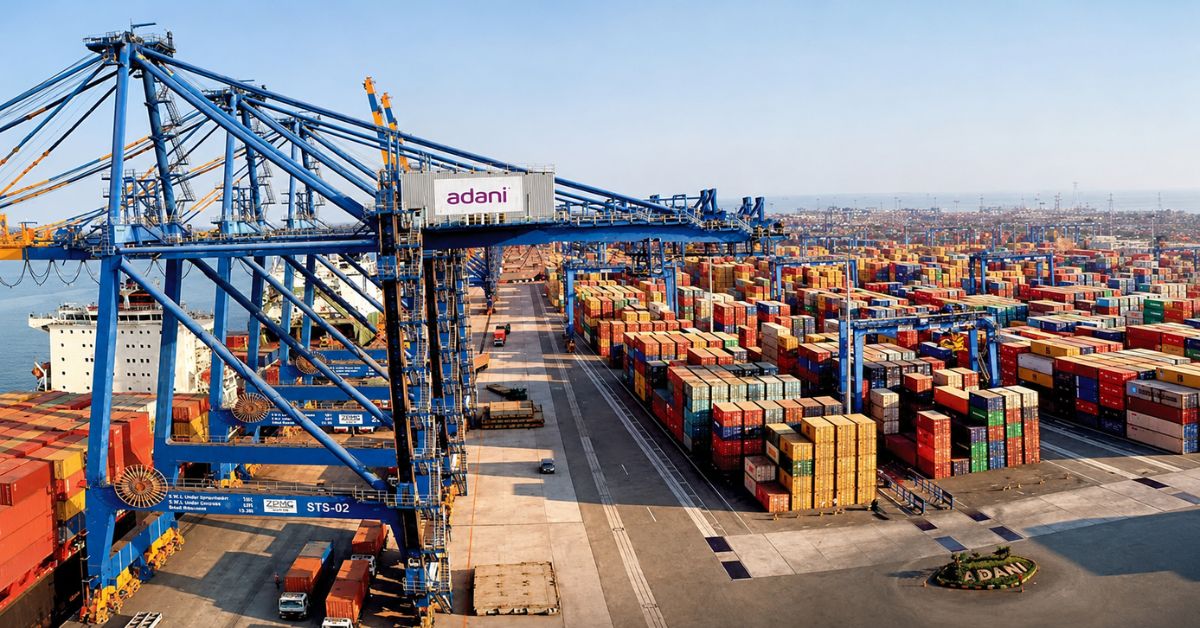

Adani Ports and Special Economic Zone reported a 10 percent rise in net profit to Rs 36.50 billion for the quarter ended June 30, 2026, with growth led by a sharp expansion in its international ports and marine businesses.
How did APSEZ perform financially in Q1 FY27?
Consolidated revenue rose 19 percent year on year to Rs 108.21 billion, while EBITDA grew 19 percent to Rs 65.41 billion. Profit after tax increased 10 percent to Rs 36.50 billion, reflecting broad-based growth across the company’s diversified business segments.
What drove growth in APSEZ’s international ports business?
International ports revenue jumped 80 percent to Rs 17.47 billion, with EBITDA surging 256 percent to Rs 7.30 billion, driven by strong performances in Australia and Colombo. Volumes rose to 22.8 million tonnes from 7.7 million tonnes a year earlier, aided by the addition of NQXT Australia and continued ramp-up at Colombo. Australia contributed 10 million tonnes, followed by Colombo at 6.9 million tonnes, Tanzania at 3.7 million tonnes and Israel at 2.2 million tonnes. EBITDA margin for the segment expanded sharply to 41.8 percent from 21.1 percent a year earlier, with Colombo revenue up five-fold year on year and Tanzania revenue rising 36 percent.
How did the domestic ports and marine businesses perform?
Domestic ports revenue grew 12 percent year on year, supported by higher cargo volumes of 115.3 million tonnes compared to 112.9 million tonnes in the same quarter last year, along with an improved cargo mix and better realisations. The segment maintained a best-in-class EBITDA margin of 74 percent. Domestic ports capacity stood at 653 million tonnes as of June 30, 2026, with APSEZ targeting expansion to 1,000 million tonnes by December 2030. All-India cargo market share stood at 27.6 percent, while container cargo market share stood at 44.8 percent.
The marine business posted 67 percent revenue growth to Rs 9.01 billion, supported by offshore vessel additions, with the fleet growing to 135 vessels from 118 a year earlier, and expansion of European subsea operations, including a new partnership with Oceaneering International and a 10-year contract supporting Argentina’s first LNG exports to India.
What impact did the Middle East crisis have on logistics operations?
The logistics business saw rail TEU volumes decline to 145,310 in Q1 FY27 from 179,479 a year earlier, impacted by the ongoing Middle East crisis. However, asset-light operations continued to expand, with trucking revenue up 26 percent year on year and International Freight Network revenue up 28 percent sequentially.
What did company leadership say about the results?
Ashwani Gupta, Whole-time Director and CEO of APSEZ, said the quarter’s performance underscored the strength of the company’s diversified business model, with domestic ports remaining the bedrock of earnings while international ports, marine and logistics transitioned from scale-up to scale-value as increasingly important growth drivers. He said the balanced growth reinforced confidence in achieving the company’s Ambition 2031 target, supported by domestic capacity expansion, a growing international portfolio and a scaling logistics ecosystem.
 Join our WhatsApp channel for more updates:
 Subscribe to our YouTube channel for more updates: