




How Artificial Intelligence is Transforming the Maritime Industry
Artificial intelligence in the maritime industry is transforming shipping by improving efficiency, safety, sustainability and decision-making. The maritime industry has always been the backbone of global trade. Every day, thousands of vessels move essential commodities, consumer goods, energy resources, and raw materials across oceans, connecting economies and keeping supply chains running. Yet despite its critical role in world commerce, the industry is facing a growing list of challenges.
Rising fuel costs, increasingly complex supply chains, stricter environmental regulations, port congestion, geopolitical disruptions, and a shortage of skilled maritime professionals are forcing industry stakeholders to rethink traditional ways of operating. At the same time, customers expect greater visibility, faster deliveries, and more reliable services than ever before.
In response, the maritime sector is accelerating its digital transformation efforts, with artificial intelligence (AI) emerging as one of the most talked-about technologies in the industry today.
From optimizing vessel routes and predicting equipment failures to improving cargo visibility and enhancing port operations, AI is gradually moving from experimental projects to real-world applications. But amid the growing excitement, an important question remains:
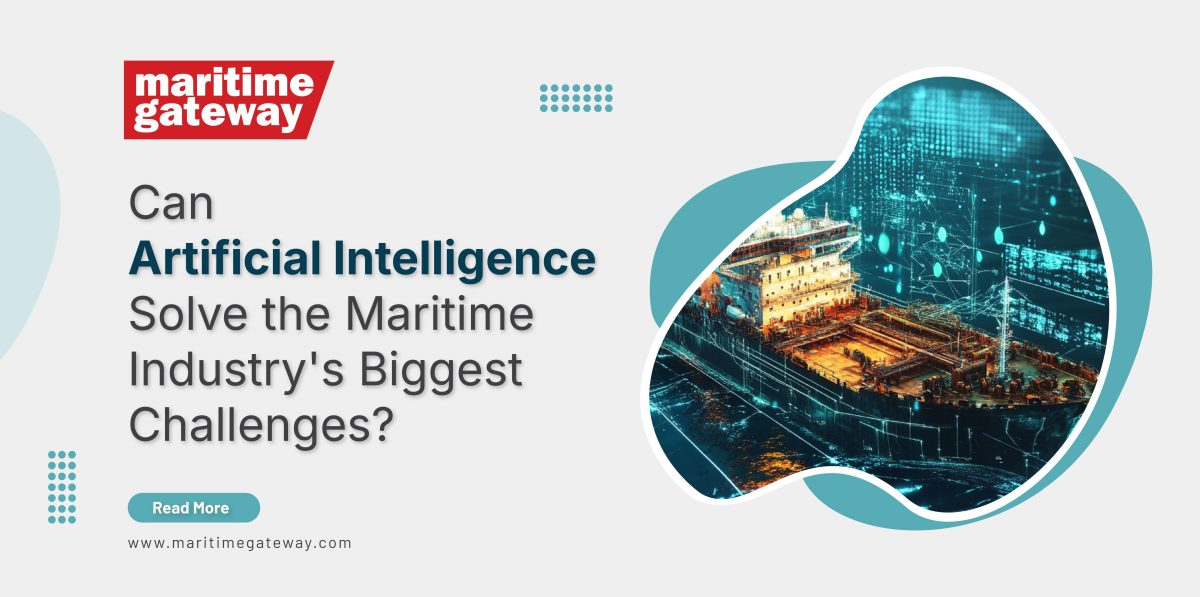
Can artificial intelligence truly solve the maritime industry’s biggest challenges, or is it simply another technology trend?
While AI may not offer a single solution to every problem, its ability to improve decision-making, increase efficiency, and support sustainability goals is already reshaping maritime operations across the globe.
Why Is the Maritime Industry Suddenly Talking About AI?
For decades, the maritime industry was considered relatively conservative when it came to technology adoption. While sectors such as finance, retail, and manufacturing rapidly embraced digital tools, shipping often relied on established processes and manual decision-making.
That is beginning to change.
The volume of data generated by vessels, ports, logistics networks, and cargo operations has increased dramatically. Modern ships are equipped with sensors that continuously monitor engines, fuel consumption, navigation systems, and equipment performance. Ports generate massive amounts of operational data through cargo movements, vessel traffic, and terminal activities.
At the same time, the industry is under pressure to do more with less.
Shipowners are looking for ways to reduce operational costs. Ports are seeking higher efficiency without significant infrastructure expansion. Logistics providers need greater visibility across increasingly complex supply chains. Regulators are pushing for lower emissions and stronger sustainability practices.
Artificial Intelligence offers a way to turn this growing volume of data into actionable insights.
Instead of relying solely on historical reports or human observation, AI systems can analyze thousands of variables in real time, identify patterns, predict outcomes, and recommend actions that improve operational performance.
As a result, AI is no longer being viewed as a futuristic concept. It is increasingly becoming a practical business tool.
Can AI Help Shipping Companies Operate More Efficiently?
Efficiency has always been a priority in shipping, but today’s economic environment has made it even more critical.
Fuel remains one of the largest operating expenses for shipping companies. Unexpected delays, inefficient routes, and operational disruptions can significantly impact profitability.
This is where AI-powered analytics are beginning to make a difference.
By analyzing weather conditions, ocean currents, vessel performance data, traffic patterns, and voyage schedules, AI systems can recommend more efficient routes for ships. Rather than following static voyage plans, operators can make dynamic adjustments based on real-time information.
Even small improvements in route planning can generate substantial savings when applied across an entire fleet.
Beyond fuel efficiency, AI can help identify operational bottlenecks, optimize fleet utilization, and improve scheduling decisions. Fleet managers gain access to insights that would be difficult—or even impossible—to identify through manual analysis alone.
As shipping companies face growing pressure to improve margins while reducing emissions, AI-driven operational efficiency is becoming a valuable competitive advantage.
What Happens When Ships Can Predict Their Own Maintenance Needs?
Unexpected equipment failures are among the most costly challenges facing shipowners and operators.
A malfunctioning engine, faulty pump, or critical machinery breakdown can lead to expensive repairs, operational delays, and safety concerns. Traditionally, maintenance has often been performed either on a fixed schedule or after problems occur.
Artificial Intelligence is changing this approach through predictive maintenance.
Modern vessels generate vast amounts of equipment performance data. AI systems can analyze this information continuously, identifying subtle changes that may indicate developing problems long before they become serious failures.
Imagine a vessel detecting signs of abnormal engine vibration several weeks before a breakdown occurs. Rather than waiting for the issue to escalate, maintenance teams can schedule inspections and repairs during a planned port call.
The benefits are significant:
- Reduced unplanned downtime
- Lower maintenance costs
- Improved asset reliability
- Enhanced operational safety
- Longer equipment lifespan
For shipowners managing large fleets, predictive maintenance can translate into substantial cost savings while improving vessel availability.
As maritime operations become increasingly data-driven, predictive maintenance is expected to become a standard practice rather than a competitive differentiator.
Are Smart Ports Becoming the New Standard?
The pressure on ports has never been greater.
Global trade volumes continue to grow, while customers expect faster turnaround times and greater supply chain reliability. Yet many ports face physical constraints that make expansion difficult and expensive.
Rather than simply building more infrastructure, many ports are focusing on becoming smarter.
Artificial intelligence is playing a central role in this transformation.
AI-powered systems can analyze vessel arrival schedules, berth availability, cargo volumes, equipment utilization, and workforce allocation to improve overall operational efficiency.
For example, predictive analytics can help port operators anticipate vessel arrivals more accurately, reducing congestion and improving berth planning. AI-driven cargo management systems can optimize container handling and storage decisions, minimizing unnecessary movements within terminals.
Container tracking has also become more sophisticated through AI-enabled visibility platforms that provide real-time updates throughout the cargo journey.
The result is not only faster operations but also improved customer service and better resource utilization.
As competition among ports intensifies, the ability to leverage AI and data analytics may increasingly determine which facilities emerge as regional and global logistics hubs.
Can AI Reduce Delays Across the Maritime Supply Chain?
Few industries experienced the impact of supply chain disruptions as dramatically as maritime logistics.
The pandemic highlighted vulnerabilities across global trade networks, exposing challenges related to port congestion, equipment shortages, unpredictable demand patterns, and limited visibility.
Many of these issues persist today in different forms.
Artificial Intelligence is helping companies address these challenges by improving forecasting, planning, and visibility.
AI-powered systems can analyze historical shipping patterns, market conditions, seasonal demand fluctuations, and real-time operational data to generate more accurate forecasts.
Logistics providers can better anticipate disruptions and adjust plans before problems escalate.
Estimated Time of Arrival (ETA) predictions have also improved significantly through machine learning models that consider factors such as weather, vessel speed, traffic conditions, and port congestion.
Greater accuracy enables stakeholders across the supply chain to make more informed decisions regarding inventory management, transportation planning, and resource allocation.
In an industry where delays can create ripple effects across entire supply chains, better visibility and predictive capabilities provide significant value.
How Is AI Helping the Industry Meet Sustainability Targets?
Sustainability has become one of the defining priorities for the maritime sector.
With increasing regulatory pressure and growing expectations from cargo owners, investors, and customers, shipping companies are actively seeking ways to reduce their environmental impact.
Artificial Intelligence is emerging as an important tool in these efforts.
One of the most immediate applications is fuel optimization.
By analyzing voyage data, weather patterns, engine performance, and operational conditions, AI systems can identify opportunities to reduce fuel consumption without compromising efficiency.
AI can also support emissions monitoring by providing more accurate insights into vessel performance and environmental impact.
In addition, intelligent energy management systems can help optimize onboard power consumption, improving overall efficiency.
While alternative fuels and new vessel technologies often dominate sustainability discussions, operational improvements enabled by AI can deliver measurable environmental benefits today.
As the industry works toward long-term decarbonization goals, data-driven decision-making is expected to play an increasingly important role.
Could AI Improve Maritime Safety?
Safety remains at the heart of maritime operations.
While shipping has become significantly safer over the years, risks associated with navigation, weather conditions, equipment failures, and human error continue to exist.
Artificial intelligence is helping strengthen safety management in several ways.
Advanced analytics can process large volumes of operational data to identify potential risks before incidents occur. AI-powered monitoring systems can detect unusual vessel behavior, equipment anomalies, or environmental conditions that may require attention.
Weather intelligence tools provide more sophisticated forecasts and route recommendations, helping vessels avoid hazardous conditions.
AI can also support bridge teams by providing additional situational awareness and decision-support capabilities.
Importantly, AI should not be viewed as a replacement for experienced maritime professionals.
Rather, its greatest value lies in enhancing human decision-making by providing timely insights and reducing information overload.
The combination of human expertise and intelligent technology has the potential to create safer maritime operations across the industry.
Will Autonomous Ships Become a Reality?
Few AI-related topics generate as much discussion as autonomous vessels.
The idea of ships operating with minimal or no onboard crew has captured attention across the maritime industry, technology sector, and regulatory community.
While fully autonomous commercial shipping remains a long-term ambition, progress is already underway.
Artificial Intelligence supports many of the technologies required for autonomous operations, including navigation systems, obstacle detection, route planning, and real-time decision-making.
However, significant challenges remain.
Maritime operations take place in highly dynamic environments influenced by weather conditions, traffic patterns, regulatory requirements, and unexpected events. Ensuring safety and reliability under all circumstances remains a complex challenge.
Questions surrounding liability, cybersecurity, regulatory compliance, and workforce implications also need to be addressed.
As a result, the near-term future is likely to involve increasing levels of automation and decision support rather than completely crewless vessels.
Even so, the technologies being developed today are expected to influence vessel operations for decades to come.
What Is Stopping Wider AI Adoption in Shipping?
Despite the growing enthusiasm surrounding artificial intelligence, implementation is not always straightforward.
Many maritime organizations continue to face barriers that slow adoption.
One of the most significant challenges is investment.
Implementing AI solutions often requires spending on sensors, connectivity infrastructure, software platforms, cybersecurity measures, and employee training.
Data quality presents another obstacle.
AI systems are only as effective as the information they receive. Inconsistent, incomplete, or inaccurate data can limit the value of advanced analytics.
Cybersecurity is also becoming a growing concern as vessels and ports become increasingly connected.
At the same time, many organizations face skills shortages when it comes to data analysis, digital technologies, and AI implementation.
Successfully adopting AI requires more than technology alone—it requires organizational readiness, workforce development, and a clear understanding of business objectives.
Companies that approach AI as part of a broader digital transformation strategy are often better positioned to achieve meaningful results.
Is AI Replacing Maritime Professionals—or Empowering Them?
One of the most common concerns surrounding artificial intelligence is its potential impact on jobs.
In the maritime sector, these concerns are understandable.
However, the reality is likely to be far more nuanced.
Maritime operations involve complex decision-making, regulatory compliance, stakeholder coordination, and risk management responsibilities that require human judgment and experience.
Rather than replacing professionals, AI is increasingly being used to support them.
Fleet managers can make faster decisions using predictive insights. Engineers can identify maintenance issues before failures occur. Port operators can allocate resources more efficiently. Navigators can benefit from enhanced situational awareness.
In each case, human expertise remains essential.
The most successful organizations are likely to be those that combine technological innovation with skilled professionals capable of interpreting insights and making informed decisions.
The future of maritime operations is not simply about automation—it is about creating stronger partnerships between people and technology.
So, Can Artificial Intelligence Solve the Maritime Industry’s Biggest Challenges?
Artificial intelligence is unlikely to be a magic solution for every challenge facing the maritime industry.
It cannot eliminate geopolitical uncertainty, remove regulatory complexity, or instantly solve global supply chain disruptions.
What it can do, however, is help organizations respond to these challenges more effectively.
By improving operational efficiency, enhancing visibility, supporting sustainability goals, strengthening safety practices, and enabling smarter decision-making, AI is already delivering measurable value across shipping, ports, and logistics.
The maritime industry’s future will not be defined solely by larger vessels, faster ports, or expanded trade routes. Increasingly, it will be shaped by how effectively organizations use data and technology to navigate an increasingly complex operating environment.
For maritime leaders, the conversation is no longer about whether AI will influence the industry. That transformation is already underway.
The real question is how quickly businesses can embrace these innovations and turn them into long-term competitive advantages in a rapidly evolving global marketplace.
 Join our WhatsApp channel for more updates:
 Subscribe to our YouTube channel for more updates: