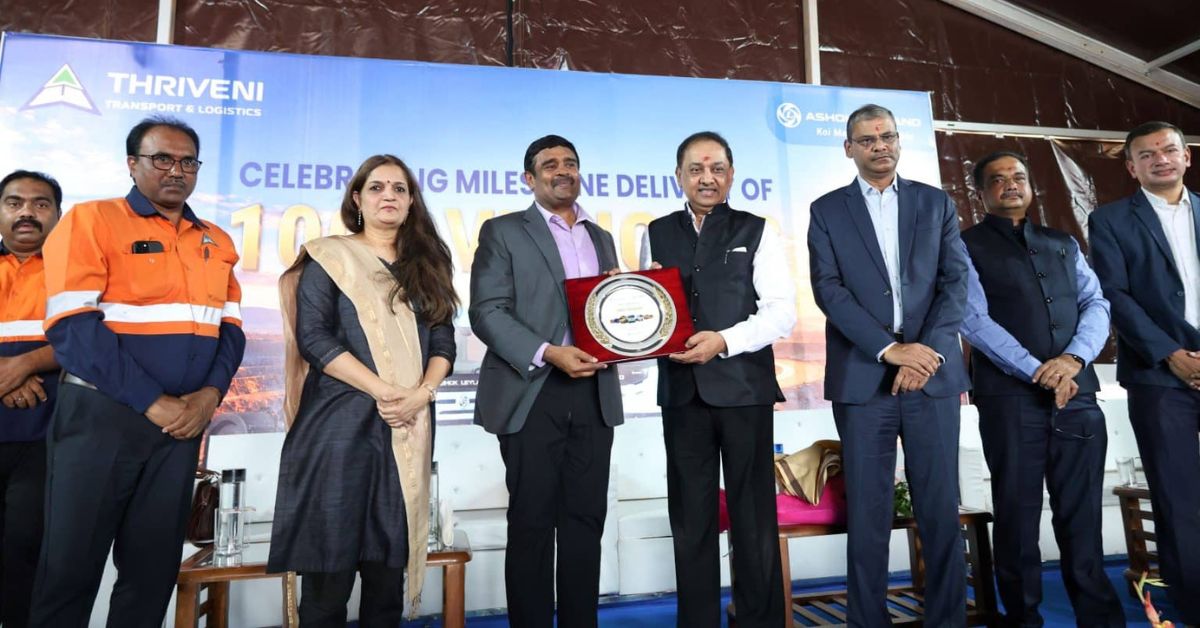

Ashok Leyland has surpassed 1,000 cumulative commercial vehicle deliveries to Thriveni Transport and Logistics, with the latest vehicles intended for iron ore transportation in Maharashtra’s Gadchiroli district. Announced on 17 November 2026, the milestone marks the expansion of its supply relationship with the Thriveni and Lloyds Group.
Ashok Leyland Managing Director and Chief Executive Officer Shenu Agarwal handed over the keys of the 1,000th vehicle to B. Prabhakaran, Managing Director of Thriveni Earthmovers and Lloyds Metals and Energy. The figure represents deliveries accumulated over the relationship, rather than a single order for 1,000 vehicles.
What vehicles has Ashok Leyland supplied?
The association expanded following an order for 160 vehicles in 2023. Subsequent supplies have covered several categories, from light commercial vehicles (LCVs) to the manufacturer’s recently introduced HIPPO tractor range.
Agarwal said Ashok Leyland would continue supporting the group’s changing operational requirements. Chief Marketing Officer Sanjeev Kumar highlighted the role of customised vehicle configurations and service support, while Prabhakaran linked continued cooperation to strengthening operations in Gadchiroli.
The announcement did not disclose the value of the cumulative deliveries, the number of vehicles handed over at the latest event or their model-wise composition.
How does the HIPPO range serve bulk cargo transport?
Ashok Leyland reintroduced its HIPPO tractor and TAURUS tipper ranges on 22 January 2026, targeting heavy-duty mining, construction and infrastructure applications.
Both ranges use the company’s AVTR modular truck platform, which supports different configurations and equipment options. The manufacturer specified an 8.0-litre, six-cylinder A-Series engine delivering 360 horsepower and 1,600 Newton-metres of torque.
HIPPO tractors are designed for transporting bulk commodities, industrial raw materials and over-dimensional cargo. The range incorporates reinforced chassis and heavy-duty drivetrains intended for demanding haulage duties.
These specifications describe the wider product range. Ashok Leyland has not identified the precise configurations supplied in the latest Thriveni delivery or provided fleet-specific payload, fuel-consumption or operating-cost figures.
Why is Gadchiroli’s mineral logistics network expanding?
The vehicle deployment comes against the background of increased iron ore production and investment in cargo evacuation infrastructure by Lloyds Metals and Energy.
In its financial year 2025–26 annual report, Lloyds reported iron ore output of 21.96 million tonnes, approximately 120% higher than the previous year. The company operates the Surjagarh iron ore mine in Gadchiroli and is developing transport links between mining, processing and dispatch facilities.
Lloyds attributed the production increase partly to improved evacuation arrangements and the commissioning of slurry pipeline infrastructure. This places the new vehicle deployment within a broader logistics system combining road transport with pipeline movement of processed mineral material.
How do trucks fit alongside slurry pipelines?
Lloyds’ annual report describes an existing 85-kilometre slurry pipeline between Hedri and Konsari, with an annual capacity of 10 million tonnes. At Hedri, iron ore is prepared as slurry for onward transportation.
The company is also developing additional pipeline infrastructure and extending its evacuation network towards Chandrapur to support downstream operations and dispatch.
Ashok Leyland’s delivery announcement identifies iron ore transportation in Gadchiroli as the latest vehicles’ purpose, but does not specify their routes or allocation within this network. The confirmed development is therefore an expansion of road-haulage resources alongside Lloyds’ wider investment in mineral evacuation capacity.
 Join our WhatsApp channel for more updates:
 Subscribe to our YouTube channel for more updates: