
Asian container shipping lines are strengthening their India networks through new services and revised port rotations, with Orient Overseas Container Line (OOCL) scheduled to launch a Malaysia–east India connection on 22 November 2026. Alongside service developments by HMM and Emirates Shipping Line (ESL), the expansion comes as Indian container gateways report rising cargo volumes.
The changes cover both Indian coasts, linking Chennai and Visakhapatnam with Malaysia while extending connections from Nhava Sheva and Mundra to East Africa and the Red Sea. They combine new regional links with the restructuring of existing services to serve different destination markets.
Which Indian ports will OOCL’s new service connect?
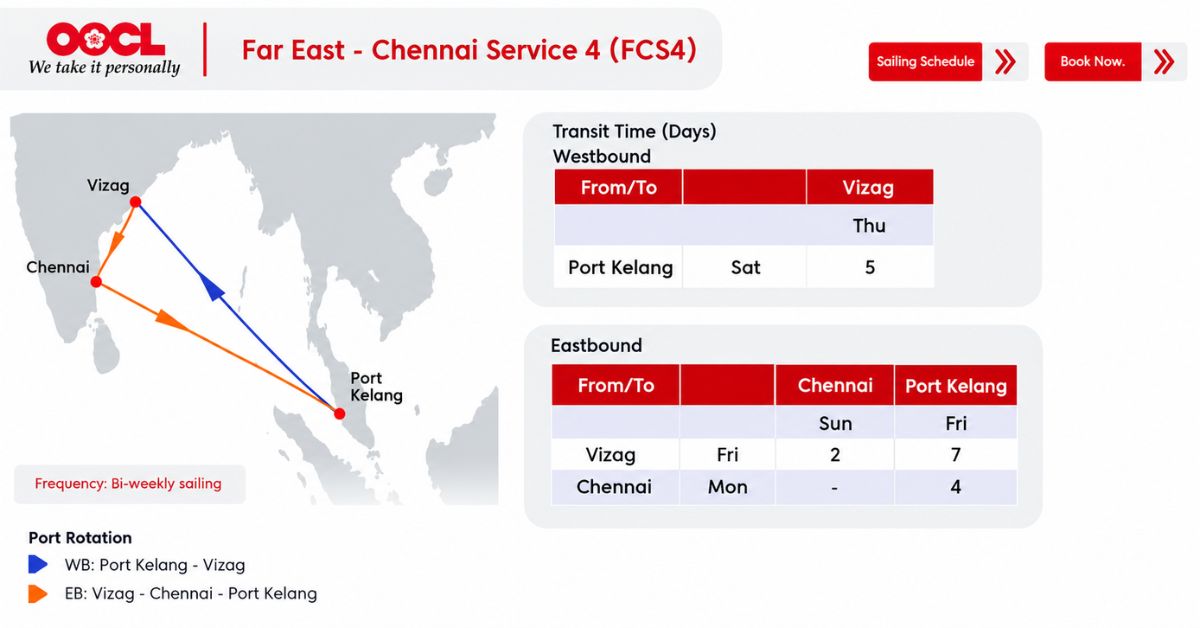
OOCL’s new Far East–Chennai Service, designated FCS4, will follow the rotation Port Klang, Visakhapatnam, Chennai and Port Klang. Announced on 6 November, the service is intended to strengthen direct cargo connections between Malaysia and India’s east coast.
The Hong Kong-based carrier said the addition would improve connectivity and provide greater flexibility for cargo moving between the two markets. Its announcement specifies the launch date and rotation but does not disclose sailing frequency, vessel capacity or transit times.
The loop also targets Indian transhipment cargo through Port Klang. It follows two intra-Asia services introduced by OOCL from India’s west coast during the second quarter of 2026, covering Jawaharlal Nehru Port and Mundra. Together, the additions broaden the carrier’s regional network across India’s principal container-handling coastlines.
How is HMM developing India–East Africa connectivity?
South Korean carrier HMM has added the Gulf–India–East Africa (GIA) service to its African network, linking Nhava Sheva and Mundra with Dar es Salaam in Tanzania and Mombasa in Kenya.
HMM’s customer advisory scheduled commencement from Nhava Sheva for 23 September 2026, with a 35-day round trip. The rotation returns to Nhava Sheva after calling at the two East African ports.
The deployment was announced with five vessels of approximately 2,800 twenty-foot equivalent units (TEUs), operated jointly by HMM, COSCO SHIPPING, Pacific International Lines and Interasia Lines.
Under HMM’s regional network model, Nhava Sheva and Mundra serve as consolidation points for cargo feeding into the East African route. The carrier also outlined plans to extend the rotation into the Gulf, although that expansion was separate from the initial port sequence.
What is changing on ESL’s India–Red Sea routes?
ESL is reorganising its India–Red Sea network into two distinct services, separating the direct Jeddah connection from other regional calls.
Its South Red Sea Service will operate as a Nhava Sheva–Jeddah shuttle, using two vessels with capacities of 1,800–2,600 TEUs. Departures are planned every nine days.
The North Red Sea Service will connect Nhava Sheva, Djibouti, Aqaba, Sokhna and Sohar before returning to India. Two vessels of 1,700–2,500 TEUs will provide approximately fortnightly departures.
The restructuring gives Saudi Arabia a dedicated shuttle while retaining broader regional coverage through the second loop.
What do port volumes show about demand?
The network developments coincide with strong container growth at Jawaharlal Nehru Port Authority (JNPA), which oversees Nhava Sheva.
JNPA handled a record 864,255 TEUs in October 2026, up 27.05% from October 2025. This surpassed September’s previous monthly record of 834,697 TEUs.
For April–October 2026, container throughput reached approximately 5.53 million TEUs, an increase of 18.99% over the corresponding period a year earlier. These figures provide evidence of expanding activity at a gateway central to the carriers’ west coast services.
The announced changes give shippers additional routing choices across Southeast Asia, East Africa and the Red Sea, with service frequency and port coverage varying by corridor.
 Join our WhatsApp channel for more updates:
 Subscribe to our YouTube channel for more updates: