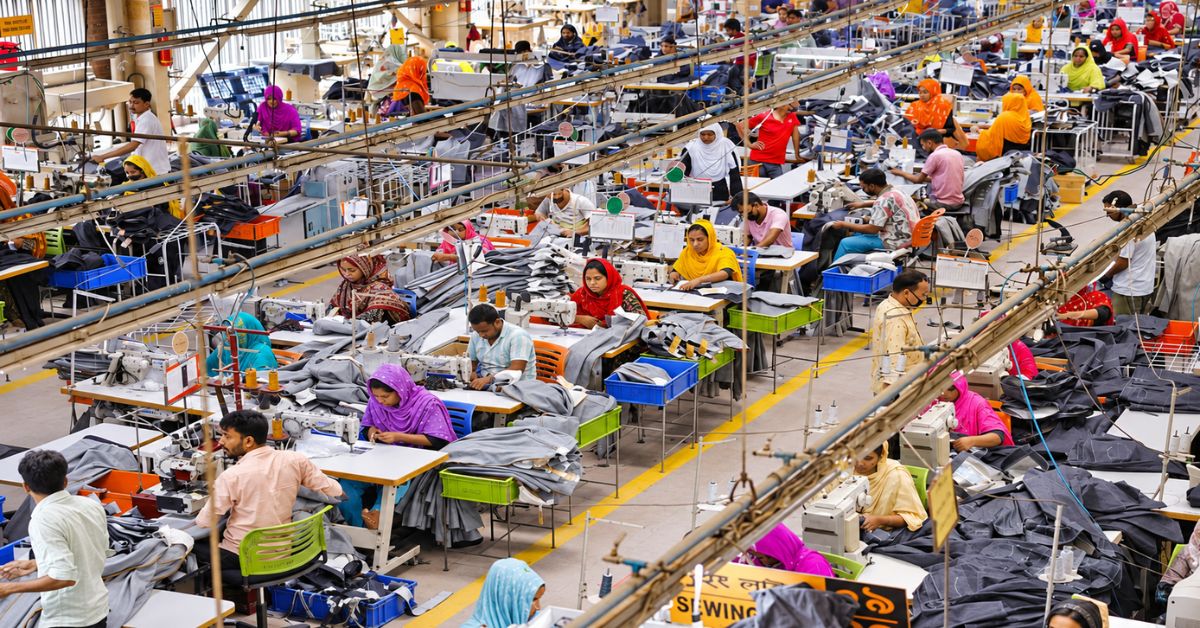

Most factories in Bangladesh’s ready-made garment (RMG) industry resumed production on 8 November 2026 as labour unrest eased across major manufacturing centres. Operations restarted in Mirpur, Gazipur and Narayanganj, although work stoppages in parts of Ashulia continued to interrupt the recovery after days of protests over minimum wages.
The improvement comes as employers and worker representatives prepare proposals for a revised wage structure. Factory reopening has eased immediate production pressure, but the minimum wage amount remains under negotiation.
Where has garment production resumed?
Workers returned across most industrial zones on Sunday, with the broader situation remaining largely stable. However, at least 34 factories in Ashulia suspended production for the day after workers abstained from work, mainly following the lunch break.
Authorities maintained security deployments across the manufacturing belt. A total of 33 platoons of Border Guard Bangladesh were stationed in Mirpur, Savar, Ashulia, Gazipur and Narayanganj to protect factories and maintain order.
Industrial Police chief and Additional Inspector General Md Israil Howlader said some factories experienced stoppages linked to unpaid October wages. He said production resumed at several units following coordination among the parties, while some employees left workplaces after scheduled wage payments were not made.
Howlader described the overall environment as peaceful, with no major disturbances across the principal industrial areas. His account indicates that local payment disputes continued even as the wider unrest subsided.
What is the status of minimum wage negotiations?
Workers have been demanding an increase in the monthly minimum wage from Tk12,500 to Tk30,000, citing rising costs of food, accommodation, transport, healthcare and education.
The government formed a six-member wage board on 1 November. Following its first meeting on 4 November, employer and worker representatives were asked to submit written proposals at a second meeting scheduled for 9 November in Dhaka.
The discussions cover minimum pay across garment-sector grades. Labour organisations have proposed different amounts, with representatives working towards a common submission.
Bangladesh Garment Manufacturers and Exporters Association (BGMEA) President Mahmud Hasan Khan said the employers’ representative was preparing an enhanced wage proposal. Worker representative Babul Akhter was also continuing consultations with labour organisations on Sunday evening.
The wage board has agreed to introduce a revised structure from December. That timetable should be distinguished from agreement on the final minimum wage, which had not been announced in the reopening reports.
Why does the restart matter for export shipments?
The disruption occurred during a busy production period for spring and summer export orders. Manufacturers had warned that factory closures could affect shipment schedules and buyer confidence.
Bangladesh’s garment exports totalled US$38.70 billion in the financial year ended June 2026, down 1.65% year on year. Earnings subsequently increased 6.1% to US$10.58 billion during July–September, underscoring the importance of maintaining production continuity.
Some manufacturers had already begun working through the disruption to meet delivery commitments. On 6 November, 88 factories in Ashulia operated despite the weekly holiday, with owners citing urgent shipment deadlines. Factory operators said they intended to increase output to recover production and delivery losses.
What concerns remain for manufacturers and workers?
Employers have submitted an 11-point set of demands alongside the wage review, seeking lower borrowing costs, uninterrupted energy supplies and fewer delays in customs and port procedures. Workers continue to seek wages that reflect living costs.
Sustained factory attendance, timely salary payments and progress towards a revised wage structure will be central to maintaining the production restart and meeting outstanding export commitments.
 Join our WhatsApp channel for more updates:
 Subscribe to our YouTube channel for more updates: